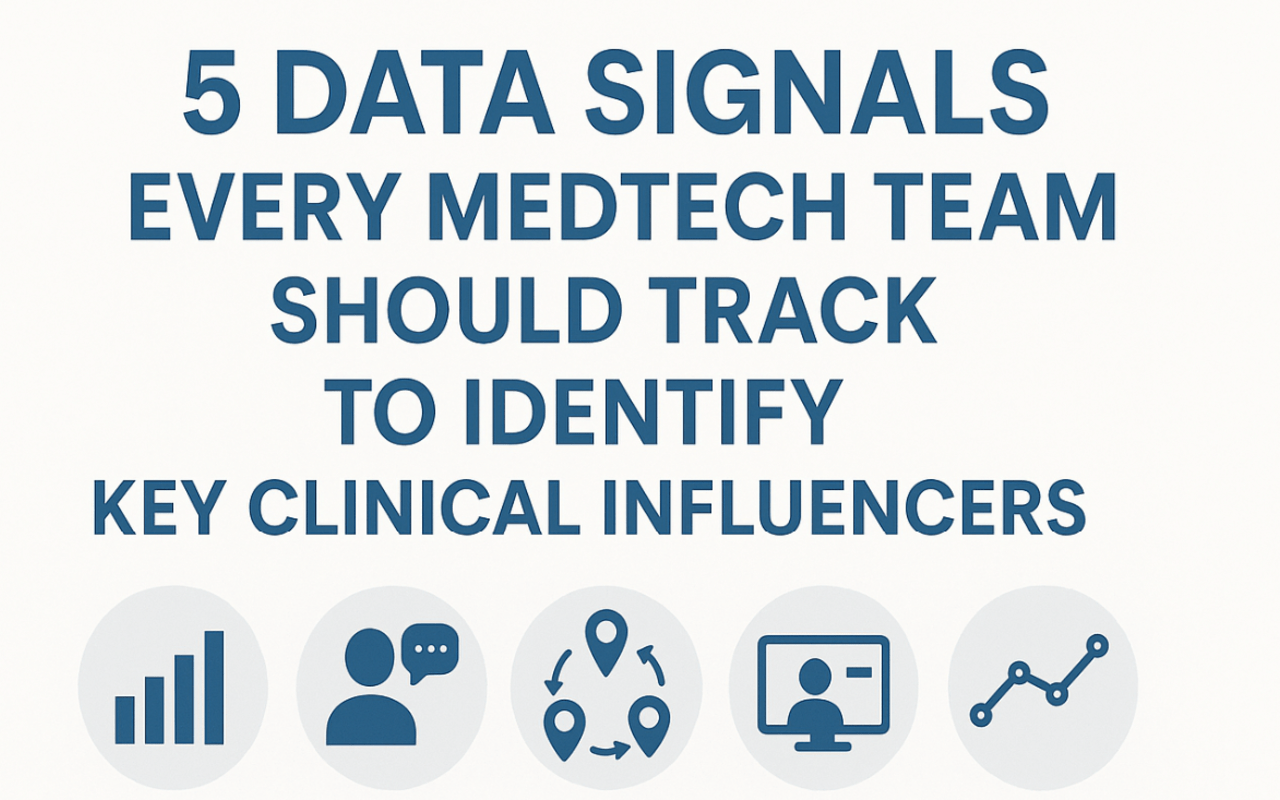
5 Data Signals Every MedTech Team Should Track to Identify Key Clinical Influencers
On this page
Related reading: 10 Best Medtech Startups Revolutionizing Healthcare, 5 Ways Medtech Companies Can Drive Commercial Success, Ai Meets Medtech A New Era For Precision Targeting And Market Success, Current Procedural Terminology, National Provider Identifier.
Ask any U.S. regional sales director where a brand-new scope, pump, or implant really wins share, and you’ll hear the same pattern that it’s the high-volume surgeons who mentor every fellow and translate their tweaks into technique papers others start citing within months.
A 2025 scoping review of surgical mentorship programs found that fellowship mentors in the top-volume quartile were 3x more likely to publish instructional research that shapes peer practice than lower-volume colleagues.
Those influencers rarely appear on legacy KOL lists because device authority is earned in operating rooms and cadaver labs, not at speaker bureaus. To bring them into your orbit before a competitor does, you need a data stack that tracks how influence actually spreads inside surgical communities.
Alpha Sophia links surgeon-level CMS and commercial claims to each provider’s NPI, CPT volume, and recent PubMed output, so you see real case load and evidence momentum side-by-side. From that work, four signals rise above all.
- Real-world procedure volume
- Publication momentum
- Clinical-trial participation & investigator stickiness
- Affiliation networks
Master these and you’ll know who already moves your market, who’s about to, and where to invest your next training dollar. Or you could use platforms like Alpha Sophia to pinpoint key clinical influencers without adding more hours to your employee roster.
The MedTech-Specific Challenge:
Launching (and defending) a device in the United States is nothing like selling a pill. Three structural realities make the influence of devices look very different from drugs, and ignoring them leads to misfires:
Innovation Cycles Are Fast and Capital-Intensive
MedTech products average an 18- to 24-month life cycle before an upgraded model arrives, forcing surgeons to reevaluate tools twice as often as drug formularies change.
A 2025 AAOS cost-modeling study showed robotic TKA systems pay off only in centres performing ≥ 50 cases a year, so vendors must convert volume leaders quickly or lose the economic argument for years.
Influence Lives Inside the OR
Prescription markets revolve around office visits, and devices are chosen in operating rooms where muscle memory, scrub-team trust, and case efficiency matter more than podium prestige.
CMS now publishes surgeon-level counts for 18 common procedures, and the top decile of joint-replacement surgeons alone influences almost one-third of all Medicare episodes, their implant pick often becomes the hospital default.
Economic Gatekeepers Listen to High-Volume Trainers
Hospital Value Analysis Committees scrutinize hard clinical data before green-lighting new capital equipment. A 2018 JAMA Surgery paper found that value analysis committees should be wary of device manufacturers promising large cost savings based on OR time alone.
Likewise, VAC consultant Maria Shepherd pointed out that a device that reduces readmission rates and has data to back up the claim is a value-add to the hospital.
So, the voices they trust are usually the surgeons running 250–300 cases a year and teaching every resident who will take that preference to the next hospital.
The 2024 AJRR report logged 4,954 such surgeons across hip and knee arthroplasty alone, underscoring how many high-impact decision-makers never speak on national stages.
Because of these factors, an effective influencer strategy must track current clinical activity, emerging thought leadership, and the networks that spread both. The next section lays out the five data signals that reliably surface those patterns.
The 5 Key Data Signals
MedTech influence is multidimensional. No single metric can tell you whether a surgeon merely likes a device or has the clout to make it the default option in a region.
When we analyze markets for Alpha Sophia clients, five signals consistently predict who will move share, who will publish the next “how-to” technique paper, and who will convince the value-analysis committee that your kit belongs on the back table.
Real-World Procedure Volume
Credibility begins with how many times a surgeon actually performs the operation your device supports. Since January 2024, CMS has published physician-level counts for a dozen high-impact procedures like hip and knee arthroplasty, CABG, cataract extraction, and more, drawn from both fee-for-service Medicare and Medicare Advantage claims.
These are not vanity numbers, they correlate directly with purchasing sway. The American Joint Replacement Registry’s 2024 report logged more than four million cumulative hip and knee cases from 4,954 surgeons and showed that hospitals almost always adopt new implants first through their busiest attendings.
To translate raw counts into action, rank every surgeon in your therapeutic CPT set, then look at two deltas that is year-over-year growth (to spot rising stars) and the proportion of cases done in ambulatory surgery centers (to see where purchasing power really sits).
A faculty member who logs 250 joint replacements and teaches residents every week will spread a device preference across graduating fellows for the next decade.
Publication Momentum and Network Centrality
Most new techniques spread first through peer-reviewed papers, surgeons cite what they read, then bring it to the OR. A 2021 scoping review on surgical practice change ranked “published evidence plus social influence” as the top driver of adoption.
Alpha Sophia pulls PubMed data, flags new first- or last-author streaks, and ties each paper to the surgeon’s NPI and procedure volume so you spot rising voices without manual PubMed wrangling.
Network-science studies in clinical specialties, from rheumatology to Medicaid care patterns, show that physicians with high scores become the first names added to guideline panels and society task forces.
A surgeon whose papers are accelerating in citations and who sits at the center of the collaboration web is writing tomorrow’s protocols. Overlay that insight with procedure volume, and you have a shortlist of operators who both do the work and tell everyone else how to do it.
Clinical-Trial Participation and Investigator Stickiness
Early-phase trials led by respected surgeons accelerate credibility, often shortening the gap between clearance and routine use. Yet Duke University-led research into FDA-regulated studies shows that more than half of principal investigators conduct a single trial and never return, creating a premium on those who stay engaged across multiple protocols.
By tracking Form 1572 filings, ClinicalTrials.gov updates, and BMIS investigator lists, you can spot “multi-cycle” PIs early. These clinicians not only influence peers with their data, but they also teach study coordinators, tweak OR workflows, and produce the real-world evidence that payers demand post-clearance.
A practical flag is that when you see the same name attached to two or more trials in the past five years, especially if one is first-in-human, move quickly. Their choice of instrumentation often becomes the default in every future protocol they design.
Affiliation and Teaching Networks
Volume and papers show where a surgeon stands today, but hospital privileges and teaching roles reveal where their influence will spread next.
Residency or fellowship faculty propagate their preferences through every trainee they mentor. Orthopaedic training programs already face the challenge of integrating robotic systems as these technologies cascade from high-volume centers into smaller sites.
Mapping these networks, like privilege rosters, ACGME teaching sites, and paid proctorships, tells you whose decisions echo across multiple ZIP codes.
Focus on surgeons who combine high case volume with documented teaching activity or proctor status. When they switch to your platform, you are effectively enlisting an unpaid sales force of residents, fellows, and satellite OR teams.
Patient-Sharing Referral Hubs
Finally, not every influential clinician wields a scalpel. In many specialties, procedure demand originates upstream with referring physicians who direct a steady flow of cases.
All-payer claims graphs reveal hubs whose referrals account for 30% or more of a target hospital’s volume. A 2024 scoping review of multilevel patient-sharing networks catalogued more than a hundred metrics, like degree, betweenness score that correlate with utilization and cost.
High-betweenness referrers can sink or float a new technology simply by shifting their patterns.
Harnessing these five signals in concert gives MedTech teams a 360-degree view of who truly moves their market. With the right data infrastructure, you can refresh the view quarterly, catch emerging talent before competitors do, and tie every engagement dollar to measurable commercial lift.
Competitor Insight Section
Before you engage a single surgeon, you need to know what rival device makers are already doing in that territory. The following data-driven cues reveal when a competitor is making a play and give you enough runway to counter it.
Sudden Volume Spikes In Target Procedures
Check regular commercial claims for surgeons whose case counts jump 20-30% in one quarter.
When you see that surge localized to a handful of operators, it usually signals pre-launch training on a rival platform.
New Device Mentions In Recent Publications
Search PubMed every month for product-specific keywords (e.g., brand name + “total knee”). A burst of technique notes or early outcomes papers, especially in high-impact subspecialty journals, means your competitor has seeded its evidence narrative.
Cross-match the lead authors with your volume list; if they overlap, you’re already behind in that region.
Repeat Principal Investigators In IDE Or EFS Trials
About 40 % of device-trial principal investigators file only one IDE and never return. The surgeons who appear on two or more trials in five years become highly credible champions.
Filter the FDA BMIS, sort by investigator ID, and flag repeat names. If a rival device shows up in both protocols, expect rapid adoption once the data is read out.
Residency Curricula And Proctorship Appointments
Robotic case logs in general-surgery residencies have tripled since 2020, where structured curricula exist.
Monitor ACGME program newsletters, hospital credentialing bulletins, and resident-certificate counts. If a competing manufacturer funds simulator time or appoints a local surgeon as a paid proctor, every graduating fellow will learn on that platform and carry the preference to their first job.
Together, these signals let you spot where a competitor is educating, equipping, and publicizing surgeons, often months before the first sales-rep rumor reaches you.
How Data Platforms Help
A device-centred stack fixes those gaps by joining procedure, evidence, and trial feeds around a single clinician ID and refreshing them fast enough to catch market shifts.
Unite Claims, Evidence, and Trials
Start with weekly CMS and commercial claims for up-to-date CPT volumes, add daily PubMed/iCite pulls for citation velocity, and layer monthly BMIS and ClinicalTrials.gov updates for IDE leadership.
Platforms such as Alpha Sophia’s KOL AI fuse exactly those feeds, so one dashboard shows case load, publication momentum side-by-side.
Refresh to Match Surgical Tempo
Procedure mix is migrating quickly, between 2016 and 2023, the share of surgeries performed in hospitals fell 16%, while ASCs picked up 24% of the volume.
Score Influence, Not Only Activity
With the feeds united, the platform can weight each surgeon by case volume, year-over-year growth, citation momentum, network centrality, and repeat-IDE status.
Alpha Sophia’s KOL AI combines real-world procedure claims with MeSH-powered PubMed search, so a surgeon’s rising case load and fresh publications appear in one view.
Link Data to Commercial Output
Because the scoring model updates continuously, territory managers can watch influence scores rise or fall alongside lead times, training slots, and device usage. Analyst hours once lost to CSV clean-up shift to engagement strategy, and launch calendars compress from years to quarters.
FAQs
How does identifying clinical influencers differ between pharma and MedTech?
Pharma influence is tied to prescription data and guideline authorship, while MedTech influence depends on operating-room metrics such as annual procedure volume, proctor roles, and IDE experience.
Why are procedure volumes and affiliations key to understanding MedTech influence?
High case counts show who already dictates technique standards, and dual privileges or teaching roles reveal where that influence will spread next.
What’s the limitation of traditional pharma-style KOL databases for MedTech?
They omit surgeon-level procedure data, proctorships, and trial leadership, so they surface respected academics who often lack purchasing sway over capital equipment.
How can MedTech companies use data to identify early adopters and trainers?
Rank surgeons by year-over-year procedure growth, then overlay recent first-author technique papers; those who score high on both metrics typically become the first local trainers of new hardware.
Which data sources best capture real-world MedTech influence?
Weekly CMS and commercial claims for procedure counts, PubMed and iCite for citation momentum, FDA BMIS and ClinicalTrials.gov for IDE leadership, privilege rosters for affiliation reach, and multi-payer claims graphs for referral flows.
What are affiliation networks, and why do they matter in surgical specialties?
They map surgeons who hold privileges at multiple facilities or teach residents, enabling device preferences to move quickly across hospitals and graduating cohorts.
How can MedTech teams ensure their data reflects real clinical activity?
Refresh claims monthly, publications weekly, and trial filings quarterly, then validate major swings with local OR-scheduling or proctor logs.
What’s the ROI of improving influencer identification in MedTech?
Targeted outreach based on these signals cuts time-to-first-purchase, reduces unused-capital risk, and often brings peak-revenue curves forward by six to twelve months.
How often should MedTech companies refresh their influencer data?
Quarterly updates work for mature products; during launches or rapid ASC migration phases, monthly or even weekly refreshes are essential.
How do modern data tools compare to traditional KOL databases in the MedTech context?
Modern platforms merge claims, publication, and trial feeds under one NPI and update automatically, allowing influence scores to adjust as soon as a surgeon’s activity changes, whereas annual-refresh KOL files miss these inflection points.
Conclusion
Influence in MedTech is measurable, predictable, and when you track the right signals, actionable months before purchase orders are signed.
By aligning continuously refreshed procedure volumes with live evidence momentum, trial leadership, affiliation reach, and referral flow, commercial teams trade guesses for hard-number foresight.
The result is a launch rhythm that moves at the speed of surgical practice. In a market where every quarter of head-start compounds into long-term shares, turning these signals into day-to-day operating intelligence is no longer a nice-to-have, it’s the difference between leading a category and chasing one.
