Alpha Sophia for Sales Targeting & Lead Qualification
Challenge

Sales targeting in healthcare is uniquely challenging because provider behavior, institutional affiliation, and clinical focus change continuously. Traditional targeting approaches—such as static NPI lists, broad specialty segments, or CRM tags—quickly become outdated and fail to reflect how care is actually delivered today. As a result, sales teams often spend significant time engaging healthcare professionals who are no longer clinically relevant, no longer accessible, or simply not positioned to influence adoption.
For example, targeting "oncologists in New York" does not distinguish between physicians who actively treat eligible patients, those who focus on research only, or those whose institutions restrict access entirely. Without deeper intelligence, outreach efforts are misaligned before the first interaction even occurs.
Alpha Sophia addresses this challenge by continuously updating physician and organizational data and allowing teams to layer multiple dimensions of intelligence into a single targeting workflow. A deeper explanation of how physician intelligence evolves and why static data fails can be found here.
The Hidden Cost of Poor Lead Qualification
When sales teams lack precise targeting tools, they are forced to rely on volume rather than relevance. This results in wasted outreach, longer sales cycles, and inconsistent performance across territories. In healthcare, where access barriers and decision-making complexity are already high, poor lead qualification compounds these challenges.
For instance, a medtech sales team may pursue physicians based on specialty alone, only to later discover that many do not perform the procedures relevant to the product, lack decision-making influence, or practice in settings where adoption is unlikely. These insights often surface too late—after significant effort has already been invested.
By enabling granular filtering across factors such as specialization, practice setting, licensure, organizational affiliation, and financial signals, Alpha Sophia allows sales teams to qualify leads before outreach begins. This shift dramatically improves efficiency and conversion rates. Additional guidance on optimizing target lists can be found here.
Solution
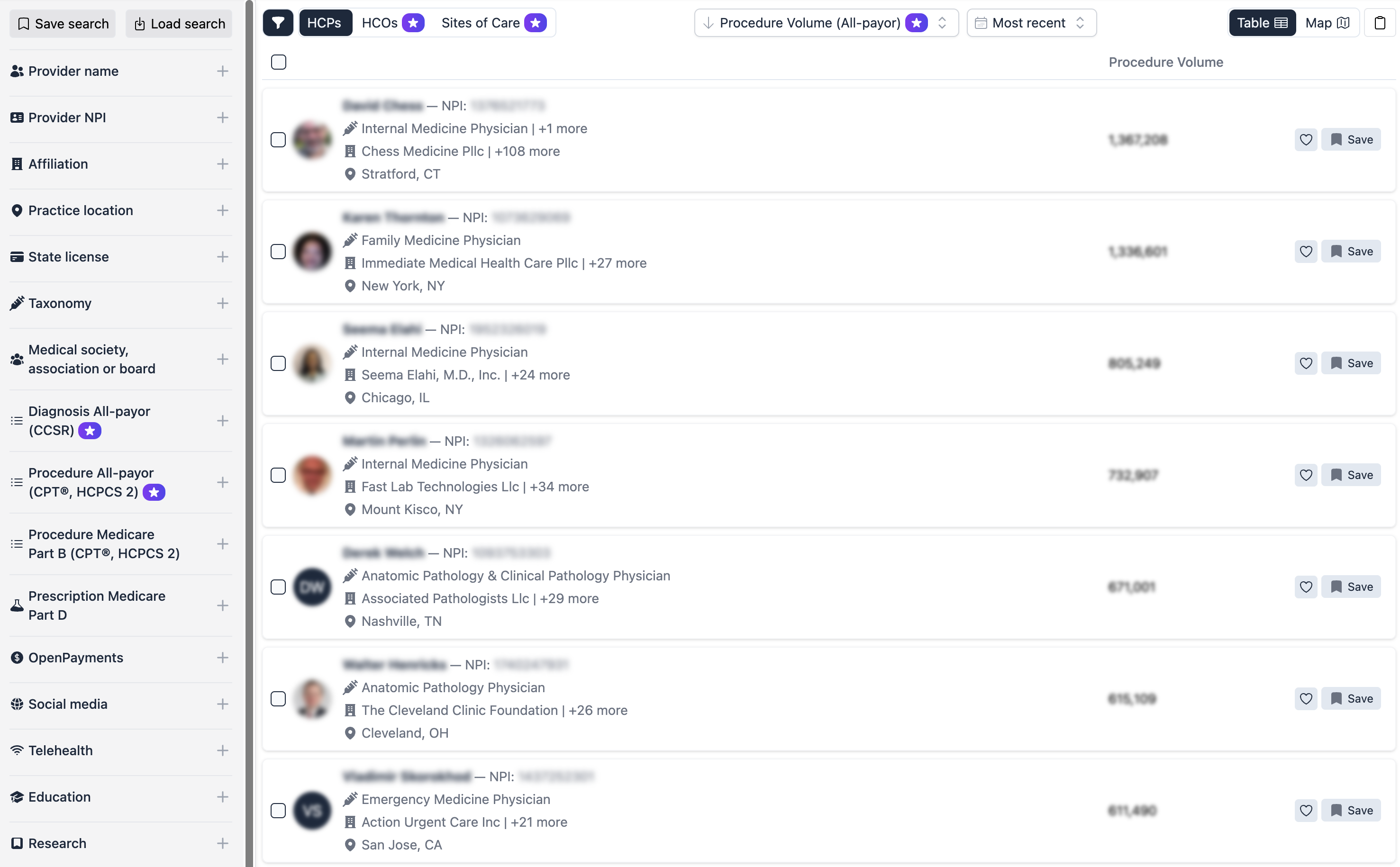
A major limitation of traditional sales targeting is the assumption that all high-volume providers represent equal opportunity. In reality, influence in healthcare is shaped by referral networks, institutional roles, and peer dynamics—not just individual activity levels.
For example, a physician with moderate personal volume but strong referral influence or academic visibility may drive broader adoption than a higher-volume peer who operates in isolation. Identifying these dynamics requires understanding how clinicians connect to one another and how information flows across care networks.
Alpha Sophia incorporates network-level insights to help teams identify not just who to contact, but who truly matters within a market. A detailed look at how physician networks impact sales outcomes is available here.
Integrating Multiple Data Dimensions into a Single Targeting Workflow
Healthcare sales data is often fragmented across systems—location data in one source, specialization in another, and financial or organizational data elsewhere. Reconciling these sources manually introduces inconsistency and slows execution.
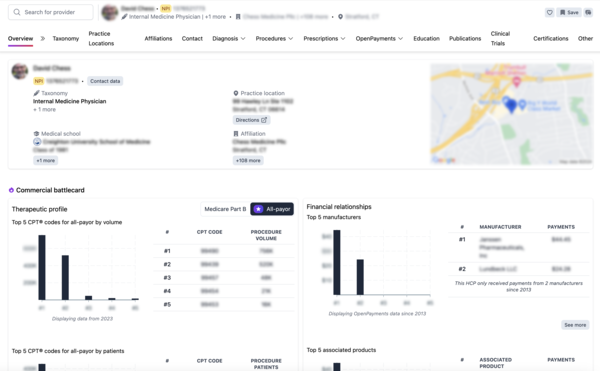
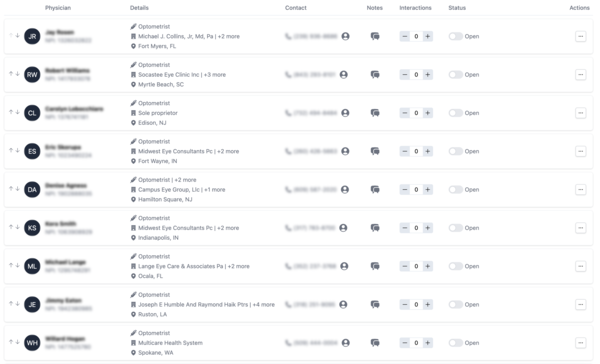
Alpha Sophia removes this friction by unifying clinical, geographic, organizational, and financial signals into a single platform. Sales teams can dynamically combine filters such as specialty, subspecialty, state licensure, practice setting, and financial indicators to build highly refined lead lists tailored to specific products or territories.
This integrated approach enables more consistent targeting strategies across regions and teams and reduces reliance on manual list-building. A broader overview of how Alpha Sophia structures and integrates physician data can be found here.
Precision Targeting Drives Measurable ROI
In modern healthcare markets, success is no longer defined by the number of contacts made, but by the quality and relevance of those engagements. Precision targeting allows sales teams to focus on fewer, higher-potential leads while achieving stronger outcomes.
Teams using data-driven targeting are able to:
- Reduce time spent on low-yield outreach
- Shorten sales cycles through more relevant first conversations
- Improve engagement rates and follow-up success
- Demonstrate clear ROI to leadership and commercial operations
This shift from volume-based to evidence-based targeting is critical in environments with rising scrutiny on commercial efficiency. For a deeper look at how precision targeting translates into measurable business impact, see here.