Agentic AI Is About to Reshape Every Function in Life Sciences—But Not for the Reason Most People Think
On this page
Most discussions about AI in life sciences begin with models.
Which model is best for drug discovery?
Will Claude outperform GPT-5 for scientific reasoning?
Can generative AI accelerate clinical development?
These questions dominate conference panels, boardroom conversations, and vendor presentations. They are also increasingly the wrong questions.
Systems That Can Act
The most important shift happening in life sciences today is not the emergence of better language models. It is the emergence of systems that can act.
Across the technology industry, attention is moving away from chatbots and toward agentic AI: software systems capable of retrieving information, coordinating workflows, interacting with tools, and executing complex tasks with limited human supervision. While much of the public conversation remains focused on AI-generated text and images, leading AI labs are investing heavily in agent architectures because they represent a fundamentally different way of interacting with information.
This distinction matters because life sciences has never really been a content-generation industry. It is an information-processing industry.
Every major function inside a pharmaceutical company—from drug discovery and clinical development to medical affairs and commercialization—exists to transform large volumes of fragmented information into decisions. Researchers sift through decades of biological literature looking for novel targets. Clinical teams analyze patient populations, trial outcomes, and operational data. Commercial organizations attempt to understand physician behavior, referral networks, and healthcare market dynamics. The underlying challenge is remarkably similar across all of these functions: there is more information available than any human organization can effectively process.
An Information-Processing Industry
That imbalance has been growing for years. The volume of biomedical research published annually continues to accelerate. ClinicalTrials.gov contains hundreds of thousands of registered studies. Genomic databases have expanded at a pace that would have seemed impossible a decade ago. Healthcare claims datasets now capture billions of patient interactions. In theory, this abundance of information should make decision-making easier. In practice, it often produces the opposite effect. The bottleneck is no longer data collection. The bottleneck is synthesis.
Reducing Complexity Rather Than Generating Content
This is why some of the most important AI breakthroughs in life sciences have been fundamentally about reducing complexity rather than generating content. When DeepMind introduced AlphaFold, the significance was not merely that the system could predict protein structures. The deeper significance was that AI demonstrated an ability to transform an overwhelming scientific challenge into something researchers could immediately use. The original Nature paper describing AlphaFold remains one of the clearest examples of AI creating scientific value through information compression rather than automation alone (https://www.nature.com/articles/s41586-021-03819-2).
What happens next may be even more significant.
Beyond Models That Answer Questions
The industry is beginning to move beyond models that answer questions toward systems capable of navigating entire workflows. Organizations such as FutureHouse are actively exploring what they call scientific agents—AI systems designed to search literature, evaluate evidence, identify relevant findings, and support scientific reasoning at a level that begins to resemble research assistance rather than traditional software. Their recent research announcements provide one of the clearest windows into how AI may evolve from a knowledge retrieval tool into an active participant in the scientific process (https://www.futurehouse.org/research-announcements).
This transition has profound implications for pharmaceutical R&D because scientific discovery is not a single task. It is a chain of interconnected activities. Researchers gather evidence, evaluate competing hypotheses, compare findings across studies, design experiments, interpret results, and refine their understanding continuously. Each step requires navigating large amounts of information spread across disconnected sources. An AI system capable of participating across that chain is fundamentally more valuable than one that simply answers isolated questions.
Clinical Development
The same pattern is emerging in clinical development. For years, discussions about AI in clinical trials focused on predictive models. Could machine learning identify better sites? Could algorithms improve patient recruitment? Could statistical models reduce operational inefficiencies? Those efforts generated meaningful progress, but they largely addressed individual components of a much larger process.
Agentic systems introduce a different possibility. Instead of improving one step, they can coordinate many. Imagine a clinical operations agent that monitors recruitment performance, reviews protocol amendments, identifies underperforming sites, tracks competitive trials, summarizes investigator feedback, and recommends corrective actions. None of these activities are individually revolutionary. Together, however, they begin to resemble a digital member of a clinical operations team. McKinsey’s work on generative and agentic AI in pharma points toward exactly this kind of transformation, where AI becomes embedded within workflows rather than existing as a standalone productivity tool (https://www.mckinsey.com/industries/life-sciences/our-insights/the-next-frontier-of-generative-ai-in-pharma).
Medical Affairs
Medical affairs may be even closer to this future than clinical development. Few functions are more information-intensive. Medical affairs professionals are expected to maintain awareness of emerging evidence, new publications, conference presentations, investigator activity, treatment trends, and competitive developments across increasingly specialized therapeutic areas. The challenge is not expertise. It is scale. The amount of relevant information has grown faster than any team’s ability to consume it.
An AI agent designed for medical affairs does not need to replace expertise to create value. It simply needs to increase the amount of information a professional can effectively manage. An agent that continuously monitors publications, identifies emerging key opinion leaders, compares study outcomes, and surfaces relevant findings allows experts to spend more time interpreting evidence and less time searching for it. This is why organizations such as the Medical Affairs Professional Society (MAPS) have become increasingly engaged in discussions about AI’s role in scientific engagement and evidence generation (https://medicalaffairs.org).
Outside R&D Altogether
Yet perhaps the most interesting developments are occurring outside R&D altogether.
Commercial organizations face a different version of the same problem. The challenge is not understanding proteins or clinical outcomes. It is understanding markets.
Healthcare markets are extraordinarily complex systems composed of providers, health systems, referral networks, procedure volumes, payer dynamics, affiliations, and geographic variation. Commercial teams have historically relied on dashboards, analytics platforms, and static reports to navigate this complexity. Those tools were designed for human consumption. Agentic AI introduces a new requirement: information must become machine-readable.
Model Context Protocol (MCP)
This is where much of the industry’s current excitement around the Model Context Protocol (MCP) originates. Introduced by Anthropic, MCP provides a standardized method for AI systems to interact with external tools and data sources. The protocol’s original announcement described a future in which models can securely access enterprise systems without requiring custom integrations for every application (https://www.anthropic.com/news/model-context-protocol). The protocol documentation itself has become essential reading for anyone attempting to understand the emerging infrastructure layer of enterprise AI (https://modelcontextprotocol.io/introduction).
The significance of MCP extends far beyond technical convenience. Historically, the value of enterprise software has come from organizing information for humans. Agentic AI requires a parallel shift toward organizing information for machines. In this environment, access becomes more important than interface design. A beautifully designed dashboard is useful. A trusted dataset that can be consumed directly by AI agents may be more useful still.
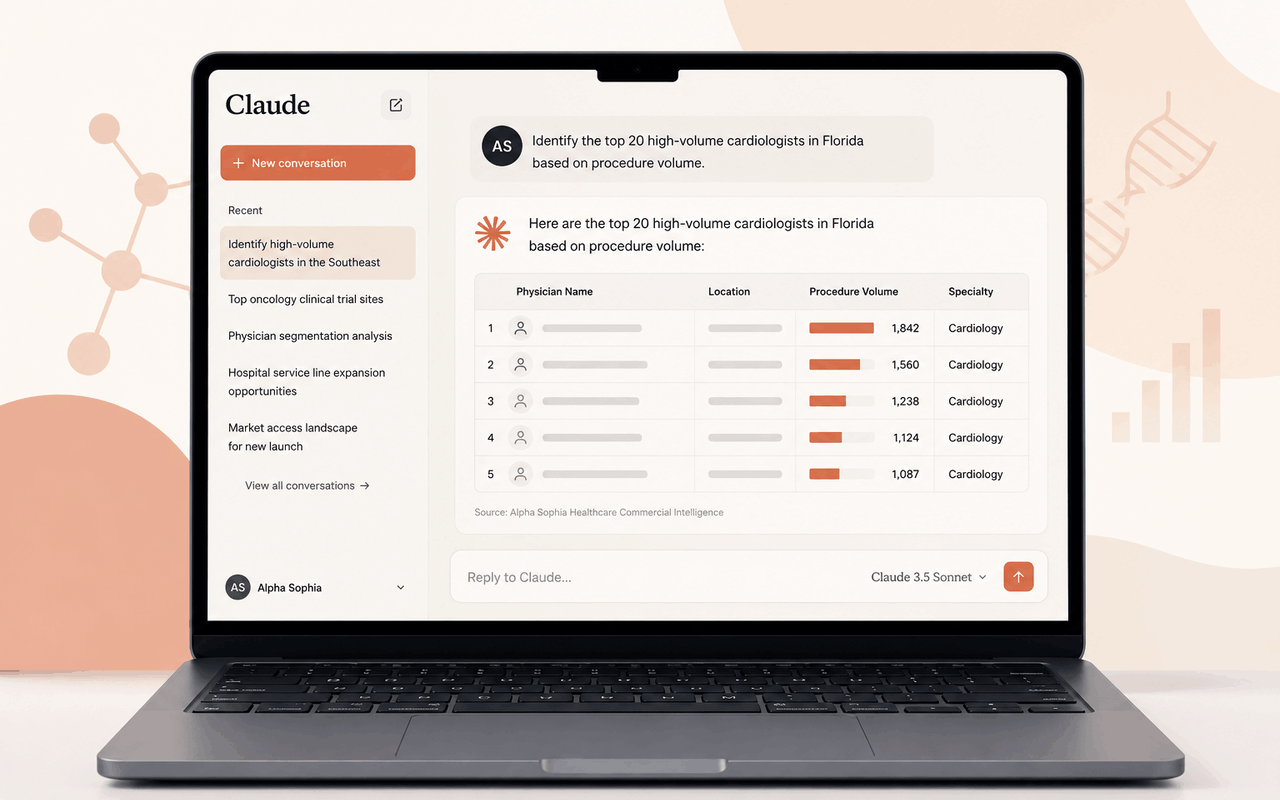
This is one reason healthcare commercial intelligence is becoming increasingly relevant in conversations about enterprise AI. Models can reason. Agents can execute. Neither can make informed commercial decisions without access to reliable data about providers, organizations, procedures, and healthcare markets. One example of this broader trend is Alpha Sophia’s MCP-enabled approach to healthcare commercial intelligence, which allows AI agents to access provider and market intelligence directly rather than requiring users to manually navigate traditional analytics workflows. The significance is not the interface. It is the fact that commercial intelligence becomes part of an agentic workflow rather than remaining trapped inside a dashboard.
A Race to Build the Best Information Infrastructure
Viewed through this lens, the future of AI in life sciences begins to look less like a competition between models and more like a race to build the best information infrastructure. The organizations that benefit most from agentic AI are unlikely to be those with access to a slightly better language model. Model performance continues to improve, but the gap between leading systems narrows over time. Proprietary data, trusted workflows, and seamless integrations are harder to replicate.
That dynamic has already emerged in other industries. Financial services firms compete on data. Legal technology companies compete on data. Cybersecurity platforms compete on data. Life sciences is moving in the same direction.
The next decade of AI adoption in healthcare may ultimately be remembered not for the emergence of powerful models but for the creation of systems capable of connecting those models to the information that matters. The winners will not necessarily have the smartest AI. They will have the best access to scientific knowledge, clinical evidence, operational workflows, and commercial intelligence. In an industry defined by information, the ability to transform knowledge into action has always been the ultimate competitive advantage. Agentic AI simply raises the stakes.
