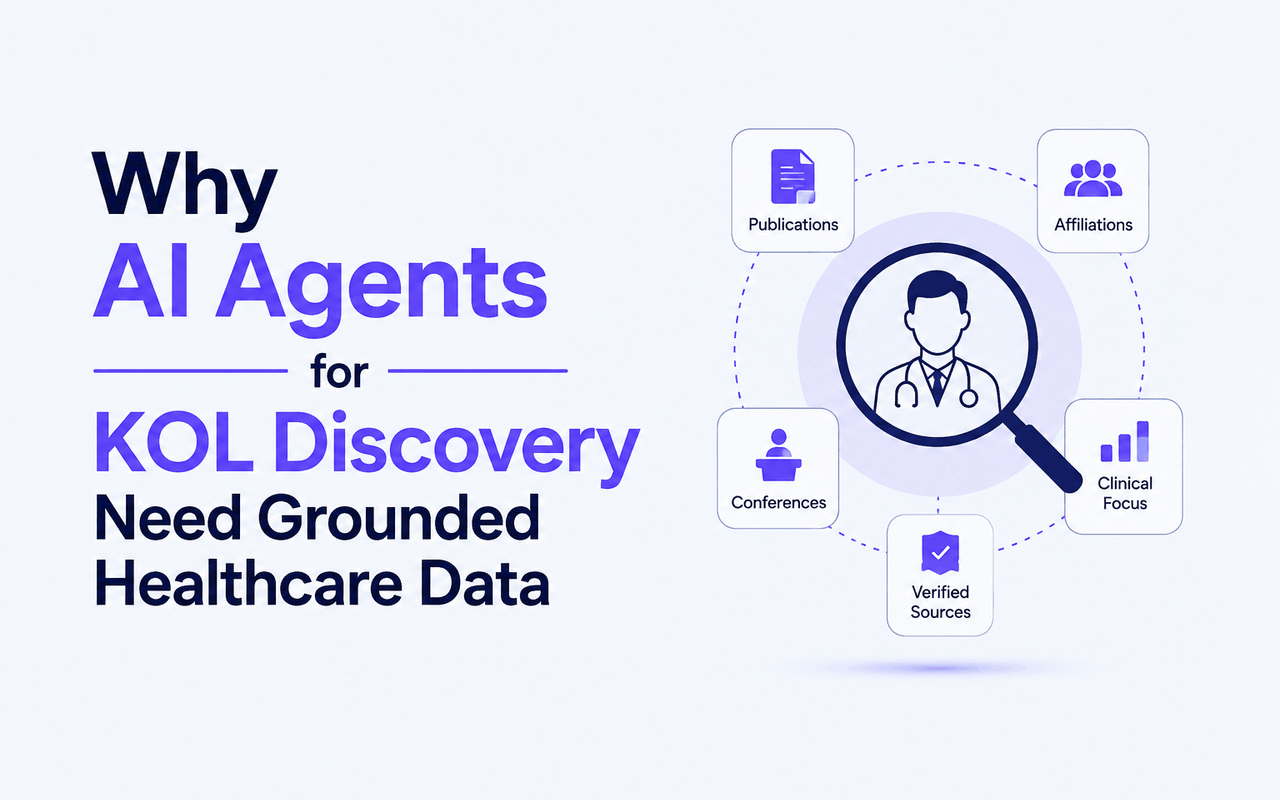
Why AI Agents for KOL Discovery Need Grounded Healthcare Data
On this page
Ask an AI agent to build you a list of the top key opinion leaders in a therapeutic area and it will hand one back in seconds. The names will look plausible. Some will be real. The trouble lies in the ones that are not, and in the ones that are real but wrong for your indication, because a model working from general web search has no reliable way to tell you which is which.
Grounded healthcare AI matters here in a way most teams underestimate.
The confidence of an agent’s output has nothing to do with the accuracy of the data underneath it, so a medical affairs lead who acts on an ungrounded list spends the next fortnight re-checking it by hand, which quietly erases the speed that made the agent appealing. Whether a KOL agent is useful or merely fast depends on what it reads before it answers.
Why Traditional KOL Discovery Takes So Long
The traditional way to build a KOL map is manual, and it is slow by construction. An analyst pulls publication records, cross-references conference faculty rosters, checks trial registries, scans society membership lists, and then tries to reconcile all of it against whatever they can find about where each physician actually practices.
The work is not intellectually hard. But it drags because the sources were never built to talk to each other.
The Reconciliation Problem Nobody Has Fully Solved
PubMed holds more than 40 million citations for biomedical literature, and ClinicalTrials.gov listed 404,637 interventional trials as of early 2025. Both are searchable. Neither ties a physician’s publications to their trial leadership to their real patient-care footprint under a shared identifier.
So an analyst spends most of the effort not finding records but stitching them together, deciding whether the “J. Smith” on a 2024 oncology paper is the same J. Smith running a Phase II trial and billing for the relevant procedures three states away. Get one of those judgments wrong and a name lands on the list that should not be there, or a rising investigator gets missed entirely.
Multiply that across a candidate pool of a few hundred physicians and the timeline stretches into weeks.
A shared identifier such as the NPI is what would collapse that work, since it lets every record about a physician resolve to the same person, but the public sources rarely carry it consistently, so the reconciliation falls back on names, institutions, and human judgment.
That is the part machines were supposed to help with, and it is also the part a general web agent handles the worst.
Why Pointing a General AI at the Web Automates the Wrong Inputs
The obvious fix looks like a general-purpose agent with web access. Point it at the internet, ask for the KOLs, let it read faster than any human could. The catch is that speed applied to bad inputs produces wrong answers faster.
A general agent grounded in open-web search reads SEO-optimized practice bios, “top doctor” ranking pages, and insurer directories, and much of that material is stale or wrong.
When AMA leadership testified before the Senate Finance Committee on directory accuracy, they cited a secret-shopper study in which only 26.6% of listed dermatologists in a set of Medicare Advantage plans were reachable, in-network, and accepting patients.
A separate Senate Finance Committee secret-shopper study found staff could book an appointment from provider directories only 18% of the time.
The web also decays underneath you. Peer-reviewed work using Medicare billing put annual physician turnover at 7.6% by 2018, which means a meaningful share of the affiliations a scraped page shows are already out of date. An agent reading that layer inherits its errors and reports them back with a straight face.
How AI Agents Search Publications, Clinical Trials, and Provider Data Simultaneously
The genuine value of an agent shows up when it queries several structured sources at once and cross-references them, collapsing the reconciliation work that eats an analyst’s week.
A well-built agent can look at publication activity, trial involvement, and billed clinical behavior in a single pass and return physicians who show up meaningfully across all of them.
That only holds if the sources it queries are grounded reference data rather than whatever the open web serves up.
Parallel Querying Across Sources That Connect
Parallel search earns its keep through corroboration. A physician who published on a mechanism is one kind of signal.
A physician who also led a trial in the indication, and who treats the patient population at real volume, is a far stronger candidate, and an agent reading connected data can require that agreement across signals before it commits a name to your list.
Manual processes tend to skip that check under time pressure. Independent evaluations reinforce why the check matters.
A systematic review in the Journal of Medical Internet Research found wide variation in how accurately large language models answer clinical questions, with performance hinging on the model and the task rather than on how fluent the answer sounded.
Fluency is not evidence, and an agent that cannot check itself against source data will produce confident prose either way.
Where the Open Web Falls Short as a Source
General web search ranks documents by relevance and popularity, not by clinical truth. It cannot separate a physician’s self-authored marketing page from their real procedure volume, since both are just text to a retrieval system.
Claims-based records work on a different principle, because they reflect what providers actually billed for rather than what a website says they do.
An agent reading observed behavior can tell you how often a surgeon actually performs a procedure, straight from the billing record. Give it only a bio to work from and the best it manages is a restatement of what the surgeon claims.
For KOL work, the gap between those two answers is the whole point, because influence you can act on has to be anchored to what a physician does rather than how they describe themselves.
A well-optimized page can make a light user of a technique look like its foremost proponent, and a genuinely high-volume specialist with a sparse web presence can vanish from the results entirely. Neither distortion is visible to a system that treats every page as equally true.
Identifying Emerging KOLs Instead of Only Established Experts
The established experts are the easy part. They have the citations, the keynote slots, and the press, so any tool built on web prominence will surface them without much help.
The physicians you most want to find early, the rising investigators and the specialists driving a new mechanism, are precisely the ones with a thin public footprint. Discovery based on web fame finds them late, if at all.
Why Open-Web Ranking Buries the Rising Names
Search ranking rewards accumulated attention, and emerging KOLs have not accumulated it yet. The failure runs deeper than ranking, though, because an ungrounded model performs worst exactly in this territory.
An experimental study of citation behavior in mental health topics found that GPT-4o invented references at higher rates on less-familiar, less-covered subjects than on well-established ones. Rare disease, a novel target, a subspecialty procedure, these are the low-coverage areas where a general model is likeliest to hallucinate, and they are also the areas where finding the right early adopter carries the most commercial weight.
So the tool fails hardest at the exact task you brought it in to do. Publication counts and conference appearances, the old bibliometric shortcuts, compound the problem, since they measure yesterday’s standing rather than this year’s momentum.
How Recent-Activity Signals Surface Them First
A physician taking on trial leadership this year, publishing at rising velocity, or climbing in procedure or prescribing volume is emerging whether or not the web has noticed.
An agent grounded in current, structured activity data can rank on those signals directly, which turns “who will matter next” from a guess into a query you can actually run. Reputation-based tools cannot do this, because reputation is a lagging indicator by construction, and by the time it catches up your competitors have already made the introduction.
The commercial stakes are concrete. In a new category, the physicians who shape the treatment paradigm are often the ones running the early trials and publishing the first real-world results, and reaching them before a launch rather than after is the difference between helping define the standard of care and arriving at a conversation someone else has already framed.
Using AI Agents to Match KOLs to Specific Therapeutic Areas and Research Topics
A name on a KOL list is only useful if it maps to your exact clinical question. Matching a physician to a precise indication takes structured clinical signals, meaning the diagnoses they manage, the procedures they perform, the indications of the trials they run, and the topics they publish on. Keyword overlap across web pages does not get you there.
Before any therapeutic-area filter can run, the signals have to belong to one resolvable physician. A publication, a trial role, and a run of billed procedures only describe a KOL if they can be confirmed as the same person, the reconciliation problem from earlier, now solved by the identifier.
In a grounded layer, every record already resolves to an NPI, so the co-author, the principal investigator, and the physician billing the procedure are matched to one person or correctly held apart before any code-based filtering begins.
Resolve names to NPIs first and the matching that follows describes real physicians, skip that step and you are attaching diagnosis and procedure codes to a name collision.
Therapeutic-Area Precision Needs Structured Clinical Signal
Think about the gap between a physician who co-authored one review touching your therapeutic area and one who treats hundreds of those patients a year.
On the open web, both surface for the same keyword, and a retrieval system has no principled way to rank the working specialist above the occasional author. Structured data separates them, because diagnosis codes such as ICD-10 and CCSR categories, together with procedure codes such as CPT and HCPCS, describe real clinical activity rather than page content.
An agent that filters on those codes returns physicians whose practice actually matches your indication, at the volume that matters, instead of everyone whose website happens to mention the condition.
For a narrow indication, that difference decides whether your field team spends its first month on the right twenty names or the wrong two hundred. Structured signal also lets you go a level deeper than specialty, which is where most keyword approaches stall.
Two physicians can share the same specialty label and treat almost entirely different patient populations, and only the diagnosis and procedure mix tells you which one manages the cases your product is indicated for.
An agent reading those codes can hold that distinction. An agent reading specialty tags scraped off the web cannot.
The Fabricated-Affiliation Risk in Ungrounded Matching
When a model cannot find a grounded answer, it tends to generate a fluent wrong one.
A study of ChatGPT-generated medical content found that most references it produced were fabricated or inaccurate, with an incorrect identifier in 93% of cited papers. The same failure mode reaches provider attributes.
An ungrounded agent asked to match KOLs to a niche indication can invent an institutional affiliation, overstate a physician’s focus, or attach a credential that does not exist, and it presents each invention in the same assured tone as a real match.
A launch team betting field time and travel budget on that output has no way to see the seam between the true rows and the manufactured ones until a rep is sitting in the wrong waiting room.
How AI Agents Help Medical Affairs Teams Spend More Time on Strategy and Less Time on Research
The payoff medical affairs leaders want from agents is time. Less manual assembly of expert lists, more scientific strategy and higher-quality engagement.
A recent survey of medical affairs professionals found that 82% said MSLs use or would use AI for tasks like literature review and real-time information retrieval, and 74% expected AI to significantly affect the function. The appetite is settled. Whether the time savings are real depends entirely on trust.
The Verification Tax of Ungrounded Lists
Any list an MSL cannot act on without re-checking carries a hidden cost. If the agent’s output has to be validated against primary sources before anyone picks up the phone, the re-verification step swallows the hours the agent was supposed to save, and the team ends up doing the old research plus a new review pass on top.
An ungrounded KOL list is worse than no list at all, because it looks finished when it is not, and it invites action before it has earned any. The failure is quiet, since nothing looks wrong until a scientific exchange opens with a physician who turns out to be a poor fit for the conversation.
What Changes When the Data Is Trustworthy by Default
Ground the agent in real claims and research data and the verification tax largely falls away.
When the providers, volumes, publications, and trial roles come straight from source records rather than from a model’s synthesis, an MSL can move from the list to the engagement without a defensive audit in between. That move from re-checking to acting frees the strategic time medical affairs keeps being promised and rarely sees.
Alpha Sophia’s own guidance on building a smarter HCP engagement plan rests on the same logic, that a plan can only be as good as the data feeding it.
How Alpha Sophia AI Agents Accelerate KOL Discovery with Real Healthcare Commercial Intelligence
Alpha Sophia sits underneath the agent as the external reference layer it queries. The reasoning happens in the agent, and the reference data stays external to your stack, which is a deliberate division of labor rather than a limitation.
The platform anchors every provider to their NPI in the federal registry and layers on a national, all-payor view of US medical claims across Medicare, Medicaid, and commercial payors, covering 4 million or more providers, with procedures, diagnoses, specialty, affiliations, prescriptions, open payments, education, publications, and clinical trials attached. When an agent needs KOL signals, it reads them from there rather than from the open web.
The Grounded Corpus an Agent Reads From
You can reach that data three ways, through the in-app Alpha Sophia Assistant, by connecting your own AI assistant over the Model Context Protocol, or through autonomous workflows that run a discovery play end to end.
In each case the agent looks up real NPIs, real procedure and diagnosis volumes, and real publication and trial activity, then reports what is actually there. Financial context sits alongside those signals, so a team can vet a candidate’s industry ties against the federal Open Payments database before committing to an engagement.
Because the answers come from governed reference data, the agent has no reason to guess, and the usual hallucination failure mode has nowhere to take hold.
Ask it something specific, along the lines of which high-volume injectors treat a given condition in the Southeast and which of them also hold recent trial roles in the indication, and it returns named providers ranked on real activity, with the filters it applied shown so you can refine them. The output is a shortlist you can hand to a field team, not a paragraph you have to fact-check line by line.
But Alpha Sophia supplies the grounded reference layer and nothing more inside your systems. It does not perform matching, merging, or deduplication in your CRM, and it is not an identity-resolution engine sitting in your pipeline.
Your own tooling owns the merge into your records and the downstream workflow, which keeps the reference data clean and keeps control of your stack with you. Teams that want the broader view can read Alpha Sophia’s knowledge hub on how agents turn provider and claims data into insight at scale.
Conclusion
An agent grounded in general web search can compress the retrieval half of KOL discovery, but it hands the verification half back with interest, because someone still has to prove every name is real, current, and right for the indication.
An agent grounded in NPI-anchored claims and research data compresses both halves at once, turning weeks of stitching into an afternoon of confident targeting.
For a medical affairs team working against a launch date, the practical result is measured in MSL cycles not wasted and engagements that start on schedule, and it traces back to one upstream decision about what the agent was allowed to read.
Frequently Asked Questions
What are AI agents for KOL discovery?
They are AI systems that identify and profile key opinion leaders by querying data sources rather than relying on a person to assemble the list by hand. Instead of generating names from training memory, a well-built agent looks up real publication, trial, and provider activity and returns candidates that match a defined clinical question.
How do AI agents identify key opinion leaders?
They search structured signals such as publication records, clinical trial involvement, and billed clinical behavior, then cross-reference those signals to find physicians who appear consistently across them. The reliability of the result depends on whether the agent reads grounded reference data or general web pages, since only the former reflects what a provider actually does.
Can AI agents identify emerging KOLs?
Yes, but only if they read current activity data rather than accumulated web prominence. Rising investigators and early adopters have thin public footprints, so an agent grounded in recent trial roles, publication velocity, and procedure or prescribing volume can surface them well before reputation-based tools do.
How do AI agents support medical affairs teams?
They shorten the manual research that consumes MSL time, freeing the team for scientific strategy and higher-quality engagement. Those savings hold only when the underlying list is trustworthy enough to act on directly, because an ungrounded list forces a re-verification step that cancels out the speed.
What data sources do AI agents use for KOL discovery?
Strong sources include peer-reviewed publications, clinical trial registries, and claims-based records of billed procedures and diagnoses, ideally tied together under a shared provider identifier such as the NPI. General web search alone is a weak source, because it ranks pages by popularity and cannot distinguish real clinical activity from self-description.
How do Alpha Sophia AI Agents accelerate KOL identification?
Alpha Sophia acts as the external, NPI-anchored reference layer an agent reads from, supplying all-payor claims data along with publications, trial activity, affiliations, and open payments across 3.9 million or more providers. The agent looks up real signals instead of guessing, while the merge and workflow logic stay in the team’s own systems.
