How AI-Based Provider Matching Reduces Manual CRM Cleanup Work
On this page
For most MedTech and pharma commercial teams, CRM cleanup is not a one-time project. It is a recurring operational cost that surfaces every quarter, consumes sales ops capacity, and still produces results that degrade before the next cycle begins.
Across B2B sales organizations broadly, research finds that 76% of CRM users report fewer than half their entries are complete and accurate, with reps entering only the minimum required fields at the point of record creation. In healthcare, where the missing field is typically an NPI rather than a phone number, the downstream consequences are substantially more disruptive.
The data gets messy, someone exports a spreadsheet, a few weeks of manual reconciliation follow, and the cycle repeats.
The root issue is that provider data in healthcare changes at a pace that manual workflows cannot match. Physicians move practices, acquire new NPIs, change affiliations, and retire. Records enter the CRM from multiple sources simultaneously, each with different formatting and no standardized identifier enforcement. By the time a cleanup project concludes, some portion of the work is already outdated.
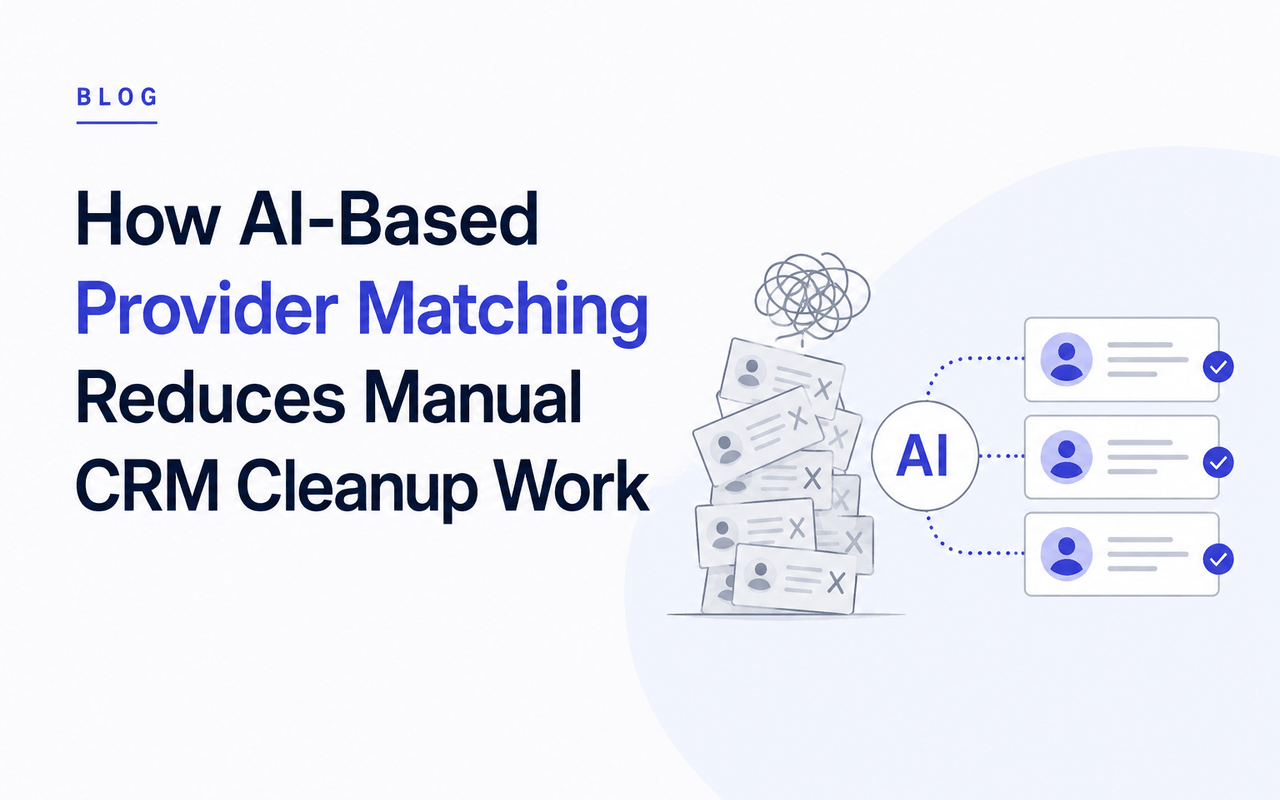
AI-based provider matching addresses this at the structural level. Rather than treating CRM cleanup as a periodic project, it creates a continuous matching layer that identifies, resolves, and standardizes provider records as they enter and update.
The result is a meaningful reduction in the manual work burden that currently consumes sales ops time without a corresponding improvement in data quality.
Why Healthcare CRM Cleanup Becomes a Manual Operational Burden
The cleanup burden in healthcare CRMs is heavier than in most industries because the underlying data it depends on is unusually unstable.
According to research, nearly a third of physicians switch practices, hospitals, or affiliations in any given year, meaning that a significant share of provider records in a commercial CRM will become inaccurate within twelve months regardless of how carefully they were entered.
That rate of change creates a structural mismatch. Sales ops teams are built to support selling, not to function as data stewards for a continuously shifting provider landscape.
When cleanup responsibility is not systematized, it defaults to manual labor, which means someone is exporting records, cross-referencing them against the NPI Registry, merging duplicates by hand, and re-importing corrected records, a process that the same analysis notes costs physician practices nearly $3 billion annually in aggregate.
Most of that cost reflects the sheer repetition of a task that should only need to happen once per record if the matching infrastructure works correctly.
Where the Workload Actually Comes From
Manual cleanup work in healthcare CRMs concentrates around a few specific failure points. A predictable failure point is the absence of a consistent primary identifier at the point of record creation.
When a field rep enters a new physician after a sales call, they typically capture a name, a clinic address, and a specialty. They may or may not enter an NPI. If they do, it might be wrong.
Meanwhile, that same physician may already exist in the CRM under a slightly different name spelling, a previous practice address, or a record imported from a conference lead list six months earlier.
The second failure point is mid-cycle record ingestion. Records arrive from conference badge scans, purchased lists, rep-entered notes, and marketing platform exports throughout the year, not in a single controlled batch.
A physician who enters the CRM from a rep’s post-call note in February may arrive again from a conference import in May, and again from a marketing list in September. Each entry looks like a new contact to a rule-based system. By the time the duplicate is caught, it has already been included in a campaign send, a territory count, or a call plan that was built on the assumption it was a distinct provider.
The cleanup burden is compounded by the fact that many of these duplicates are only discoverable after the downstream workflow they corrupted has already run.
Why Cleanup Cycles Repeat
Manual cleanup resolves the immediate discrepancy without addressing the conditions that created it.
Merging two duplicate records fixes one data point but it does not change how new records enter the CRM or how they are validated at intake. The cleanup project produces a clean database as of the date it finishes, and the database begins degrading again the following week.
This is the cycle that AI-based matching breaks. Its value is in persistence. An AI matching layer runs continuously, applies the same logic to every new record, and flags inconsistencies before they compound.
Common Provider Data Issues That Create Cleanup Work
Provider data problems in healthcare CRMs tend to cluster into predictable categories. Each requires a different resolution approach, and AI-based matching handles them differently than manual workflows do.
Name Variants Turn One Provider Into Multiple Records
Name variants are the most widespread problem. A single physician can appear as differently across different source records. None of these are wrong in isolation. In aggregate, they create four separate records for one provider, none of which a rule-based deduplication system will reliably consolidate.
Missing NPIs Remove the Only Reliable Matching Anchor
According to provider data research, 30% of provider records contain inaccurate or missing NPI numbers, and 23% of provider addresses are incorrect or absent.
Without an NPI, there is no anchor identifier to determine whether a new record is a duplicate or a genuinely distinct provider. Without a validated address, territory assignment logic cannot be trusted.
Stale Affiliations Misdirect Call Plans at the Account Level
When a physician leaves a health system and joins an independent group practice, the CRM record may still show the old affiliation for months.
A territory manager building call plans from that data may be routing reps to an account the physician no longer works at. This category is the hardest to catch manually because the record looks complete, only the affiliation value is wrong.
A 2025 survey on provider directory accuracy found that a third of directory users had encountered outdated or incorrect information, with stale practice locations among the most commonly reported errors.
What a Verified Record Needs to Contain
A clean provider record requires more than accurate name and address fields. It needs a validated NPI, a confirmed current affiliation, a correct specialty, and a flag distinguishing it from any duplicate entries in the system.
For a team managing several thousand HCPs across multiple territories, maintaining records to that standard without automated matching is not feasible within normal sales ops capacity.
Why Manual Provider Matching Is Slow and Error-Prone
Manual provider matching requires a human to compare records across multiple fields and make a judgment call on each near-match. At a few hundred records this is tedious but manageable, at the scale most commercial teams operate, it is not.
Time Costs Compound with Record Volume
Across B2B sales organizations broadly, research puts general CRM data entry and maintenance at seven or more hours per rep per week.
Provider-specific cleanup projects run longer. A sales ops analyst who spends three full days reconciling 1,500 records is not doing territory analysis, call plan design, or any of the work that actually feeds the commercial strategy.
Inconsistent Judgment Produces Inconsistent Results
The error rate is the more consequential problem. Human matching is subjective. Two analysts applying the same logic to the same set of near-matches will produce different results because the decision threshold is not explicit.
One will merge records that share an NPI but differ on practice location while the other will flag them for review. One will treat “J. Smith” and “Janet Smith” as the same provider while the other will not. These inconsistencies accumulate invisibly, and the only way to find them is another manual audit.
Common Names and Recent Moves Create Systematic Blind Spots
Manual matching fails most predictably on two specific record types. Providers with common names in a geographic area produce false positive matches at a high rate when NPIs are missing.
Providers who have recently changed affiliations produce false negatives, appearing as new records when they are updates to existing ones. Both failure modes require significant time to resolve after they are identified.
How Inconsistent Provider Records Affect Commercial Teams
Bad provider data does not stay contained in the CRM. It propagates downstream into every workflow that depends on it.
Phantom Providers Inflate Territory Size
Territory design built on inaccurate records produces boundaries that misrepresent opportunity size.
If a territory appears to contain 400 qualified physicians when the actual deduplicated count is 310, the rep assigned to that territory will have call plans and quota targets built on 90 phantom providers.
The problem only becomes visible when coverage reporting fails to reflect reality, at which point someone has to trace the discrepancy back to the source data.
Duplicate Records Corrupt Campaign Metrics
When a campaign list is built from a CRM that contains duplicate records for the same providers, some physicians receive the same outreach multiple times.
The practical effect is list fatigue, inflated send volumes, and open rate metrics that do not accurately reflect engagement.
A 2023 JAMA study of physician directory data covering more than 40% of US physicians found inconsistencies in 81% of entries across five large national health insurers, a figure that reflects how broadly provider data problems extend beyond any single commercial team’s database.
Coverage Reports Inherit Every Data Error
Reporting distortions are the least visible consequence. Coverage reports built on duplicated records inflate the denominator, reports built on stale affiliations skew geographic distribution. Either way, the headcount and territory decisions built from those reports carry the error forward.
The Limitations of Traditional CRM Data Cleanup Workflows
The standard approach to CRM data quality in most commercial teams is periodic cleanup. A rules-based deduplication tool flags obvious duplicates, an analyst reviews and resolves them, and the cleaned database goes back into production once or twice a year. This approach has two structural limitations that worsen as the commercial operation scales.
Rules-Based Logic Fails Where Data Quality Is Lowest
Rules-based deduplication is effective only against the exact patterns it was designed to catch. A rule that identifies duplicate records by NPI will miss every duplicate where the NPI is absent or incorrect.
A rule that flags records with identical last names and ZIP codes will produce false positives for any two providers who share demographics.
As research on matching logic notes, exact match logic is insufficient for real-world healthcare data because the format and completeness of source records varies too much for fixed rules to cover reliably.
Cleanup Timing Doesn’t Match Data Decay Rate
A cleanup cycle that runs in January produces clean data in January. Provider mobility, new record intake, and normal CRM activity mean that data quality begins degrading in February. By the time the next cleanup cycle runs, a year’s worth of decay has accumulated.
For a commercial team actively growing its provider database through conference imports, rep notes, and marketing platform integrations, that decay is not gradual. It is continuous.
Provider data research identifies this as a structural failure mode, where periodic cleanup produces temporary improvements without solving the underlying gap between data change and directory correction.
What AI-Based Provider Matching Actually Does
AI-based provider matching works differently from rules-based deduplication in one fundamental way.
Instead of checking whether records match on specific predefined fields, it evaluates the probability that two records refer to the same provider based on the pattern of similarities and differences across all available fields simultaneously.
So this means the system is not looking for a single decisive identifier but weighing a combination of signals.
Two records that share an NPI but differ on practice name and address suggest an affiliation change rather than a duplicate, and a system trained on healthcare provider data can distinguish between the two.
Two records that differ on name spelling but share NPI, ZIP code, and specialty suggest a match with high confidence despite the name discrepancy.
The underlying methods include the techniques that data matching research describes as layered matching logic, combining character-level fuzzy matching for name variants, geographic filters, and specialty or taxonomy cross-checks to confirm contextual accuracy.
What AI adds to this stack is the ability to weight these signals adaptively rather than applying fixed rules, and to learn from resolved matches over time so that the system’s confidence calibration improves as it processes more data from a specific commercial context.
How AI Improves Provider Matching Accuracy at Scale
The accuracy advantage of AI-based matching is most significant in the categories where manual matching is weakest.
Handling Name Variants and Incomplete Records
Name variant resolution is one of the clearest performance differentials. A physician who appears as “Michael O’Brien, MD” in one record and “Mike Obrien” in another presents no obvious match signal for rules-based logic.
An AI system that has processed thousands of similar patterns recognizes this as a high-probability match and assigns a confidence score accordingly.
The human reviewer sees the candidate and the score, not a list of 200 records to manually compare. Incomplete records where an NPI is missing or an address is blank are handled similarly.
The system uses available fields to generate a ranked candidate list rather than skipping the record or defaulting to a generic low-confidence flag.
Cross-Field Validation
Where manual matching checks fields in sequence, AI-based matching evaluates them in combination. A record that fails on name but passes on NPI, specialty, and ZIP code produces a different confidence score than one that fails on name and passes only on ZIP code.
That distinction is what allows the system to auto-resolve high-confidence matches and direct human review time to the genuinely ambiguous ones.
Confidence Scoring and Continuous Updates
Confidence scoring is the mechanism that makes AI matching scalable at the operational level.
As the Alpha Sophia NPI matching guide notes, every match attempt should produce a score, and that score determines whether the match is auto-applied, queued for review, or flagged as a probable new record. This tiered approach is what allows a system to process thousands of records without requiring proportional human review time.
The analyst’s attention is directed to the genuinely uncertain cases, not the high-confidence resolutions that could be handled automatically.
Reducing Duplicate Records and Unmatched Providers with AI
The reduction in manual cleanup work AI-based matching produces comes from two mechanisms operating in parallel.
The first is intake-level validation. When a new provider record enters the CRM from a rep’s field entry, a conference badge import, or a marketing list, the matching system checks it against existing records before it is created. High-confidence matches trigger a merge or flagged review, records with no candidate are created as new entries. This prevents duplicates from accumulating rather than resolving them after the fact.
The second mechanism is continuous resolution of the existing record base. For teams managing CRMs with years of accumulated inconsistencies, AI matching generates a prioritized list of probable duplicates ranked by confidence score.
The analyst works through the queue resolving high-probability cases quickly and spending time only on the genuinely ambiguous ones.
The combined effect is a sustained reduction in the volume of cleanup work rather than a periodic improvement that degrades between cycles.
Firsteigen’s analysis of pharma data quality operations notes that conventional rule-based approaches require constant adjustment as data formats change and new source systems are added, which means the cleanup workload grows alongside the commercial operation.
AI-based matching is less sensitive to format variation, which means its maintenance overhead does not scale linearly with data volume.
How Alpha Sophia Uses AI-Based Matching to Simplify CRM Cleanup
The manual work in healthcare CRM cleanup concentrates around three tasks. Identifying which records are wrong, finding the correct version, and getting the corrected record back into the system.
Alpha Sophia’s matching capability is built around removing each of those steps from the sales ops workflow.
Bulk NPI Lookup
Alpha Sophia’s Bulk NPI Lookup and Physician Matching runs a full record list, whether a CRM export, a conference import, or a purchased contact file, against a provider database built from claims data across Medicare, Medicaid, and commercial payors.
Each record is checked against verified billing history, specialty data, and taxonomy classification.
Where a name is formatted inconsistently or an NPI is missing, those additional data fields serve as cross-checks rather than leaving the match dependent on a single input. Matches that cannot be resolved with sufficient certainty are flagged for human review rather than auto-applied.
The result is that a batch of several thousand records runs through the process as a single operation, with only the genuinely ambiguous cases surfaced for a person to resolve.
Export and API
Matched records export directly from Alpha Sophia into a CRM or data pipeline via the open API.
Each returned record is enriched with the validated NPI, current specialty, and taxonomy data the original was missing, so the cleaned record is immediately usable rather than requiring a separate enrichment step.
ICD-10 and CPT Data
A record can be accurately matched and still be commercially useless. Alpha Sophia’s platform includes ICD-10 diagnosis data alongside CPT and HCPCS procedure volumes, which means the enriched record carries billing context alongside the corrected identity fields.
A rep reviewing matched records can see whether a physician bills for the procedures relevant to their product line. A provider who matches correctly but shows no relevant billing activity is a candidate for removal from the call plan, not just a corrected entry.
That distinction keeps CRM cleanup from producing a tidy database full of accounts that were never worth calling.
Conclusion
Provider records in healthcare change faster than manual workflows can track, and the processes most commercial teams use to maintain data quality are built for point-in-time correction rather than continuous accuracy.
AI-based provider matching shifts work from human review to automated resolution. Records that match clearly are handled without analyst time; ambiguous ones are flagged for human judgment. New records are checked at intake rather than accumulating as future projects.
The result is a sustained improvement in data quality that does not require periodic cleanup cycles or proportional growth in sales ops capacity as the commercial operation scales.
For MedTech and pharma teams where territory planning, call plan integrity, and campaign targeting depend on the accuracy of the underlying provider database, that shift from reactive cleanup to continuous matching is the difference between data quality as an ongoing task and data quality as a solved operational problem.
FAQs
Why is healthcare CRM cleanup so time-consuming?
Provider data changes continuously as physicians move practices, change affiliations, and acquire new NPIs. Most commercial CRMs lack the intake validation to catch these changes automatically, so discrepancies accumulate until a manual cleanup cycle is required. The work of exporting, cross-referencing, and re-importing records is time-intensive and does not scale as the provider database grows.
What causes provider matching errors in CRM systems?
The most common causes are missing NPIs, name variants across data sources, and stale affiliation information. When records enter the CRM from multiple channels without a consistent identifier, rules-based deduplication logic cannot reliably determine whether two entries represent the same provider.
How does AI-based provider matching work?
AI-based matching evaluates multiple fields simultaneously rather than checking for exact matches on specific identifiers. It uses layered logic that includes fuzzy name matching, geographic filtering, and specialty cross-checks, then assigns each potential match a confidence score.
Why is manual provider matching difficult to scale?
Manual matching requires an analyst to review records individually and make judgment calls on near-matches. That process takes proportional time relative to record volume, is inconsistent across reviewers, and is most error-prone in exactly the categories where errors matter most, common names, missing NPIs, and recently relocated providers.
How can AI reduce duplicate provider records?
By running at the point of record intake rather than only during cleanup cycles. When a new record enters the CRM, AI matching checks it against the existing database before it is created. High-confidence matches trigger a merge or a review; genuinely new providers are created as distinct records. This prevents duplicates from forming rather than resolving them after the fact.
How does Alpha Sophia support AI-powered provider matching?
Alpha Sophia’s Bulk NPI Lookup and Physician Matching capability matches uploaded provider records against a database built from US medical claims, using layered NPI validation, fuzzy name matching, and specialty cross-checks to return enriched, confidence-scored results. Matched records are enriched with verified NPI, specialty, and taxonomy data and returned via export or the open API. ICD-10 and CPT data in the enriched records also confirm whether each provider is commercially relevant to the team’s product line.
