Billing Location vs. Practice Location: What Pharma Teams Need to Know About HCP Data
On this page
A single physician can surface in commercial data at several addresses before anyone has confirmed where she actually sees patients. The NPI registry holds a mailing address and a primary practice location. The group she belongs to bills from its own business address, sometimes in a different ZIP code.
If a hospital has acquired the practice, her office visits may now be billed as hospital outpatient services under the hospital’s identity, even though the exam rooms have not moved.
Each of these addresses is correct for the purpose it was created to serve. Problems begin when a targeting model or a territory map treats one of them as the place where care happens.
For pharma and MedTech commercial teams, HCP location data sits underneath decisions that carry real cost. It determines which rep owns an account, which ZIP codes count toward a regional opportunity, and which sites qualify for a field visit or a speaker program.
When the location layer is wrong, claims volume gets credited to a billing office no rep will ever walk into, while the clinic generating that volume sits uncovered in the next territory over.
Avoiding that starts with knowing which address a dataset is actually supplying and where it came from.
Billing Location vs. Practice Location: What Is the Difference?
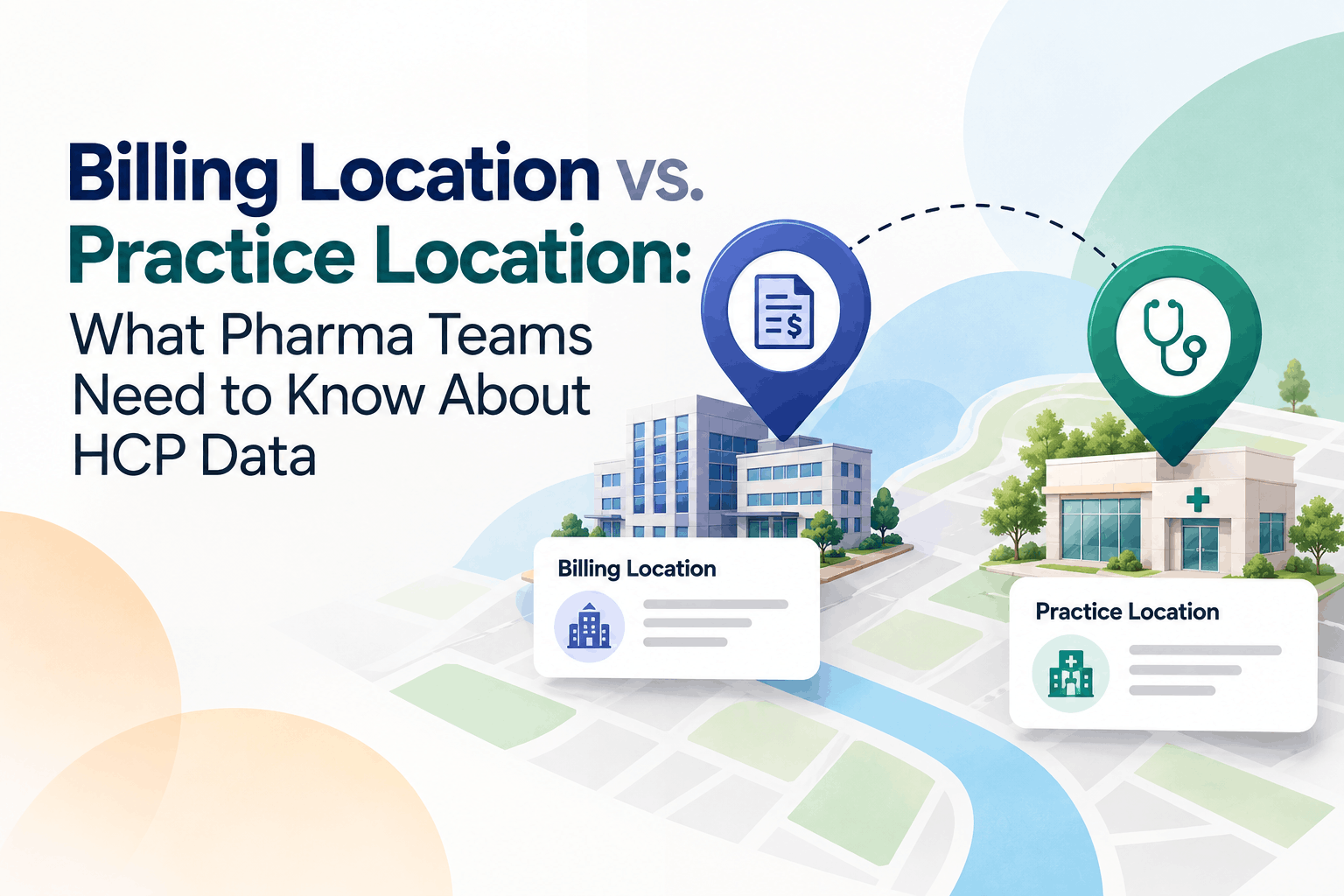
The two terms often sit in the same address column of a commercial dataset, and many teams use them interchangeably. They come from different systems and answer different questions, so choosing which one to trust depends on understanding how each is created.
Why HCP Location Data Is More Complicated Than a Street Address
Most HCP address data traces back to the National Plan and Provider Enumeration System (NPPES), the federal registry that issues NPIs.
The registry was never designed as a location intelligence source. When HHS finalized the NPI, it concluded that provider location addresses change so frequently that the field is of limited use in electronic matching, and it kept only a mailing address and one location address as required elements. That is the registry’s own assessment of its address data, restated by CMS as recently as 2024.
Providers are obligated to report changes to their required NPPES data elements within 30 days. So that obligation depends on each provider or practice administrator remembering to log in after a move, an acquisition, or a new clinic opening.
The registry is therefore the most widely used source of HCP address data while remaining self-reported, with no independent check on whether a listed site is still active.
Layer claims on top and the picture gets more complicated. A claim describes a payment event, and the addresses attached to it reflect who is getting paid and under which identity. Those addresses can diverge from the registry and from each other, and neither has to match the room where a patient was seen.
Practice Location Points to Where Care Happens, With Limits
The practice location is meant to describe a physical site where a provider delivers care. In NPPES, the required location field holds one address, and the data element description specifies that for providers with more than one physical location, it records the primary location.
Additional practice locations can be listed, but only the primary one is mandatory. A cardiologist who rotates between a hospital campus and two satellite clinics may appear in the registry at exactly one of those sites.
A newer exception loosens the field further. Since April 3, 2024, individual providers whose only physical location is their home, such as clinicians who deliver telehealth exclusively from home, may enter a post office box or a private mailbox as their practice location.
Some practice locations in current registry data therefore point to no clinical site at all, which matters for any team geocoding addresses to plan field coverage.
Billing Location Describes Where Payment Is Processed
The billing location is the address associated with the entity that submits the claim and receives payment. On the professional claim form, Medicare separates the rendering provider NPI, the service facility NPI, and the billing provider NPI into distinct fields.
For an independent physician billing under her own NPI, the billing and practice addresses may be identical. For a physician in a group, the billing provider is usually the group’s organizational NPI, and its address is the group’s business address.
That address may belong to a central business office or to the main campus of a health system, and neither is necessarily a place where the physician treats patients. So when a commercial dataset labels a field “HCP address” without stating its source, the first job is to find out whether it came from the registry, from the billing provider on claims, or from the service facility, because each describes a different place.
Why Claims and Billing Data Can Point to Different Locations
Claims data exists to pay providers accurately, and every location field on a claim serves that purpose first.
For Medicare physician services, the payment locality, and with it the fee schedule amount, is set by the ZIP code where the service was furnished. The address on a claim tells the payer which rate applies, and whether it also identifies the room where a patient was seen depends on the dataset reading it. Take a three-site orthopedic group billing under one organizational NPI. Its claims can report the clinic where each visit happened.
A dataset that rolls volume up to the billing NPI, however, attaches every visit to the group’s business address, and a public Medicare file attaches each surgeon’s volume to the address that surgeon listed as primary in NPPES.
The same encounters can land at three different addresses depending on which file a team opens, and the billing mechanics behind that spread all show up in the provider-level files pharma teams use for targeting.
One Claim Carries Several Provider Identities
A professional claim can name the clinician who performed the service, the group that bills for it, and the facility where it happened. In Medicare carrier claims, the organization NPI reported on the line for the performing physician is the NPI of the group practice to which that physician belongs.
Analysts who aggregate by billing or group NPI get volume at the practice level. Analysts who aggregate by rendering NPI get volume at the individual level. Both totals are legitimate, and they attach to different addresses.
The service facility field is the one closest to a true site of care, and it is often absent. Under Medicare’s claims processing instructions, when the service facility matches the billing provider, only the billing provider is entered and the service is priced on the billing provider’s ZIP code.
The site of care in those cases is inferred from the billing address. For a single-site practice that inference holds. For a multi-site group billing from one address, it quietly assigns every encounter to the business office.
Public Claims Files Take the Address From the Registry
Many teams start with public CMS data, and those files rarely carry a claim-level service address.
In the Medicare Physician and Other Practitioners dataset, the address fields describe the rendering provider’s street, city, and state as reported in NPPES, and place of service is reduced to a single flag indicating a facility or non-facility setting.
The procedure volume is real, while the address attached to it is whatever the registry lists as the primary location.
The Part D prescriber data works the same way. CMS builds the prescriber city and state fields from the NPPES business practice location address, which is the primary practice location.
A prescriber who writes most of her prescriptions at a satellite clinic forty miles away will still appear in the city of her primary registry address. For brand teams sizing regional prescribing, that difference can move volume across territory and even state lines.
Hospital Acquisition Changes the Bill Without Moving the Clinic
MedPAC reports that the share of physicians either in practices at least partly owned by hospitals or employed by hospitals rose from 29.0% in 2012 to 39.8% in 2020.
As that happens, billing shifts from the physician fee schedule to the hospital outpatient payment system even when the physical setting of the service does not change at all.
Pharma teams with infused or injected products see this directly in the data. In the same MedPAC analysis, the share of chemotherapy administration billed under the hospital outpatient system grew from 35.2% in 2012 to 51.9% in 2021.
When a hospital acquires an oncology practice, the claims can switch from a non-facility to a facility place of service and from the practice’s billing NPI to the hospital’s, while the oncologist keeps treating the same patients in the same infusion chairs.
A location analysis built on billing entities would show the account moving to the hospital, even though the physician stayed exactly where she was.
The same pattern appears in commercial claims. The Health Care Cost Institute notes that a hospital-owned physician office may bill a facility fee despite no physical change in where patients are treated, and its national data show an average biopsy price of $146 with a professional bill alone versus $791 when a facility charge is added.
A gap that wide gives the billing entity real commercial weight, since it shapes the economics of every service delivered at that site.
Telehealth Separates the Encounter From a Single Address
Telehealth adds another gap. Medicare guidance states that practitioners who furnish telehealth from home but have a physical practice location are not required to report their home address on their enrollment application, and a separate place of service code identifies visits where the patient was at home.
In those encounters, clinician and patient may both be at home while the address on file belongs to a clinic neither of them visited. Behavioral health is where this gap is widest.
MedPAC’s analysis of Medicare claims found that half of common 60-minute psychotherapy services were delivered by telehealth, and that in 2022, 21% of behavioral health clinicians provided telehealth services exclusively, compared with about 1% of other clinicians.
For those clinicians, the address on a claim may not correspond to any place a rep could visit.
What Pharma and MedTech Teams Should Consider When Using HCP Location Data
Each of these mechanics leaves claims and registry data accurate for a narrower question than many teams assume. The practical discipline is deciding which question an analysis is asking before choosing which address to join on.
How Multiple Locations Affect HCP and Account Analysis
A provider with several locations creates attribution problems at every level of commercial analysis. At the territory level, all of a surgeon’s procedure volume may be credited to the ZIP code of her primary registry address, even when most of her cases happen at an ambulatory surgery center in a neighboring territory.
Reps in one territory inherit a high-volume target they cannot easily reach, and reps in the other never see the volume walking through their accounts.
Account roll-ups suffer in two directions. Rolling individual physicians up to organizations by billing NPI can concentrate volume at a health system’s main campus while its outlying clinics look empty.
Rolling up by registry address can split one physician’s activity across accounts or drop it entirely when the registry lists a site the physician has left. Both errors show up as unexplained gaps between a forecast and what reps see in the field.
Engagement planning for individual physicians feels it too. A medical science liaison scheduling a visit and a marketing team geotargeting a digital campaign both need the place where the physician is reachable on a given day, and the billing address rarely supplies it.
Match the Address to the Decision It Supports
The most useful habit is to tie each commercial use case to the location field that actually describes it. Field visits and route design depend on verified, recent practice locations, ideally with every active site rather than the primary one alone.
Contracting, account ownership, and pull-through work depend on the billing entity, because that is where purchasing and reimbursement decisions sit. Site-of-care economics, especially for buy-and-bill products, depend on place of service and facility status. Mail and sample logistics depend on the mailing address.
Few teams have a single source that cleanly supplies all four. Even so, labeling each address in the CRM by its source and intended use prevents the most common mistake, which is a rep driving to a billing office because it was the only address in the record.
Keep Individual and Organization NPIs in Separate Lanes
Individual providers carry Type 1 NPIs and organizations carry Type 2 NPIs, and each has its own registry record and address.
When an organization’s billing address is copied into an individual’s record, the individual inherits a location that may have nothing to do with where they practice.
Keeping the two identities separate, and linking them through affiliation rather than overwriting one address with another, preserves the ability to analyze volume at either level without contaminating the other.
Treat Every Address as a Dated Observation
An address is a snapshot. The 30-day update rule in NPPES describes an obligation, and the 2024 Federal Register notice is candid that location data changes faster than it is maintained. Between acquisitions and physicians moving groups, a record can be outdated within a quarter.
Recording the source and the as-of date for each address lets a team weigh a registry address updated last month differently from one untouched for six years, and it makes stale records visible before a territory realignment depends on them.
Claims data needs the same treatment. Volume aggregated over a full year may include months before an acquisition and months after it. Analysts reading a physician’s annual total should check whether the billing entity changed within the period, because the location that best describes the most recent quarter may differ from the one that dominated the year.
How Alpha Sophia Helps Teams Interpret HCP Location and Claims Data
The reconciliation decisions described above belong to the commercial team. Which address goes into the CRM, how accounts are defined, and how territories are drawn are judgments that depend on each company’s products and go-to-market model.
Alpha Sophia’s role is to supply an external, NPI-anchored reference that teams can query and check their own records against while they make those calls.
Provider and Site-of-Care Views Keyed to the Same NPI
Alpha Sophia profiles all HCPs using all-payor claims that span Medicare, including Medicare Advantage, Medicaid, and commercial payors.
Each provider profile is keyed to the NPI and includes affiliations that connect the individual to health systems, groups, and physical sites of care such as hospital campuses, clinics, labs, and pharmacies.
Because both views hang off the same identifier, a team can look at what an individual physician bills and at the organizations and facilities that physician connects to, side by side, rather than inferring one from the other.
Sites of care can also be targeted directly. When the question is where volume concentrates rather than who generates it, teams can search hospitals, clinics, labs, and pharmacies by the procedures performed there, the specialties on staff, facility type, and geography.
That makes it possible to compare a physician-level view of a market with a facility-level view and see where the two disagree.
Location Filters Work From the NPI Address or the Site of Care
Location only becomes useful for targeting when it is paired with clinical activity and when a team can choose which location it means.
Alpha Sophia lets teams search by a provider’s NPI location or by the locations of the sites of care where that provider practices, and it shows every location for each affiliation instead of collapsing a provider to one primary address.
A team planning field visits can search by site of care to find physicians who treat patients inside a territory, while a team checking CRM records against the registry can search by NPI location.
Either search combines with CPT and HCPCS procedure codes, ICD-10 diagnoses and CCSR categories, taxonomy, and prescribing behavior, with results ranked by volume.
The Territory Manager carries that into field design, with territories built and edited nationwide, driving distance measured in miles, start and end points for rep routes, and opportunity size displayed alongside the territory boundaries.
For teams starting from their own lists, Bulk NPI Lookup matches physician records to NPIs so internal entries can be compared against the reference. Any merge or address decision that follows stays inside the team’s own CRM.
Location Questions Asked in Plain Language
Location analysis usually involves many small, specific questions, and the Alpha Sophia Assistant lets teams ask them in plain English.
A request such as the highest-volume orthopedic surgeons performing total knee replacement within 25 miles of a given city returns a ranked list along with the filters the Assistant applied, so the analyst can see exactly which specialty, procedure, and geography were counted.
Teams that work in their own AI tools can connect Claude, ChatGPT, or Cursor to Alpha Sophia over the Model Context Protocol and query the same claims-grounded data there, or run autonomous workflows that pass target lists to connected systems such as a CRM.
In each case, the answers come from the same underlying data, and the location judgments stay with the people who own the territories.
Conclusion
HCP location data looks like a solved problem because every record has an address. Look closer and that address usually turns out to be the registry’s primary location, the billing entity’s business office, or a hospital that took over the bill without moving the clinic.
All of them are accurate for their own purpose, and none of them answers every commercial question.
Pharma and MedTech teams that label addresses by source, keep individual and organization identities separate, and date-stamp what they know will make fewer territory and targeting errors than teams that treat one address field as the truth.
Pairing that discipline with an NPI-anchored claims reference, one that shows both what a provider bills and where they connect, gives commercial teams a sounder basis for deciding where reps should go and which accounts deserve the effort.
FAQs
What is an HCP billing location?
An HCP billing location is the address associated with the provider or organization that submits a claim and receives payment. For physicians in a group or health system, it is usually the address tied to the organization’s billing NPI, which may be a business office rather than a clinical site.
What is the difference between billing location and practice location?
The practice location describes where a provider physically delivers care, and NPPES requires only one primary practice location. The billing location describes where claims are submitted and payment is processed. The two match for many solo practices but often differ for physicians in groups or hospital-owned practices.
Why can an HCP have multiple locations?
Many physicians see patients at more than one site, such as a hospital, an outpatient clinic, and an ambulatory surgery center. They may also be affiliated with several organizations, each with its own address and billing identity. Telehealth adds encounters that have no single physical meeting point.
Why does billing location matter when analyzing HCP claims data?
Claims volume is often attached to the billing entity or to the provider’s registry address rather than to the site where care happened. If analysts do not know which address a dataset uses, they can credit volume to the wrong territory or account. Billing location also shows who controls purchasing and reimbursement at an account.
How can pharma teams use HCP location data accurately?
Teams should label each address by its source and intended use, and match the field to the decision at hand. Practice locations support field visits, billing entities support account and contracting work, and place of service supports site-of-care analysis. Recording an as-of date for every address helps catch stale records before they drive territory decisions.
How does Alpha Sophia help analyze HCP location and billing data?
Alpha Sophia provides an NPI-anchored reference built on all-payor claims for all HCPs, with affiliations linking each provider to health systems, groups, and sites of care. Teams can filter by procedure, diagnosis, prescribing, and geography, compare provider and facility views, and design territories with the Territory Manager. Decisions about which address to keep in the CRM remain with the team.
