Building AI Agent Workflows for Physician Account Planning in Pharma
On this page
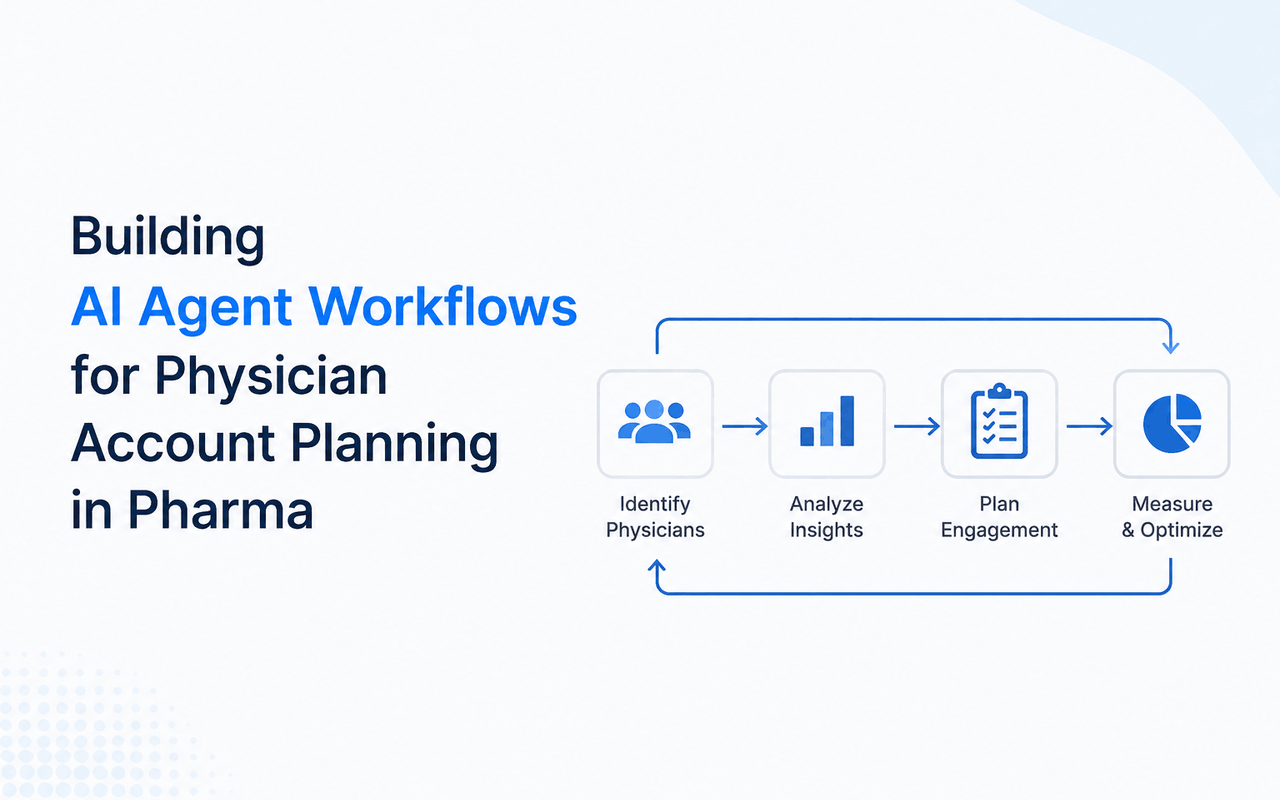
A commercial team spends a week each quarter sorting targets into tiers and writing engagement notes for the accounts that matter, and by about week six the document has hardened into a reference nobody can really trust.
By then the prescribing has shifted, a couple of the practices have been acquired, and a high-value physician has moved to a new system that sets her access and formulary rules from the top. None of that surfaces in the plan, which has no way of registering that the market it describes has already moved on.
That lag is where commercial teams lose ground, because a plan written in the past has to compete against a market that keeps changing underneath it. It helps to treat account planning as a working hypothesis about where opportunity sits and how to act on it, one that holds value only for as long as it tracks what providers are actually doing.
Keeping that hypothesis current by hand is the part that breaks down, since a manual refresh tends to run once a quarter while prescribing, and employment shifts week to week.
AI agents change the underlying economics of that upkeep, though only if they read from grounded provider data instead of reasoning from whatever they happen to half-remember. An agent working off a weak data layer will simply automate the same stale plan faster than a person could.
Why Traditional Physician Account Planning Leaves Commercial Teams Behind
Poor planning is rarely the real issue. These plans fall behind because the ground underneath them keeps shifting faster than any manual method can re-survey it.
The Account Moved While Your Plan Didn’t
By the start of 2026, 82% of US physicians were employed by hospitals or other corporate entities, and roughly 85,000 additional practices had been absorbed into hospital or corporate ownership since 2018.
For a pharma commercial team, that reshapes the thing you are planning against. The unit you target is less and less an independent physician with a durable address, and more and more a physician sitting inside a system whose access rules, formulary decisions, and referral flow are set above them.
When a practice gets acquired, several things tend to change at once that a tier list rarely captures. Rep access often gets set by the system rather than the physician, so a doctor who used to take meetings may now sit behind a corporate no-see policy, and at the same time the formulary they prescribe from can shift toward the acquirer’s preferred products.
The referral pattern usually reroutes as well. Plan around the individual alone and you miss the access and formulary shifts an affiliation-level view would catch.
Static Tiers Reward the Physicians You Already Know
Traditional tiering ranks physicians on last year’s volume and a rep’s familiarity, which makes it backward-looking by construction. The A-list fills up with names the team already calls on, while a physician who has just started managing a relevant patient population sits in tier C or drops off the list altogether, because nothing in the spreadsheet registered the change.
The same blind spot hides the specialist who recently absorbed a retiring colleague’s panel and the early adopter quietly shifting volume toward your mechanism of action, and by the time the next manual refresh surfaces any of them, a competitor’s rep has often already built the relationship.
So, the cost of running on stale tiers is that the budget keeps flowing toward saturated accounts and away from the ones where a first conversation would actually move share.
The Building Blocks of an AI Agent Workflow for Account Planning
An account-planning agent works best as a small set of parts with clearly divided jobs, rather than a single model asked to do everything, and most of the value comes from getting that division of labor right.
A Retrieval Layer That Grounds Every Decision in Real Data
The building block teams most often skip is the first one. Before an agent can rank a physician or draft a plan, it needs to look up what that physician actually does, and it needs to pull that from a source of record rather than generate it, which is precisely where most pilots stall.
The same tension shows up in Deloitte’s 2026 life sciences outlook survey, a general industry source, where 30% of executives named agentic AI as an influential trend while only 22% said they had scaled AI and just 9% reported significant returns.
A good part of that gap between interest and return traces back to data grounding, because an agent that invents an NPI or guesses at a procedure volume produces exactly the plan no compliance team will sign off on.
Connecting a retrieval layer through something like the Model Context Protocol, the open standard for wiring AI assistants to external data, gives the agent real records to work from instead.
An Agent That Reasons, and a Human Who Signs Off
The second block is the reasoning itself, and the third is the person who approves what it produces. Once the agent has the retrieved records, it weighs them against the goal of the plan and drafts account priorities and suggested next steps, all of which a human reviews before any of it reaches the field or the CRM.
Keeping that review in place makes the workflow usable in a regulated setting, and it also lets a team start small instead of betting a full territory on an untested pipeline.
Where a team starts can match how it already works. One option runs the agent as an assistant that answers planning questions inside the platform, while teams whose analysts already work in a general AI tool can connect the agent there instead.
A workflow that has proven repeatable can then be handed off almost entirely, building the plan and passing the output to connected systems without anyone opening the app.
The discipline holds across all three modes, since the agent proposes rather than decides, and a person signs off on its grounded output before any of it reaches a rep.
How AI Agents Prioritize Physicians Based on Commercial Signals
Prioritization is where an account-planning agent earns its keep, because it decides where finite rep time goes. The quality of that decision depends entirely on which signals the agent reads.
Billed Behavior Tells You More Than a Specialty Label
A physician’s specialty tells you what they were trained to do, while their claims show what they actually do this year, and those two diverge often enough that the gap between them tends to decide whether targeting lands.
A physician listed under a general specialty may run a high volume of a specific procedure that a specialty filter would never surface, and a nominally relevant specialist may show almost none of the activity your product depends on.
Medicare’s Physician and Other Practitioners data records utilization by individual NPI and procedure code, and the Part D Prescribers dataset ties each prescriber’s NPI to the prescriptions they wrote and the drug cost.
Diagnoses add a third layer, coded in ICD-10-CM, the US standard the CDC’s National Center for Health Statistics maintains, which lets the agent see which conditions a physician manages rather than only which procedures they bill.
Read together across payers, signals like these reflect what a physician actually does instead of how well known they happen to be, so an agent ranking on billed behavior can surface the doctor quietly running high procedure counts in your indication even when nobody on the team had flagged them, and demote the familiar name whose relevant volume has quietly dried up.
Ranking by Opportunity, Because the Value Is Never Evenly Spread
In Medicare Part B, the 50 highest-spending drugs accounted for 80% of Part B drug spending in 2019, a concentration that mirrors how a handful of physicians can carry most of the relevant volume in a therapeutic area.
When value concentrates that heavily, the order of the list matters as much as its contents, because a plan that treats the tenth-best account like the first squanders the scarcest resource a commercial team has, a rep’s time in front of a physician.
Connecting Provider Data to Create Smarter Account Plans
A ranked list is not yet a plan. To become one, the signals scattered across procedures, diagnoses, prescriptions, and affiliations have to come together into a single view of each account, and how that view gets assembled is where the choice of data layer matters most.
One NPI, Many Data Points, a Single Account View
Every US provider carries a National Provider Identifier in the CMS NPPES registry, and that identifier is the hook everything else hangs on.
When provider data is already anchored to the NPI in an external reference, the agent does not have to stitch fragments together or guess whether two records describe the same doctor, and can instead query the anchored record and read back a physician’s procedures, diagnoses, prescribing, and affiliations as one picture. That anchoring also marks a clean boundary.
The external layer supplies the grounded, NPI-anchored data while the agent composes the account plan on top of it, which leaves cleaning your internal CRM or building your master record outside the agent’s remit. Handing it that job anyway is how grounded workflows drift back into guesswork.
Planning Around the System That Sets the Rules
Because most physicians now practice inside a larger organization, an account plan that stops at the individual is incomplete.
Affiliation data lets the agent roll a physician up to their practice, group, or health system and plan at the level where the decisions actually get made, which matters because the buying signals often live at the organization rather than the individual.
A single high-volume prescriber may be worth less than a mid-volume physician whose health system steers a preferred product across its sites, and only an account view that carries affiliations can tell the two apart.
Payer mix belongs in that picture too. With more than half of eligible Medicare beneficiaries, 55%, now enrolled in Medicare Advantage plans, a view built on one payer’s data misses most of the market, which is why an all-payer foundation across commercial, Medicare, and Medicaid changes what the plan can see.
A physician who looks low-volume in fee-for-service Medicare may be busy under the commercial and Medicare Advantage claims that a single-payer view never captured.
With this layer in place, the plan reflects how the account actually operates today instead of mirroring an org chart that is two years out of date.
Turning AI Insights into Actionable Field Sales Strategies
A plan that never reaches a rep in a usable form is just analysis. The last stretch of the workflow turns ranked accounts and account-level context into something a field team can act on this week.
From Ranked Accounts to a Rep’s Monday Morning
The useful output for a rep is a short, ordered set of accounts that each carry the reason they made the list, rather than a raw data export.
An agent can hand over a shortlist of accounts worth a visit, tagging each with the procedure or diagnosis signal that put it there and a first-call angle grounded in what the physician actually does.
A rep who walks in already knowing that a physician runs a high volume of a relevant procedure, and which adjacent products they already use, opens a very different conversation from one working off a name and a specialty.
When the ranked plan pushes into the CRM and outreach tools the team already uses, the rep starts the week knowing where to go and why, rather than reverse-engineering a target list from a stale export. HubSpot users get that through a native integration, and teams on other systems can move the same output by export or the open API.
Designing Territories Around Where the Opportunity Actually Sits
Territory design is account planning at scale, and the same grounded signals feed it. Rather than drawing boundaries by ZIP code and hoping the volume follows, a team can size the real opportunity in a region first and shape territories around it.
Alpha Sophia’s market access and opportunity sizing tools let a team quantify procedure volume and addressable audience before a single line is drawn, and its territory tools build and redraw those boundaries by driving distance and opportunity rather than raw area.
A rep covering a territory designed around indicated-patient density spends less time driving between low-value stops and more time in front of physicians who fit the product.
How Alpha Sophia Powers AI-Driven Physician Account Planning
Everything above depends on one thing being true, that the agent can reach grounded provider data on demand. That is the specific role Alpha Sophia plays in the workflow.
Grounded Provider Data Your Agent Can Query Directly
Alpha Sophia is the external, claims-grounded reference layer an agent reads from, covering all-payer US medical claims across 4M+ providers. It does not act as the reasoning engine, and it does not build your golden record. It supplies the verified data the agent reasons over, so the counts, NPIs, and volumes in a plan get looked up rather than invented.
That distinction separates a plan a compliance team can defend from a confident guess, because the agent reports what the claims record shows instead of producing a plausible-sounding physician who never existed.
Requests also stay scoped to a team’s own access and entitlements, so the approach holds up for regulated life-science procurement. Teams reach that data three ways, through an in-app assistant that answers planning questions inside the platform, through their own AI tool connected over the Model Context Protocol, or through a fully autonomous agent that runs a repeatable plan end to end and hands the result to connected systems.
Developers who want the data inside their own stack can build against the Alpha Sophia Provider API.
The Filters That Turn a Question Into an Account Plan
The planning signals live in the platform’s filters. A team can segment providers by procedure codes (CPT and HCPCS), diagnosis (ICD-10 and CCSR categories), taxonomy, and affiliation, then compare those groups over time with cohort analysis to see how a target population is shifting rather than reading a single frozen snapshot.
That time dimension matters for account planning, because a physician whose relevant volume grew 40% over the last year is a different priority from one holding flat, even when today’s counts look alike.
Provider profiles then pull a single physician’s billed behavior, prescribing, and organizational ties into one view an agent can hand to a rep.
Stacked together, those pieces let an agent move from a broad question to a finished plan in one pass. It sizes the audience and ranks the accounts, then attaches the evidence behind every pick so a reviewer can check the logic.
Because the same data grounds both the in-app assistant and any connected AI tool, a plan built by your own agent rests on records the platform already stands behind, which spares a compliance team the work of re-checking each one by hand.
Conclusion
The change here is smaller than a wholesale move from human planning to machine planning, and more useful for it.
A plan that used to go stale the moment it was finished can now be re-checked against grounded data as often as the market shifts, which for a pharma commercial team turns into a few concrete gains.
Reps walk into accounts chosen on real billed behavior rather than last year’s tiers, and territories begin to track where patients actually are instead of where the ZIP lines happen to fall. The plan also keeps pace as the market consolidates around it, rather than lagging a full cycle behind.
Because the agent has to read grounded data before it answers, continuous planning becomes both fast enough to be worth doing and reliable enough to act on, which is most of what account planning was ever meant to give a commercial team, a clear read on where the next call should go.
FAQs
What is physician account planning in pharma?
Physician account planning is how a pharma commercial team decides which providers and provider organizations to prioritize, sizes the opportunity at each one, and sets an approach for engaging them. Traditionally it produced a static tier list refreshed once a quarter. Grounded in live data, it becomes a continuously updated view of where commercial opportunity actually sits.
How do AI agents improve physician account planning?
AI agents keep the plan current by retrieving live provider data instead of relying on a periodic manual refresh. They rank accounts on billed behavior, compose account-level context, and draft next steps for a human to approve. The result is a plan that reflects this quarter’s market rather than last quarter’s assumptions.
What data is needed for AI-driven account planning?
The core inputs are claims-based signals tied to each provider’s NPI, including procedure volumes (CPT and HCPCS), diagnoses (ICD-10 and CCSR), prescribing, and organizational affiliations. All-payer coverage across commercial, Medicare, and Medicaid matters, since a single payer’s data shows only part of a physician’s activity. Grounding those inputs in a verified external source keeps the agent’s output reliable.
How can AI agents help prioritize HCP accounts?
Agents rank providers by the commercial signals that predict opportunity, such as procedure volume and diagnosis density in a given indication, rather than by specialty label or rep familiarity. Because value in pharma concentrates in a small share of providers, that ranking directs finite field time toward the accounts most likely to move share. A human reviews the ranked list before it drives any outreach.
Can AI agents support field sales planning?
Yes. An agent can turn ranked accounts into a rep-ready plan, with each account tagged by the signal that put it on the list and a grounded first-call angle. The same data can shape territory design around opportunity and driving distance, so reps spend more time in front of relevant physicians.
How does Alpha Sophia enable AI-powered physician account planning?
Alpha Sophia is the external, claims-grounded data layer an agent queries, covering all-payer US medical claims across 4M+ providers. It supplies verified, NPI-anchored provider data rather than acting as the reasoning engine or building a team’s internal records. Teams can reach it through the in-app assistant, connect their own AI tool over the Model Context Protocol, or run fully autonomous workflows.
