How Healthcare APIs Power the Next Generation of AI Agents
On this page
Life sciences teams are not waiting to find out whether AI agents work. In Menlo Ventures’ 2025 healthcare survey, 22% of healthcare organizations had implemented domain-specific AI tools, a sevenfold jump over the prior year, and 66% of pharma and biotech companies were building or fine-tuning their own models.
That last number is the tell.
Building or fine-tuning your own model is a bet that a smarter, more specialized model is the missing piece and the bet aims at the wrong component.
Ask a general model which cardiologists in a given state perform the most transcatheter valve replacements, and it will answer with confidence, complete with names and volumes it has largely invented.
Fluency is cheap. The data underneath it is the hard part, and an agent gets that data through an API rather than from its own training.
That single design choice, retrieval instead of recall, decides whether a commercial team can deploy the agent or is left with a demo that impresses in a meeting and fails in the field.
Why Healthcare AI Agents Need More Than a Language Model
A language model is a prediction engine. It produces the most statistically likely next words given everything it absorbed during training. That makes it fluent on anything that appeared often in text like how a procedure works, what a diagnosis means, the textbook version of a drug’s dosing. It makes the model unreliable the moment the answer never appeared in that text at all.
The failure there is an absence in the data, no amount of added intelligence recovers a fact that was never learned.
A commercial question like which surgeons perform a procedure at volume in a metro area has exactly one correct set of answers, and that set lives in billing records the model has never seen.
Three gaps show up the moment a commercial team runs real work through an agent.
A Model Trained on the Past Cannot Answer Questions About the Present
A model’s knowledge freezes at the end of its training run. Provider reality does not. Physicians change practices, retire, add procedures, and shift billing patterns constantly, which is why provider records go stale so fast.
When federal reviewers audited Medicare Advantage directories, nearly half of the listed provider locations, 48.74%, carried at least one inaccuracy.
A separate analysis of five national insurers found address and specialty details that disagreed for more than 80% of physicians across directories. Those gaps persist even under federal rules meant to close them, with enforcement of directory-accuracy requirements described as minimal and errors surviving for months.
No model, however large, can recall a fact that was wrong or missing when it trained, and it certainly cannot know that a physician moved practices last month. The current answer has to be fetched at the moment of the question, from a source that maintains it.
Fluent and Wrong Costs More Than Slow
In a regulated commercial setting, a confident fabrication does more damage than a slow answer. Researchers testing six leading models on clinical vignettes found that when a single false detail was planted in a prompt, the models repeated or expanded on it in as many as 83% of cases.
A study of GPT-5 on an orthopaedic board examination found fabricated or misrepresented references in roughly one in three answers, even when the final answer was correct.
A systematic review of healthcare AI catalogued the same failure modes across dozens of studies, from invented citations to inaccurate summaries of patient context. Translate that into commercial work and the fabrication becomes a provider who does not exist, an NPI that belongs to someone else, or a procedure volume with no basis in any claim.
Grounding Separates a Demo From a Deployment
A fabricated provider slips right past the room where the agent gets sold. In a demo, a fluent, specific answer is the whole show, and no one drives to the address to check it, in the field, a rep does, and the invented NPI becomes a wasted visit and a blown quarter. The difference between those two rooms is grounding.
Impressive demos are easy. Production systems are not, and the gap between them usually comes down to data.
Gartner expects more than 40% of agentic AI projects to be scrapped by the end of 2027, pointing to escalating cost, unclear value, and weak risk controls. That framing from the research and advisory firm matters for healthcare, where an agent that cannot show where its answer came from will never clear procurement or compliance.
Grounding means every answer traces back to a specific record the team can inspect, with a trail showing what was queried and what came back.
A compliance reviewer can accept a system that cites its source. They cannot sign off on one that produces numbers with no lineage. An agent grounded in an authoritative data source, reached through an API, moves from a slide into a workflow reps actually use.
What Healthcare APIs Provide That AI Agents Cannot Generate Alone
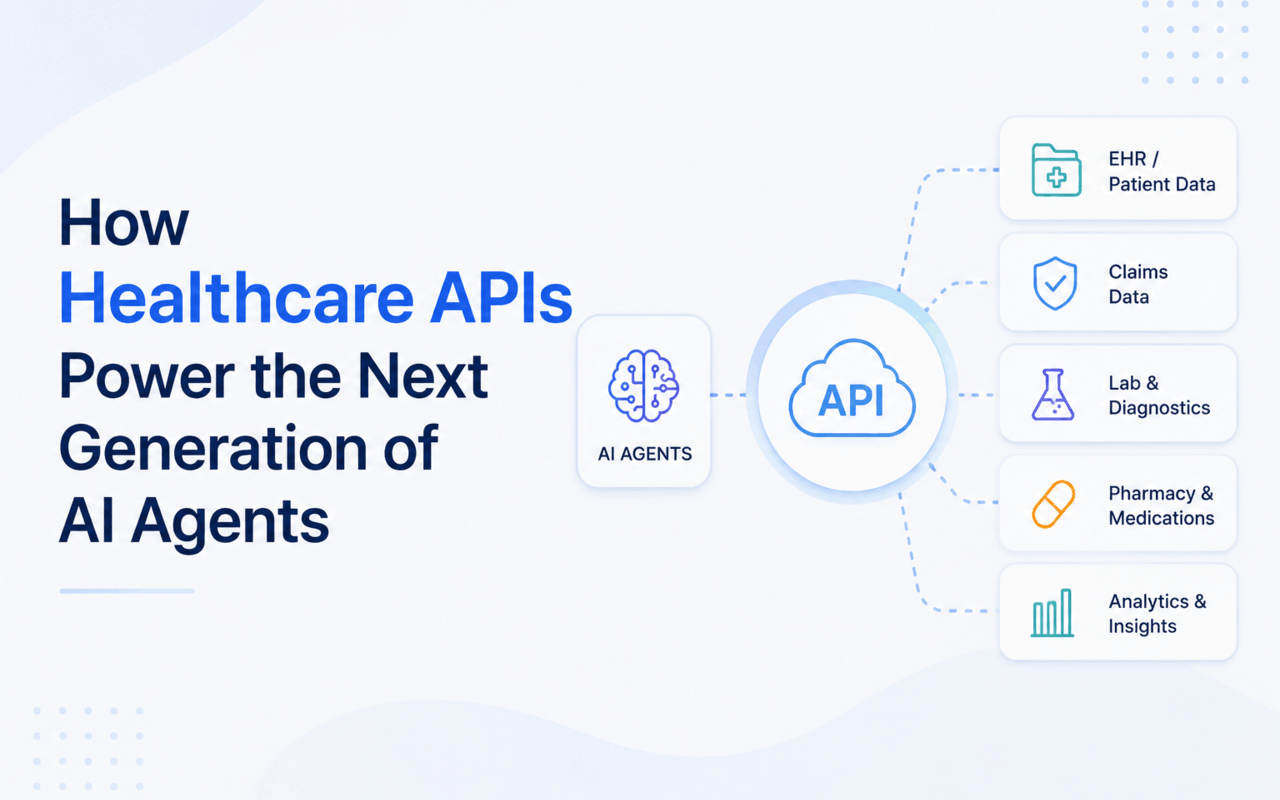
An API is a defined way for one system to request specific data from another and get back a structured answer. For healthcare commercial work, the data on the other side of that request is the whole point. It records what providers actually do, drawn from claims and reference files that no model carries in its weights.
A model can reason about that data once you hand it over. It cannot conjure it, because the underlying facts came from real clinical and billing activity rather than from language.
Real Provider Records the Agent Can Point To
Every provider in the United States has a National Provider Identifier, maintained in the federal NPPES registry.
A claims-grounded API keys its records to that identifier, so when an agent returns a physician, it returns a real, addressable entity with a verifiable ID rather than a plausible-sounding name.
The agent reports what the database holds instead of composing a person who fits the description. That distinction matters most when a list feeds an outreach campaign or a territory plan, where a single invented NPI sends a rep to an address that does not exist.
Procedure and Diagnosis Volumes the Model Never Saw
Claims data records what was billed, by whom, and how often. That produces quantitative signals a model has no way to generate, such as how many total knee replacements a specific surgeon performed, which physicians treat a given diagnosis at volume, and where prescribing concentrates by geography.
These are counts pulled from billing records, expressed through standardized code sets like CPT and HCPCS for procedures and ICD-10 for diagnoses.
Consider a device team selling into structural heart procedures. A specialty label groups thousands of cardiologists together, most of whom never touch the relevant intervention.
The billing record separates the ones who perform it in volume from the rest, and it does so with counts a rep can rank. A model can describe what a CPT code is. Only the data can tell you who billed it and how many times.
A Current View, Because Provider Reality Keeps Moving
A maintained API refreshes as new claims and reference data arrive, so the answer an agent gets today reflects the market as it stands now, not as it looked whenever a model finished training. That currency is exactly what a frozen model cannot offer.
For a launch team sizing an audience or a rep planning next week’s calls, a six-month-old snapshot and a current one point to different doctors.
The rep who works from the stale list burns a visit on a physician who left the practice, while the current list routes that same hour to someone who actually bills the procedure.
How APIs Connect AI Agents to Real-Time Commercial Intelligence
The connection between an agent and a data API follows a simple loop, even though the underlying systems are sophisticated. The agent interprets the user’s question, calls the API for the specific data it needs, and composes an answer from what comes back.
The retrieved data does the factual work, while the model handles language and structure. This is the same foundation behind agentic HCP engagement built on claims data.
Retrieval Replaces Recall
When an agent answers from retrieved data instead of its own memory, its factual reliability changes sharply. In a controlled radiology study, adding retrieval to a local model cut its hallucination rate from 8% to zero on the tested consultations.
A public health framework built on the same principle reduced hallucination rates by more than 40% against standard baselines.
The mechanism is straightforward. The model stops guessing at facts and starts reporting retrieved ones, which also means its knowledge updates the moment the source does, with no retraining required.
From Question to Structured Answer in One Call
A commercial user does not write code or memorize filters. They ask, in plain language, for the high-volume injectors treating a condition in the Southeast, and the agent maps those terms to the right specialty, procedure, diagnosis, and geography in the underlying data.
The API returns a structured result, a ranked and filtered list of real providers, which the agent presents in the conversation. Each provider in that result carries the attributes the query implied, the procedure counts, the location, the affiliation, so the team acts without a second lookup.
If the first cut runs too broad, the user narrows it in the same thread, and the agent reruns the query against the live data rather than reworking a static file.
Work that once took an analyst and a data request now happens inside a single exchange.
The Same Data Every Time, Across Every Surface
Because every answer comes from the same governed source, a question asked inside a chat window and the same question asked by an autonomous workflow return the same numbers. That consistency lets a team trust the output enough to act on it.
There is no separate export drifting out of date, and no divergence between what one rep sees and what another does.
The Role of MCP Servers in Secure Healthcare AI Integrations
An API defines what data an agent can request. The Model Context Protocol defines how the agent and the data source talk to each other in the first place.
MCP is an open standard for connecting AI assistants to external tools and data, and for healthcare it carries a specific advantage around security and governance beyond simple convenience.
A Standard Connection Instead of a Custom Build
A traditional integration is bespoke code written for one pair of systems and maintained as either side changes.
An MCP server publishes its capabilities in a standard form that any compatible agent can read and call, so a commercial team connects the AI tools it already uses without commissioning a custom connector for each one. Fewer custom integrations also means a smaller surface area to secure and audit.
Requests Scoped to Who Is Asking
In a regulated industry, access control is not optional. A well-built healthcare MCP connection authenticates every request and scopes it to the asking organization’s entitlements, so an agent sees exactly what that customer is licensed to see and nothing more.
Licensing terms differ by customer, and a scoped connection enforces those terms automatically instead of trusting each user to stay inside them.
The same governance that already applies inside the platform travels with the connection, keeping it viable for enterprise procurement and privacy review.
Data That Informs the Agent Without Training the Model
There is an important privacy distinction between data an agent retrieves at the moment of a query and data absorbed into a model’s weights.
With an MCP connection to a commercial intelligence source, the data informs a single answer and leaves the exchange afterward. Nothing sensitive gets baked into a model or crosses the governed boundary to be memorized, which keeps proprietary commercial data and licensed data under control.
For a commercial team, that protects both the vendor’s licensed dataset and the team’s own strategy, since the questions it asks never become training signal for someone else’s model.
For a commercial team, that protects both the vendor’s licensed dataset and the team’s own strategy, since the questions it asks never become training signal for someone else’s model.
In life sciences that second protection carries real weight. The questions a brand team asks in the months before a launch are the launch plan in miniature, which indication it is sizing, which prescriber segment it is prioritizing, which markets it is sequencing first.
Put those to a model that learns from its inputs and the strategy becomes a latent signal a competitor’s near-identical query could surface later.
Retrieval that leaves nothing behind keeps pre-launch targeting, competitive positioning, and the shape of a portfolio’s commercial plan out of any model’s memory. It also honors the terms the claims data is licensed under, which typically bar that data from being absorbed into a third party’s model, so one boundary protects the vendor’s data rights and the customer’s strategy at the same time.
Real-World Use Cases: Pharma, MedTech, and Diagnostics Teams
The value of a grounded agent shows up differently across life sciences, though the pattern holds. A commercial user asks a question in plain language, and the agent answers from claims-grounded data instead of guesswork.
Pharma Commercial Teams Sizing a Launch Audience From a Chat
A brand team preparing a launch needs to know how large its addressable prescriber base is before committing a budget.
Rather than briefing an analyst and waiting days, a marketer asks the agent how many rheumatologists in a region prescribe biologics and treat the relevant diagnosis at volume.
The agent returns a count and a list drawn from prescribing and diagnosis data, and the team refines the definition in seconds rather than in another round of requests.
Because the count updates with the underlying data, the number the team plans against reflects current prescribing instead of a figure that was accurate two refreshes ago. The same session can hand that audience to the outreach tools the team already runs.
MedTech Reps Targeting the Surgeons Who Actually Do the Procedure
A device rep’s time is the scarcest resource in the commercial model, and walking into every orthopaedic practice in a territory wastes most of it.
With a grounded agent, the rep asks for the highest-volume surgeons performing a specific procedure within driving distance of a city and gets a ranked shortlist keyed to real procedure counts.
The conversation starts from evidence that the surgeon does the relevant work, a far stronger opening than a cold list pulled from a specialty label. The rep spends the week in front of surgeons who already perform the procedure, which is the single biggest lever on a field team’s return.
Diagnostics and Lab Teams Finding Where the Volume Actually Sits
Independent labs and diagnostic manufacturers sell into a thin, specific market where a general provider list is close to useless.
An agent grounded in claims data lets a lab filter for the exact CPT and HCPCS codes that match its testing menu, then cross-reference diagnosis patterns to find the clinics generating that volume.
The output is a segmented set of high-probability accounts ranked by billing intensity, which tells a rep where the diagnostic volume actually justifies the visit.
In a thin market, that difference decides whether a small sales team hits its number or spends a quarter on clinics that were never going to convert.
How Alpha Sophia’s Healthcare API Powers AI Agents with Trusted Commercial Data
Everything to this point describes what a healthcare API has to do for an agent. Alpha Sophia is built to be that data layer for commercial teams in life sciences, reached through the AI tools those teams already work in.
Three Ways to Put Claims-Grounded Data Behind Your Agent
Alpha Sophia exposes its agent-native access through three modes, so a team picks the one that fits how it already operates.
The in-app Assistant answers plain-language questions inside the platform and lets a user act on the results without leaving it. A direct connection over MCP brings the same data into Claude, ChatGPT, or Cursor, so the agent a team already uses answers healthcare questions with grounded data.
Fully autonomous workflows let an agent run an end-to-end play, sizing a market and building a target list, then handing the output to the other tools a team connects.
Every Answer Anchored to a Real NPI
Each response draws from a national, all-payor view of US medical claims across 4 million or more providers, spanning commercial, Medicare, and Medicaid activity.
That foundation carries procedures in CPT and HCPCS, diagnoses in ICD-10 and CCSR, specialty and taxonomy, affiliations and sites of care, prescriptions, open payments, and education, publication, and clinical trial records.
The agent looks these up and reports them. It does not invent providers, NPIs, or volumes, because every answer resolves to an entry that already exists in the data.
Alpha Sophia Supplies the Data While Your Systems Own the Workflow
Alpha Sophia is the external reference and enrichment layer an agent grounds on. It does not reach into a customer’s CRM to merge or deduplicate records, and the logic that loads, matches, and reconciles data inside a company’s own stack stays with that company’s tools.
The platform supplies verifiable commercial intelligence through its API and MCP connection, and the customer’s systems decide what to do with it. That boundary keeps the data trustworthy and the customer in control of its own records.
Conclusion
Models are converging, and any of them can produce fluent healthcare language. What separates an agent that gets deployed from one that gets abandoned is whether it can reach real, current, governed data at the moment it answers.
A healthcare API, exposed securely through a standard like MCP, is the component that supplies that data. The teams that win this shift will treat the data layer as the product decision it actually is, not an afterthought bolted on once the agent already talks fluently.
Teams that connect their agents to a claims-grounded source move from question to qualified target list in a single exchange. The ones leaning on the model alone keep getting confident answers no one can act on.
Frequently Asked Questions
What is a healthcare API?
A healthcare API is a defined interface that lets one software system request specific healthcare data from another and receive a structured response. In a commercial context, that data often includes provider records, procedure and diagnosis volumes, affiliations, and prescribing activity keyed to standardized identifiers and code sets.
Why do AI agents need healthcare APIs?
A language model generates plausible text from its training data, which means it can fabricate provider names, identifiers, and volumes that sound correct but are not. A healthcare API lets the agent retrieve real, current records at the moment of the query, so its answers reflect actual claims and reference data.
How does an MCP server work with healthcare AI agents?
An MCP server publishes a data source’s capabilities in a standard form that any compatible AI agent can discover and call, without a custom integration for each pairing. When a question needs external data, the agent calls the relevant tool on the server and receives a structured result scoped to the organization’s access. Because the protocol is standardized and authenticated, the same server works across different AI tools while keeping requests governed.
What healthcare data can AI agents access through APIs?
It depends on what the underlying source exposes. A commercial intelligence API can give agents access to provider records across millions of NPIs, procedure data in CPT and HCPCS, diagnosis data in ICD-10 and CCSR, specialty and taxonomy, affiliations and sites of care, prescriptions, open payments, and publication and clinical trial activity. The agent retrieves these records rather than generating them, so the values it reports are real.
How do healthcare APIs improve AI agent accuracy?
By grounding answers in retrieved data instead of the model’s memory, an API removes the main cause of fabricated output. Controlled healthcare studies have shown retrieval sharply lowering or eliminating hallucination compared with a model working alone. The API also keeps the agent current, since its answers update the moment the underlying data does, with no model retraining required.
How does Alpha Sophia’s healthcare API support commercial AI agents?
Alpha Sophia connects its claims-grounded database of US healthcare providers to AI agents through an API and an MCP connection, with in-app, bring-your-own-AI, and fully autonomous options. Every answer is retrieved from all-payor claims data across millions or more providers and anchored to a real NPI, so agents report verified records rather than guesses. Alpha Sophia supplies the reference data while the customer’s own systems own any merge or workflow logic.
