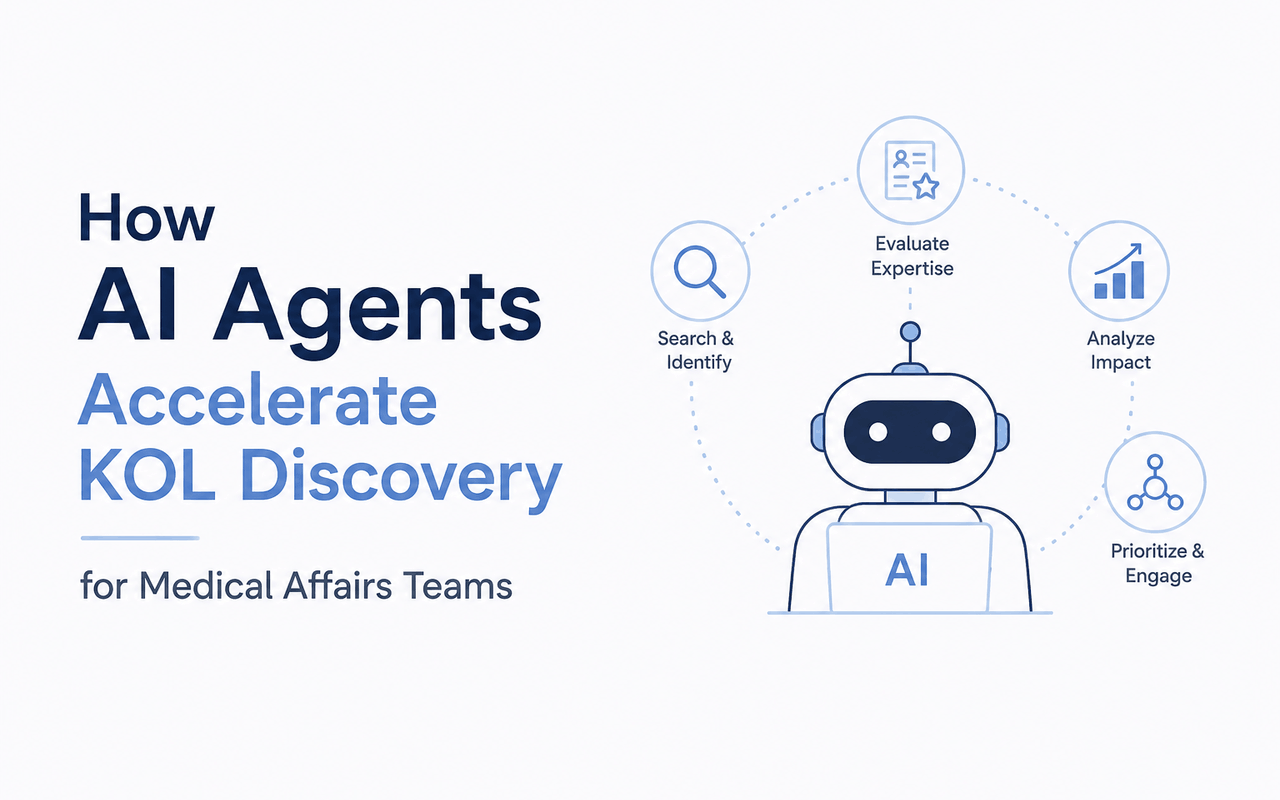
How AI Agents Accelerate KOL Discovery for Medical Affairs Teams
On this page
Every therapeutic area has a short list of names that surface in every internal conversation. The people who reliably show up are rarely the problem.
The problem is the clinician gaining influence right now who is not on anyone’s list yet, and the name still sitting on last year’s plan who changed institutions or stopped treating the relevant patients months ago.
Medical affairs is expected to know the difference, and to know it faster than a manual review can keep up. Medical affairs is also held to a standard that sales is not. Its engagements are non-promotional, so any decision about who to engage has to hold up to scientific and compliance scrutiny.
As medical affairs has grown from an information desk into a strategic scientific function, that expectation has sharpened rather than eased. AI agents are starting to close the gap, though only when what they produce can be traced back to real evidence.
Why KOL Discovery Is Becoming More Complex for Medical Affairs Teams
The signals that mark someone out are scattered across more sources than any team can watch, and they move faster than a quarterly refresh can capture.
The Expert Universe Has Outgrown Manual Tracking
Start with how many clinicians there are to consider. The United States has more than 1.08 million actively licensed physicians, trained across 2,392 medical schools in 171 countries.
Then add the literature they generate. Roughly a million new records reach the biomedical databases every year, which is over two citations a minute.
You cannot read that by hand. A target list built from whatever you happened to catch goes stale before it is finished, and the gap between your list and reality stays hidden until an engagement lands with someone who left the field last spring.
Influence No Longer Lives in One Place
Influence used to sit in predictable places. Journal articles, trial leadership, a named chair at an academic center. Those still count for a great deal.
What is new is a second layer of it running through social platforms, where digital opinion leaders, clinicians with real followings who share evidence-based information and push back on misinformation, can shift practice before a paper clears review.
A team watching only citation counts never sees these people coming. Follower counts on their own mislead just as badly, since reach and credibility come apart quickly online, where volume tends to reward the loud over the careful.
The real task is holding both kinds of signal in view and deciding how much each is worth.
The Identity Problem Undermines the Whole Exercise
Even with the right signals in hand, pinning them to the right person is where things quietly go wrong.
More than 55% of author names in PubMed are ambiguous, shared by different individual researchers. The productive J. Smith in your oncology search might be three people, or one person filed under two spellings.
Attribute a body of work to the wrong clinician and the mistake travels into your tiering, your outreach, your advisory board roster, and nobody notices until it turns up in a meeting. This is the problem sitting underneath all the others, and the one manual methods are least equipped to catch.
How AI Agents Identify Relevant KOLs Using Publications, Clinical Activity, and Expertise
An agent helps by doing the retrieval and cross-referencing you cannot do at your scale, then handing back something structured enough to act on.
How much it helps depends on the data it can reach, and on how tightly that data ties back to real people.
Reading the Signals Together Instead of One at a Time
Run a conventional search and publications, trials, and practice patterns come back as three separate queries in three separate tools, which you then stitch together in your head. An agent pulls them in one pass and reconciles them against the criteria you set.
Ask for clinicians active in a specific heart-failure subtype, and it can line up who is publishing on it, who is running trials in it, and who is actually treating those patients. That last signal, clinical activity read from claims, is the one most KOL work leaves out, and often the most telling, because it shows what a clinician does rather than only what they write.
Bringing these together is the substance of modern KOL identification. Reconciling them is where it gets hard.
The same person can appear under a maiden name on early papers, initials on a trial registry, and a group affiliation in claims, and an agent that cannot connect those threads hands you three thin profiles in place of one real one.
Anchoring Every Signal to a Verified Provider
Retrieval only helps if the results point at the right clinician. When an agent works from a dataset keyed to National Provider Identifiers, every publication, trial, and procedure attaches to one verified person rather than a name that three people share.
That is what turns a loose pile of activity into a profile a medical reviewer can stand behind, and it answers the name-ambiguity problem that corrupts hand-built lists head on.
Returning Structure
What you can use is a record. Specialty, the procedures and diagnoses that show up in their practice, what they have published, which trials they have run, where they work.
Laid out that way, you scan and compare instead of taking a summary on trust. A colleague can check the criteria and the source records without reconstructing the agent’s reasoning from prose, which is what you want when someone in compliance asks why a name made the list.
Accelerating Literature Review and Evidence Gathering for KOL Evaluation
Deciding whether a candidate belongs on an advisory board or a publication plan means reading their work, and that reading is where the hours go. The evidence base is enormous and, increasingly, unreliable, which raises the cost of doing the review badly.
The Manual Review Burden Is Real and Measured
The labor here has been measured, so it is not a vague complaint. One analysis priced a single systematic literature review at about $141,000 and 1.72 scientist-years of effort.
Most teams will not run a full systematic review to vet a KOL, but the underlying work of finding relevant papers, screening them, and pulling out what matters scales the same way. Hand the first two stages to an agent and the timeline compresses.
In a JAMA Network Open study, a language model screening citations held acceptable sensitivity while cutting the screening time for 100 studies well below the manual pace.
Screening is only half of it. Once the relevant papers are in front of you, someone still has to read them and extract the clinician’s positions, how strong their evidence is, and what they have disclosed. An agent can return that as a structured dossier, the thing a liaison would otherwise lose most of a day assembling.
The Literature Itself Has an Integrity Problem
None of that speed matters if the evidence underneath is compromised, and a rising share of it is. More than 10,000 papers were retracted in 2023, a record, and the retraction rate has more than tripled over the past decade.
Judging a clinician on raw publication count was always a blunt instrument. Now it carries real risk, because the count can include work that has since been pulled or flagged.
An agent that surfaces the whole record, corrections and retractions included, gives you the context a citation tally hides.
Grounding Is the Difference Between Help and Liability
Generative AI brings a specific failure that medical affairs cannot live with. When researchers had ChatGPT write medical content, 47% of its references were fabricated and another 46% were real but inaccurate, leaving 7% that were both real and correct.
A later study found close to two-thirds of a model’s citations fabricated or flawed, with the fabrication worst on specialized, low-visibility topics, which is exactly where rare-disease and niche-indication teams work.
An agent that invents its evidence sets you back further than having no agent at all. The fix is grounding, holding the model to sources it has to retrieve so it reports what is actually there instead of composing plausible citations from memory.
How AI Agents Help Prioritize and Monitor Emerging KOLs
Discovery and evaluation give you a list. A list will not tell you where to spend a field team that cannot be everywhere.
And the clinicians who will shape guidelines two years out are usually not the ones already at the top of a legacy ranking, which is where continuous, agent-driven monitoring changes what you can attempt.
Ranking by Trajectory, Not Tenure
Established influence tells you about the past. A clinician with thirty years of citations is easy to find and, more often than not, already crowded with industry attention.
An agent can rank on the slope instead, publications picking up, new trial roles, procedure volume climbing in a relevant area, which points you at the person on the way up rather than the one who peaked a decade ago.
Rank on its own is not enough. The agent should also score candidates against what your program actually needs, its therapeutic focus, its patient population, its geography, and sort them into tiers, so a small team can work the list in an order it can defend.
Watching the Field Continuously
A hand-built map is a snapshot, and it starts decaying the day it is finished. An agent can re-run your criteria on a schedule and tell you what changed, whether that is a new investigator on a competitor’s trial, a clinician whose relevant volume jumped, or a voice rising in a subspecialty.
Influence mapping becomes something running quietly in the background. For a lean field medical team that shift is bigger than it sounds.
You hear about the competitor’s new investigator or the fast-rising subspecialist within weeks, not at the next planning cycle, by which point the chance to engage early has usually passed.
Bringing Digital Influence Into the Same View
Emerging influence tends to show up online before it reaches a journal. A Medical Affairs Professional Society roundtable, an industry discussion of digital opinion leaders and influence mapping, made the point that teams now have to weigh social and peer-to-peer activity next to traditional credentials.
An agent can fold that activity in as one input among several, so a rising digital voice gets checked against clinical and research signals rather than tracked on a separate, unverified list.
In practice that keeps a physician with a large, engaged following from being over-weighted on reach alone, and it stops a quieter clinician doing serious work from slipping past you because they rarely post.
Best Practices for Integrating AI Agents into Medical Affairs Workflows
Putting agents to work in a function that is closely watched is mostly a governance question, not a technical one. The practices that make AI safe in medical affairs are the ones that keep the work traceable and keep a person in charge of the judgment.
Insist on Provenance for Every Output
You have to be able to explain why you engaged someone if the question ever comes up. So every output an agent hands you needs to carry its sources, which record backs which claim, close enough to check by hand.
Grounding does more than keep the answer accurate. It makes the answer defensible, and in a non-promotional function your legal and compliance partners care about that as much as you do.
An answer you cannot trace is one you cannot use, however right it happens to be.
Keep the Human in the Decision
Agents are good at fetching, ranking, and summarizing. They are not the ones who decide who your company engages, and handing them that call invites both compliance trouble and plain scientific error.
The arrangement that works gives the agent the legwork of building profiles and dossiers, and leaves the judgment with the person who understands the therapeutic and regulatory ground.
What you get is a reviewer starting from a sourced draft instead of an empty search box.
Standardize the Criteria Before You Automate
An agent applies whatever rules you give it, every time, which only helps if the rules are sound.
Teams that write down what makes a clinician qualify for a given program, and how the signals are weighted, get output they can compare and trust. Teams that automate a fuzzy brief get fast, consistent noise.
Spelling out the criteria is the dull step that decides whether the medical affairs insights coming back are worth acting on.
Access belongs in the same conversation, because these queries touch sensitive provider data, and the agent’s reach should stay inside the team’s existing entitlements so automation does not widen who can see what.
How Alpha Sophia Supports AI-Powered KOL Discovery
Everything above comes back to one dependency. An agent is only as good as the data it retrieves from, and medical affairs needs that data verified, structured, and traceable to the source.
Alpha Sophia is built to be that layer, rather than the agent on top of it.
The Data Layer Agents Retrieve From
Alpha Sophia is now agent-native. You can query it through an in-app assistant, connect your own tools such as Claude or ChatGPT, or run autonomous workflows, all against the same governed dataset.
The platform supplies the trusted healthcare data, and the reasoning and orchestration stay in whatever AI layer you already work in.
For a medical affairs team, that means the answers an agent gives you about clinicians come out of real records rather than the model’s best guess. The split matters for how you think about the tool.
Alpha Sophia is the external reference and enrichment layer the agent reads from. It does not run inside your systems or take over the records those systems own, which keeps its role clear and its data something you can verify independently.
Three KOL Signals Keyed to a Verified NPI
The data spans all-payor US medical claims across more than 4 million providers, with procedures, diagnoses, specialty, affiliations, publications, and clinical trial activity layered on top.
For KOL work, that spread is the point. An agent can assemble a candidate’s real-world clinical activity, their research, and their trial involvement, with every signal tied to a verified National Provider Identifier.
That anchoring settles the name-ambiguity problem hand-built lists never could, and it is the foundation that KOL AI and influence mapping are built on. What that buys a reviewer is a single, coherent profile instead of three half-matched ones drawn from tools that never agreed on who the person was.
Grounded Answers a Medical Reviewer Can Defend
Because the agent pulls from the platform instead of generating references, the fabrication risk that makes generative AI dangerous for evidence work stays contained.
The providers, volumes, and affiliations it reports are real and current, and every answer traces back to a source.
For a team whose engagements have to survive scientific and compliance review, that traceability is the precondition for adopting agent-assisted discovery at all.
Conclusion
KOL discovery has outrun the methods most medical affairs teams still lean on. There are more experts to track, their influence is spread across more places, the literature behind any judgment is shakier, and the identity problem underneath quietly poisons manual lists.
Agents ease the pressure by retrieving and reconciling signals at a scale no person reaches, then returning sourced profiles a reviewer can actually work with.
That holds only when the intelligence is grounded in verified data and every answer carries its provenance, since a non-promotional team cannot engage on evidence it cannot defend.
Pair a capable agent with a governed, NPI-anchored data layer and discovery gets faster without giving up the auditability the work demands. Skip the grounding and the only thing you have made faster is the wrong engagement.
FAQs
What is AI-powered KOL discovery?
It is the use of AI agents to find and evaluate key opinion leaders by retrieving and cross-referencing signals such as publications, clinical trial roles, and real-world clinical activity. Instead of running separate manual searches, the agent assembles structured candidate profiles a medical affairs reviewer can verify and act on.
How do AI agents identify relevant key opinion leaders?
Agents combine several signals in one pass, matching authorship, trial involvement, and treatment activity against criteria the team defines. When the data is keyed to verified provider identifiers, each signal attaches to a specific clinician rather than an ambiguous name.
How can AI accelerate medical affairs research?
AI agents compress the slowest stages of evidence work, finding relevant literature and screening it, which studies show can sharply reduce screening time against manual methods. That lets medical affairs professionals start from a sourced draft rather than a blank search. The judgment about who to engage stays with the human reviewer.
What data sources do AI agents use for KOL identification?
Common sources include biomedical publications, clinical trial registries, and real-world clinical activity captured in claims data, along with provider specialty, affiliations, and geography. The more reliable setups anchor these sources to a verified provider record so signals map to the correct individual.
What are the benefits of AI agents for medical affairs teams?
Agents cut the manual burden of discovery and evaluation, surface emerging experts a legacy ranking would miss, and keep influence maps current through repeated monitoring. Because a lean team can cover far more ground, engagement planning gets faster and more evidence-based.
How does Alpha Sophia support AI-driven KOL discovery?
Alpha Sophia acts as the governed data layer an AI agent retrieves from, spanning all-payor US claims across more than 4 million providers with procedures, diagnoses, publications, and trial activity attached to verified provider identifiers. Teams can use its in-app assistant or connect their own AI tools, keeping the reasoning in their stack while the answers stay grounded in real records. That combination gives medical affairs discovery that is both fast and defensible.
