How AI Helps Resolve Ambiguous Physician Records Across Large Datasets
On this page
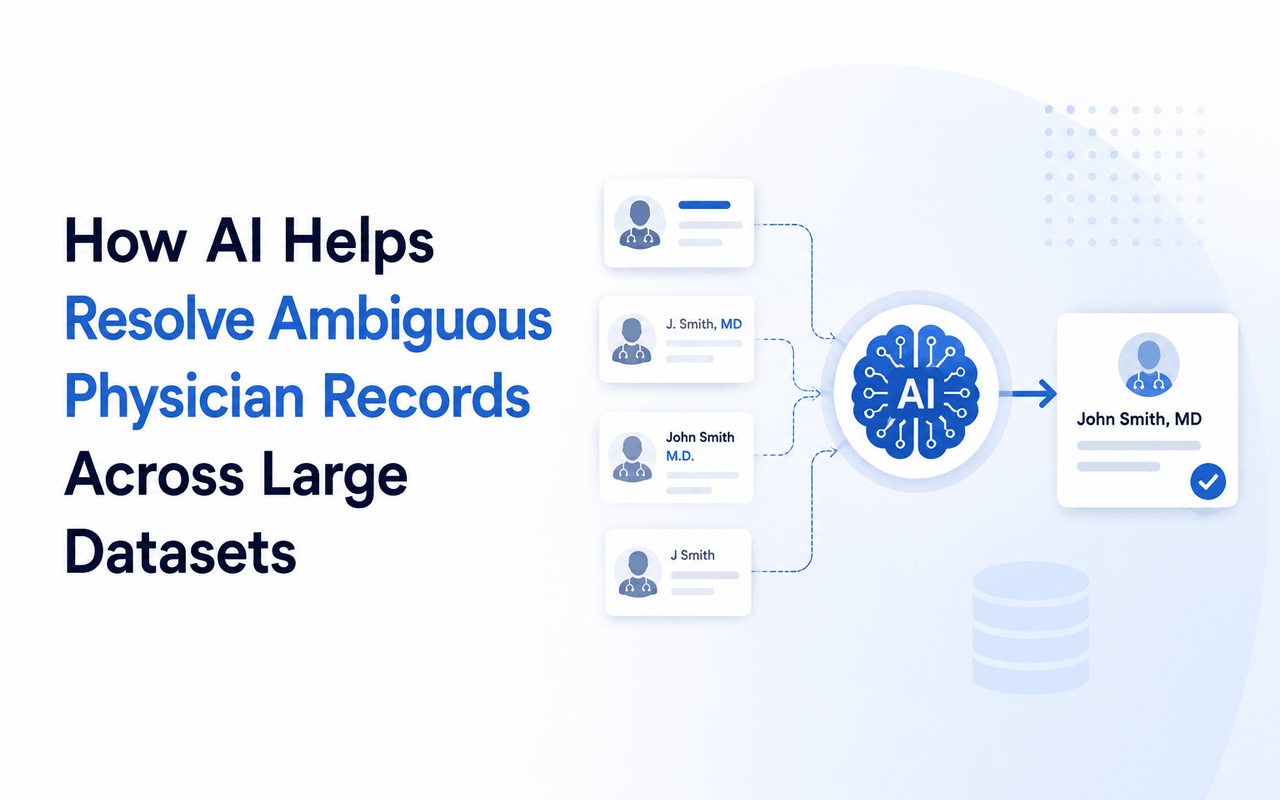
Two rows land in your dataset. One reads “Robert J. Smith, MD, Cardiology, Boston.” The other reads “Bob Smith, M.D.” with a 617 area code and a Brigham affiliation. One person or two?
At a single record, a person answers that in five seconds. At 200,000 records, that same question becomes the entire data operation, and a literal string comparison cannot answer it at all, because none of the fields match exactly even when the two rows describe the same cardiologist.
That question sits underneath every commercial decision a healthcare team makes. A rep’s target list, a marketer’s campaign audience, a territory’s opportunity size, all of them inherit whatever answer the dataset gave when it decided which records were the same provider and which were different.
Get those calls wrong and the damage is huge. You do not see the surgeon you double-counted or the two doctors you accidentally merged into one. You just see numbers that feel slightly off and a sales motion that underperforms for reasons nobody can name.
AI physician record matching exists to make those calls at scale and to make them consistently. It replaces the all-or-nothing string test with a graded judgment about how likely two records describe one provider, and the gap between doing that well and doing it badly is wide.
In one third-party evaluation against a 30,000-record gold standard, a referential matching approach reached an F-score of 97.83% while a conventional probabilistic algorithm landed at 78.91%. Same data, very different reliability. The method matters, and so does what you match against.
The Problem With Exact Matching on Real Provider Data
Exact matching asks one thing of two records. Are these fields identical, character for character?
When the answer is yes, you have a confident match. When the answer is no, you have nothing, and provider data almost never gives you a clean yes.
Provider Names Never Arrive in a Single Canonical Form
Names are the first place where exact matching doesn’t work. A physician entered as Robert in one system is Bob in another and Bobby in a third. William becomes Bill, Elizabeth becomes Liz, and a married name in one record sits beside a maiden name in another.
Much of this inconsistency traces back to how the data was entered in the first place. Legacy CRMs built for general sales contacts, not healthcare specifically, let reps and data-entry staff type a name field freely, so the same physician ends up as “Dr. Smith,” “Robert Smith MD,” and “R. Smith” depending on who logged the call and when.
Systems that have been in use for a decade or more accumulate these variants across every sales rep, every acquisition-era data migration, and every manual fix a frustrated user applied to make a record “look right” without any standardization rule enforcing consistency.
The result is not a single bad batch of data but a slow accumulation of small, well-intentioned inconsistencies that a one-time cleanup cannot fully undo.
Credentials add their own issues, changing across MD, M.D., DO, and the occasional stray PA appended by a registrar who guessed.
Matching tools absorb some of this with nickname dictionaries and edit-distance measures that can read “Bill Richardson” and “William Richardson” as one person. Even so, every variant they have to absorb is another place a strict comparison would have failed silently.
One Provider Can Wear Several Identifiers
Names are only the surface. The same physician can show up in your data attached to more than one identifier, which breaks exact matching in a way that looks like legitimate distinctness rather than a typo.
Administrative mistakes and weak internal handoffs mean that multiple NPIs sometimes end up linked to a single provider, so two records with different NPI values can still be the same person.
Specialty makes it worse. A physician holds exactly one individual NPI that stays stable when they change practices, and can report both a primary and a secondary taxonomy, such as family medicine alongside adolescent medicine.
The same clinician practicing at three sites under two specialties generates records that disagree on location and specialty while describing one real person. Exact matching reads those disagreements as separate providers.
The Cost of Strict Matching Is Invisible Until You Measure It
When two records of the same provider do not match on a required field, the system does not flag a problem. It treats them as two different people.
Deterministic logic that demands exact or phonetic agreement on key elements yields accuracy in the 50% to 60% range, which means a large share of real matches slip through as separate records.
Those misses pile up as duplicates, and the scale is documented. When CMS examined Medicare Advantage directories, the JAMA Dermatology study it relied on found that 45.5% of dermatologist listings in a single plan directory were duplicates of one another.
Nearly half the entries for one specialty were the same physicians listed more than once. Exact matching does not create that kind of duplication on purpose. It just cannot see it coming and cannot catch it afterward.
How AI Decides Whether Two Records Are the Same Person
AI matching abandons the binary test. Instead of asking whether two records are identical, it asks how much evidence there is that they describe the same provider, weighs that evidence across many fields at once, and produces a score.
A threshold then turns that score into a decision. The interesting part is everything that happens before the threshold.
Exact Strings to Field-Level Similarity
The first move is to stop comparing whole strings and start comparing how similar individual fields are. Fuzzy matching measures the distance between two values rather than demanding they be equal.
Phonetic and edit-distance algorithms long used in healthcare master patient index systems measure how many edits separate two strings, so “Smyth” and “Smith” register as near-identical and a transposed digit in a phone number does not sink an otherwise strong match.
None of that works well on raw data. Standardization comes first. Names get normalized, addresses get parsed into consistent components, and specialty and taxonomy values get mapped to a common scheme before any comparison runs.
The principle Alpha Sophia describes in its own matching guidance is the old one, that cleaning and standardizing internal records before matching gives the engine a fighting chance. Garbage in still produces garbage out, no matter how good the algorithm.
Weighing Evidence Across Fields Instead of One
Field similarity is only useful once you decide how much each field counts. A matching last name barely moves the needle, since thousands of physicians share one. A matching NPI is close to decisive. A shared rare subspecialty in the same metropolitan area is strong evidence even when the names look different.
Probabilistic matching formalizes this by assigning each field a weight based on how much agreement or disagreement on that field tells you, then combining the weights into a single likelihood that two records are one entity.
The Fellegi-Sunter model is the classic version of this approach and remains the backbone of probabilistic record linkage for large, messy datasets. The output is a confidence score, simply a number expressing how sure the system is.
Where Machine Learning Raises the Ceiling
Two developments push accuracy past what hand-tuned probabilistic weights achieve. The first is supervised machine learning, where a model learns matching patterns from labeled examples of known matches and non-matches rather than relying on weights an analyst guessed at.
That technique, documented across general data-matching practice rather than healthcare specifically, calibrates its own sense of which field combinations signal a real match once it has enough labeled pairs to learn from.
The second matters more for commercial teams. Matching records against a maintained, high-quality reference dataset outperforms matching two unmaintained lists against each other.
The JAMIA evaluation makes the size of that gap concrete, with the referential approach reaching a 97.83% F-score against the probabilistic algorithm’s 78.91% on the same 30,000-record sample drawn from a health information exchange of more than 47 million registrations.
The lesson is structural. Half the difficulty in matching comes from both sides of the comparison being unreliable, and you remove that half by anchoring to something already resolved.
The Matching Errors That Do the Most Damage
Every matching system makes mistakes in two opposite directions, and treating them as equally bad is itself a mistake.
Research on record matching separates false positives, where records are incorrectly merged, from false negatives, where records that should link stay separate, and finds that failure to link is the more common problem, with match rates between organizations falling as low as 50%.
The two errors cost very different things.
False Splits Hide Volume You Already Found
A false split is a missed match. The system saw Robert Smith and Bob Smith, found no decisive agreement, and kept them as two records.
Now your highest-value cardiologist exists in the dataset three times, each fragment showing a third of his real procedure volume, none of them crossing the threshold that would put him on the priority list.
The downstream effect is misjudged priority. The rep deprioritizes a target who should have been first through the door, the marketer counts one physician as three audience members, and the territory planner sees an opportunity smaller than it actually is.
With roughly 18% of records running as duplicates, the cost is paid in opportunity you already had and could not see.
False Merges Corrupt the Record You Trust Most
A false merge is worse, and it is worse precisely because it looks like success. Two different physicians get collapsed into one record, an error the data integrity field calls an overlay, and overlays are considered more urgent than duplicates because one chart now carries a different person’s information.
Your single, confident view of Dr. Smith now blends two people’s billing histories, specialties, and contact details.
The failure propagates without warning. The rep walks into the call with the wrong information, the campaign reaches the wrong physician with messaging built for someone else, and nobody catches it, because the merged record looks more complete than the fragments around it. That is why a system tuned to merge aggressively is more dangerous than one that tolerates some duplicates.
The financial signal backs it up, with misidentification costing the average healthcare facility about $17.4 million a year in denied claims and lost revenue.
For a commercial team the currency differs but the logic holds, since a false merge spends real budget reaching the wrong person and erodes trust in the dataset the whole motion depends on.
Where Human Review Still Has to Set the Line
The score a matching system produces is continuous. The decision it feeds is not. Somewhere on that scale you draw a line above which records auto-merge, below which they stay separate, and in between which a person has to look. Where you draw it is a business judgment.
Precision Versus Recall
Tighten the line toward precision and you make fewer false merges at the cost of leaving more duplicates behind. Loosen it toward recall and you catch more duplicates at the cost of risking bad merges.
There is no universally correct setting, only a setting that fits what the data drives.
A rep target list can usually absorb a missed duplicate, because the worst case is a slightly fragmented view. It absorbs a false merge far less well, because that puts the wrong person’s profile in front of a rep about to make a call.
For most commercial use cases that argues for erring toward precision and accepting a larger review queue.
What Belongs in the Review Queue
The middle band is where humans earn their place. These are the rows where the evidence is genuinely split, a name and metro that agree but a specialty that does not, or two strong candidates for one record.
The reliable workflow sends those to a person for a side-by-side comparison where they pick the right match or drop the row rather than forcing the algorithm to gamble.
The math justifies it as well. Even well-built fuzzy matching only reaches the 90% to 98% accuracy range when standardization and field weighting are paired with human review, a figure that comes from general data practice but holds in healthcare.
Someone has to own the threshold and the queue. The machine handles volume, and the human handles the cases where volume is exactly the wrong tool.
How Alpha Sophia Reduces the Matching Work With Pre-Resolved Data
Most of the matching burden lands on commercial teams for one reason. They are trying to resolve two unreliable datasets against each other, their own records on one side and a raw provider universe on the other.
Alpha Sophia takes one side of that comparison off the table. It functions as an external reference layer in which provider identity has already been resolved and keyed to the NPI, so the work in front of you shrinks from reconciling mess against mess to mapping your records onto a clean anchor.
Matching Against a Resolved Anchor Instead of Another Messy List
When one side of the comparison is already canonical and NPI-keyed, the ambiguity that makes matching hard largely collapses. You are no longer guessing whether two of your own rows are the same physician. You are asking a narrower question, which single reference provider each of your rows corresponds to.
That is the referential advantage the JAMIA evaluation quantified earlier, applied to commercial provider data. The hard identity resolution has been done on the reference side and maintained there, so you inherit the result rather than rebuilding it list by list.
Bulk NPI Lookup and Physician Matching as the On-Ramp
The mapping itself runs through two confirmed tools. With bulk NPI lookup and physician matching, you export the records from your CRM that are missing NPIs, run them through matching, and push the resolved identifiers back.
The engine handles fuzzy matching across name variants and incomplete fields at scale, and the rows it cannot resolve confidently land in a review step where you choose the correct NPI or remove the record.
Finalized matches return as an NPI-keyed list ready to export to Excel or sync to HubSpot through the native integration or into another system entirely. This is reconciliation toward a reference, not a master data engine running inside your stack.
Alpha Sophia resolves your records to the NPI anchor. It does not take ownership of your golden record or maintain your CRM for you.
An API Path for Teams That Skip the Export Cycle
Manual export and re-import is fine for a quarterly list maintenance. It is the wrong shape for teams that ingest new provider records continuously.
The same resolved data is reachable through the Alpha Sophia API, which lets engineering wire identity resolution into existing pipelines so inbound records get keyed to the NPI as they arrive rather than in batches. The matching becomes a step in the data flow instead of a periodic project.
Conclusion
Matching is the layer every commercial number rests on. When records resolve correctly, the rep list ranks real providers by their true volume, the campaign audience counts each physician once, and the territory opportunity figure reflects the market that is actually there.
When they do not, the team pays twice for the same target, walks into calls carrying someone else’s profile, and plans against a market that is partly an artifact of bad merges and missed links.
The practical move is to stop treating your CRM as the place where provider identity gets decided. Resolve inbound records against a maintained, NPI-anchored reference, send the genuinely ambiguous rows to a person, and tune the threshold toward precision so a false merge never reaches a rep.
The payoff is where leaders already look, in a pipeline that is sized correctly and rep time spent on providers who are real and distinct.
FAQs
What is AI physician record matching?
AI physician record matching is the use of fuzzy, probabilistic, and machine-learning techniques to decide whether two or more records describe the same healthcare provider, even when no field matches exactly.
How does AI provider matching differ from standard NPI matching in healthcare?
Standard NPI matching is an exact lookup that works only when a clean, correct NPI is already present in the record. AI provider matching handles the far more common case where the NPI is missing or the record arrived as a name and a location, using similarity scoring across fields to map it to the right provider.
What is provider identity resolution and how does AI improve it?
Provider identity resolution is the process of determining which records across one or more systems refer to the same real-world clinician or organization. AI improves it by weighing partial evidence across many fields rather than relying on a single exact match, which raises accuracy well above strict deterministic logic.
How does healthcare data matching help resolve duplicate physician records?
Duplicate physician records form when the same provider enters a system more than once and strict matching fails to connect the entries. Healthcare data matching catches these near-matches by scoring similarity across names, locations, and identifiers, then flagging or merging the records that describe one person. Anchoring those records to the NPI gives the deduplication a stable reference so the same provider does not fragment again.
How can AI be used for healthcare CRM data cleanup?
AI supports healthcare CRM data cleanup by identifying likely duplicate provider records, scoring proposed merges, and routing ambiguous cases to human review rather than guessing. Resolving each record to a canonical NPI-anchored identity gives the team a consistent reference to reconcile their CRM toward. The cleanup decisions and the system of record stay with the team, while the matching does the heavy lifting of finding the records that need attention.
