How Commercial Teams Use AI Agents to Validate HCP Target Lists Before Launch
On this page
By the time a commercial team locks its HCP target list, most of the launch is already riding on it. Territories get drawn around those names, the brand’s promotional spend is committed against them, and field and medical teams build their quarter plans assuming the list is right.
Whatever is wrong with it gets inherited by every decision downstream, usually without anyone stopping to re-examine the list itself.
That gap has real consequences. Deloitte’s analysis of US drug launches found that 34% failed to meet their own expectations, with inadequate understanding of the market and customer needs cited in 47% of those failures.
A list that carries the wrong physicians, overlooks high-value ones, or leans on outdated affiliation data is one of the quieter ways that understanding erodes long before the first call.
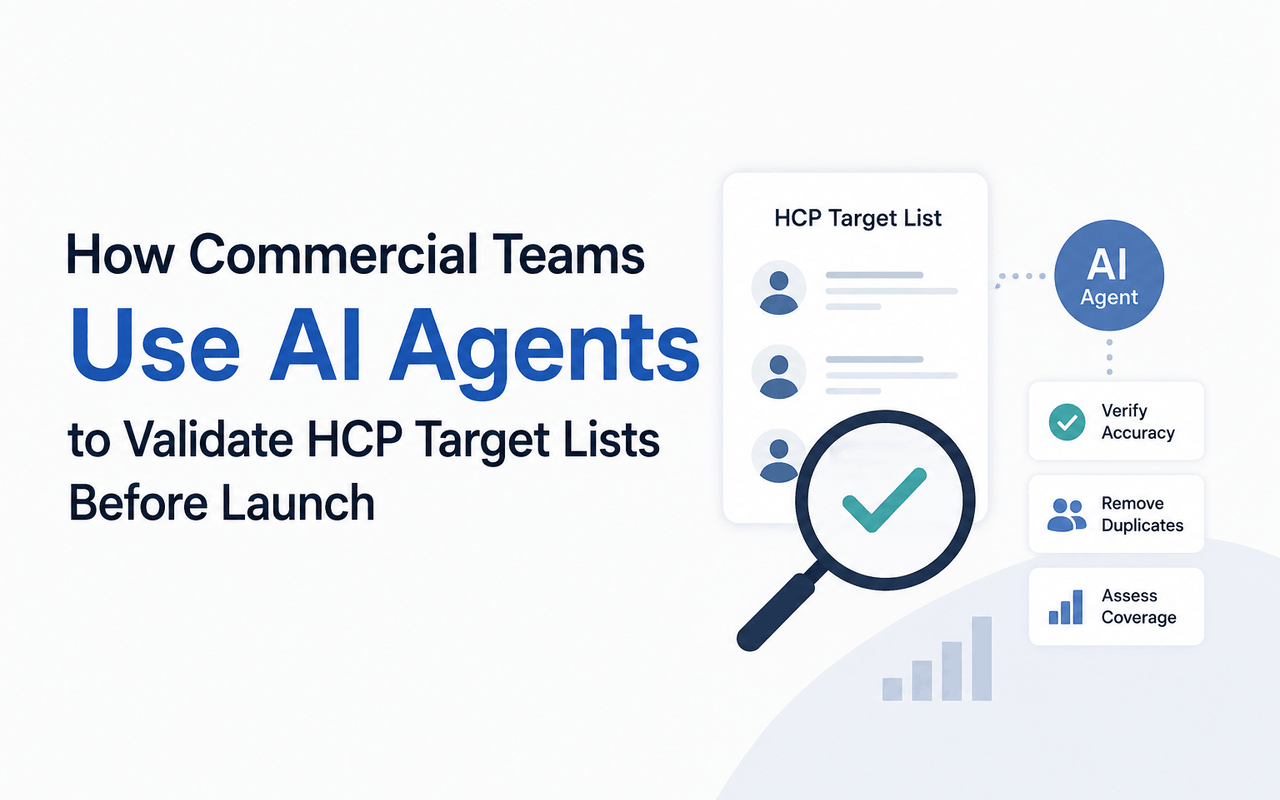
AI agents have started to change how teams handle this moment. An agent can take a list of a team already built and test each provider on it against grounded claims data. Some names turn out to belong to providers who no longer practice where the record says. Others belong to physicians whose billing history has nothing to do with the indication.
The agent flags both while there is still time to fix the list, which is the difference between spending a launch budget on the right audience and discovering the problem three months into a disappointing quarter.
Why Launch Success Depends on the Quality of Your HCP Target List
A target list is not a deliverable that sits off to the side. It is the input that shapes territory design, campaign spend, field routing, and medical engagement planning. When the list is sound, those decisions start from solid ground.
Errors in it, by contrast, get paid for by every team downstream, usually weeks before performance data reveals what went wrong.
Everything Downstream Inherits the List’s Errors
Sales operations draws territories to balance workload and opportunity, using the list as its map of where the volume sits. Marketing sizes audiences and buys media against the same names.
For medical affairs, the same list decides which physicians get early engagement. If a cluster of those physicians turns out to be low-relevance, or if a territory is built around providers who moved to a different health system last year, the flaw propagates into a rep’s daily route and a marketer’s audience segment. Nobody set out to target the wrong doctors. The list simply carried assumptions that no one checked.
A Short Launch Window Leaves No Room for Wasted Targets
Launch performance tends to lock in early. Deloitte’s work on US launches, cited above, found that products missing expectations in their first year usually keep missing them, which puts a premium on getting the first few quarters right.
During that window, a rep who spends a morning at a clinic with no relevant procedure volume is not just wasting a visit. That time competes directly with the high-value account down the road that never gets a call.
A validated list protects the scarcest resource a launch has, which is the field team’s attention during the months when it matters most.
Physician Access Keeps Tightening
The provider landscape a launch targets is also consolidating fast. As of January 2026, 82% of US physicians were employed by hospitals or corporate entities, according to the Physicians Advocacy Institute and Avalere Health, up steadily over eight years of tracking.
Employed physicians are harder to reach, often gated behind system-level access rules and formulary committees. When getting in front of a provider is already difficult, targeting one who does not fit the indication is a compounding waste. The list has to earn every name before the field team invests in reaching it.
What AI Agents Check Before Recommending Physicians for Launch Campaigns
Validation is a set of pass-or-fail integrity checks an agent runs against a trusted reference before it endorses a provider for a campaign.
The value comes from doing this at the scale of a full list, provider by provider, in the time it would take an analyst to check a handful by hand. Here is what a well-built agent looks for.
A Real, Active Provider Behind Every NPI
An NPI on a spreadsheet looks authoritative, but the identifier alone proves very little. CMS states plainly that issuance of an NPI does not confirm that the provider is licensed or credentialed. The registry includes individual and organizational records, and it includes deactivated ones.
An agent matches each name on the list to its NPI record and confirms the record describes an active, individual provider rather than a defunct entry or an organization masquerading as a person. This is the floor of validation. A name that fails should never reach a rep.
Billing History Has to Match the Indication
A provider can be entirely real and still be the wrong target. The question that actually predicts fit is whether the physician does the clinical work the product is built for. Claims data answers this directly.
The CMS Medicare Physician and Other Practitioners dataset organizes utilization by NPI, HCPCS code, and place of service, which means an agent can check whether a targeted surgeon actually bills for the relevant procedure and at what volume.
Cross-referenced with diagnosis data, this separates a physician who occasionally touches the therapeutic area from one who manages it as a core part of their practice. A specialty label only hints at fit, while the billing record shows whether the work is actually there.
Excluded Providers Come Off the List
Some providers should be removed from a target list for reasons that have nothing to do with clinical relevance.
The HHS Office of Inspector General maintains the List of Excluded Individuals and Entities, a roster of providers barred from federal health care programs, and it updates the list monthly.
Engaging an excluded provider carries real liability for a life sciences company. An agent can screen a full target list against the exclusion list as part of validation, catching a problem that a purely commercial view of the data would miss entirely.
Records Go Stale as Affiliations Change
Provider records decay quietly. Affiliations churn as health systems acquire practices, and the physician workforce is aging, with roughly one-third of licensed physicians aged 60 or older per the Federation of State Medical Boards. A list built even a year ago may point reps at addresses and organizations that have since changed.
An agent checks the current record against the live reference data, flagging providers whose affiliation, location, or practice status no longer matches what the list assumes. The flag lets a team correct the record before a rep drives to an office the physician left.
Key Data Signals That Strengthen HCP Target List Validation
Passing the integrity checks tells you a provider is real and reachable. It does not tell you the provider is a strong target. That judgment rests on positive signals in the claims data, the evidence that tells you which valid providers are actually high-value for a specific launch.
An agent weighs these signals to rank a validated list rather than treat every surviving name as equal.
Procedure and Diagnosis Volume Rank the Real Targets
The strongest signal of fit is what a provider actually does, measured in volume. Procedure counts drawn from billed CPT and HCPCS codes show which physicians perform a relevant intervention often enough to matter, and diagnosis data anchored to ICD-10 shows which providers manage the patient population the product serves.
A device targeting a cardiac procedure, for instance, benefits from knowing which interventional cardiologists bill for it at high frequency rather than which ones list cardiology as a specialty. Volume turns a plausible target into a ranked one, and it gives a rep a concrete reason to prioritize one account over another.
Prescribing History Warms Up a Therapy Launch
For therapies rather than devices, prescribing history carries the same weight. The CMS Medicare Part D Prescribers dataset records prescriptions by prescribing NPI and drug, which lets an agent confirm that a targeted physician already prescribes in the relevant class.
A provider who writes steadily for an adjacent brand is a warmer target than one whose prescribing profile shows no activity in the category. That distinction is hard to see on a raw list and obvious once the prescribing signal is layered on.
Open Payments Reveal Who the Competition Already Owns
Knowing who a competitor already engages is its own validation input.
The CMS Open Payments program published 13.18 billion dollars in industry payments to physicians and teaching hospitals for 2024, spanning consulting, speaking, and research relationships across roughly 652,000 physicians.
An agent can read this to see which physicians on a list already have financial ties to a competing manufacturer, which reframes them as either entrenched or contested. That context changes how a commercial team sequences its outreach and what it expects each conversation to cost.
Affiliations Decide Whether a Target Is Reachable
Many launches, particularly in MedTech, target facilities as much as individuals. There are roughly 6,100 hospitals in the United States per the American Hospital Association, alongside a wider network of ambulatory surgery centers, labs, and clinics.
An agent can validate whether a list’s sites of care map to where the relevant procedures actually happen, and whether the physicians on it connect to the systems that control purchasing.
For account-based launches, the affiliation signal is often the one that separates a reachable target from a name with no path to a decision maker.
How AI Agents Help Commercial Teams Spot Coverage Gaps and Targeting Errors
Validation catches bad entries, but the more valuable work is often about what the list is missing. A list can be spotless and still miss half the market, or aim reps at the wrong part of it.
An agent that can size the real market and compare it to the list surfaces the errors a team cannot see by inspecting the names it already has.
Sizing the True Addressable Market Against the List
The first question a coverage check answers is how large the real opportunity is. Prevalence and procedure data give the agent a defensible market size to measure the list against.
Diagnosed atrial fibrillation, to take one cardiology example, is projected to affect 12.1 million people in the US by 2050 per the CDC, which implies a specific universe of managing physicians and treating sites.
When an agent sizes that universe from claims data and finds the list covers a fraction of it, the gap is quantified rather than assumed. Teams can build and refine that audience conversationally when the list connects to a grounded data layer, which is what tools like cohort analysis and audience building are designed to support.
The List Usually Misses High-Value Physicians
Coverage gaps usually hide the most costly errors. A list assembled from conference contacts and legacy CRM records tends to over-index on physicians a team already knows, which means the high-volume providers outside that network never make it on.
An agent working from claims data can identify providers whose procedure or prescribing volume marks them as high-value even though no one on the commercial team has met them.
Given a shortage of up to 86,000 physicians projected by 2036 by the AAMC, and the concentration of volume among a smaller set of active proceduralists, missing even a handful of these providers can leave a meaningful share of the market untouched at launch.
Low-Relevance Names Dilute the Field Team’s Focus
The opposite error is a list padded with low-relevance names, and it is just as expensive because it dilutes the field team’s focus.
An agent flags providers whose billing history shows little or no activity in the therapeutic area, giving sales operations a defensible reason to remove them rather than staff a territory around them.
Trimming the list this way is not about making it smaller for its own sake. It concentrates finite rep and campaign capacity on the providers who can actually move the launch.
Turning Validated HCP Lists into More Confident Launch Decisions
A validated list is worth more than a clean spreadsheet. It is a defensible foundation for the commercial decisions a launch depends on, because each of those decisions inherits the confidence the validation built. The payoff shows up in three places where launches most often go wrong.
Territory Design Built on Real Volume
Territories drawn around validated, volume-ranked providers balance opportunity rather than guesswork.
A sales operations lead can allocate reps against where the relevant procedures actually happen, knowing the underlying names have been checked for relevance and currency.
That reduces the churn of reassigning territories mid-launch when the original assumptions fail, and it gives reps routes built around accounts worth their time.
Forecasts and Market Sizing That Hold Up
A forecast is only as credible as the target universe beneath it. When the list has been sized against real prevalence and procedure data, the addressable market feeding the revenue model reflects the actual opportunity rather than an optimistic estimate.
This matters most for teams sizing a market for the first time, where a grounded view of market access and opportunity can be the difference between a forecast that survives its first quarterly review and one that gets rebuilt under pressure.
One Set of Targets Across Sales, Marketing, and Medical
When sales, marketing, and medical affairs work from separate versions of the target list, their efforts drift apart, and a physician gets a rep visit, an unrelated email campaign, and no medical engagement at all.
A validated list built on shared, grounded data gives all three functions the same source of truth. The alignment is not cosmetic. It determines whether a launch reaches a high-value physician with a coherent effort or three disconnected ones.
How Alpha Sophia Helps Commercial Teams Build AI-Ready HCP Target Lists
Validation depends entirely on what an agent checks against. An agent reasoning over a general model’s training data will confirm nothing, because that data cannot verify whether a specific NPI is active or whether a physician bills for a procedure.
Alpha Sophia supplies the grounded reference layer that makes validation possible, and it does so in a way that keeps the reasoning with the agent and the trusted data with the platform.
An NPI-Anchored Reference Layer Agents Query
Alpha Sophia is the reference an agent validates against, anchored to the NPI and built on all-payor US medical claims spanning commercial, Medicare including Medicare Advantage, and Medicaid, across more than 4 million providers.
Each provider record carries procedures billed as CPT and HCPCS codes, diagnoses as ICD-10 and CCSR categories, specialty and taxonomy, affiliations and sites of care, prescriptions, open payments, and education, publications, and clinical trial activity.
When an agent needs to confirm a provider is real and clinically relevant, it queries this layer rather than guessing. The agent does the checking and the ranking. Alpha Sophia supplies the ground truth those judgments rest on.
Three Ways to Put an Agent to Work
A team can reach this reference layer in whatever way fits how it already operates. The in-app Alpha Sophia Assistant turns plain-English questions into validated provider lists inside the platform.
Teams that already work in Claude, ChatGPT, or Cursor can connect those tools to Alpha Sophia over the Model Context Protocol and validate lists without leaving the environment they know.
For repeatable pipelines, a fully autonomous agent can size a market, check a target list, and hand the validated output to a connected CRM or outreach tool on its own. The choice depends on how much of the workflow a team wants to automate, and all three run on the same claims-grounded data.
From List Matching to a Validated Target Set
Validation often starts with a list a team already has, which means the first step is matching those names to their provider records.
Alpha Sophia’s bulk NPI lookup matches an existing physician list to NPI numbers, giving an agent the anchored records it needs to run every downstream check.
From there the agent can layer on procedure volume, prescribing history, exclusion screening, and affiliation currency, turning a raw list into a target set a commercial team can defend heading into launch.
Conclusion
The HCP target list is one of the highest-leverage inputs a launch has, and for years it has received far less scrutiny than the plans built on top of it. AI agents change that economics.
Checking a full list against grounded claims data, provider by provider, was never practical to do by hand at the scale and speed a launch requires.
An agent makes it routine. It catches the dead NPIs and irrelevant specialists before they cost a rep’s time or a marketer’s budget. It also screens out providers a team cannot legally engage and points to the high-value physicians the list missed. A team that validates this way heads into launch spending against providers it has actually verified.
FAQs
What is HCP target list validation?
HCP target list validation is the process of checking each healthcare provider on a target list against trusted data to confirm they are real, active, clinically relevant, and safe to engage. It catches errors like dead NPIs, misclassified specialties, and outdated affiliations before a team acts on the list. Done with an AI agent, it can cover an entire list rather than a sampled few.
Why should commercial teams validate HCP target lists before launch?
Because the target list feeds territory design, campaign spend, and field deployment, so any error in it propagates into every downstream decision. Launches that start on the wrong providers tend to underperform early and keep underperforming. Validating first protects the field team’s limited time during the window when launch performance locks in.
How do AI agents improve HCP targeting?
AI agents check and rank providers against grounded claims data at a scale and speed that manual review cannot match. They confirm each NPI belongs to an active provider and check that its billing history fits the indication. They also surface high-value physicians a list may have missed, producing a target set based on demonstrated behavior rather than assumptions.
What data signals help validate physician target lists?
The strongest signals are procedure and diagnosis volume from claims, prescribing behavior, existing manufacturer relationships from open payments data, and current affiliations and sites of care. Together they show whether a provider is both relevant to the indication and worth prioritizing. An agent weighs these signals to rank a validated list.
Can AI agents identify missing high-value physicians?
Yes. By sizing the real addressable market from prevalence and claims data and comparing it to the list, an agent can find high-volume providers the commercial team never captured, often physicians outside its existing network. Surfacing them closes coverage gaps that would otherwise go unnoticed at launch.
How does Alpha Sophia support AI-driven HCP targeting?
Alpha Sophia provides the NPI-anchored, claims-grounded reference layer that an agent validates a target list against, built on all-payor US medical claims across more than 3.9 million providers. Teams can reach it through the in-app Assistant, by connecting their own AI tools over the Model Context Protocol, or through fully autonomous workflows. The agent handles the reasoning while Alpha Sophia supplies the trusted data behind every check.
