How Healthcare Teams Standardize Physician Data Across Multiple Systems
On this page
A physician has one identity in the real world and one NPI to prove it. Inside a commercial team’s systems, that same person fragments into several records that rarely agree.
The CRM holds one spelling of the name, the marketing platform holds another, a conference export lists a different practice address, and the billing or ERP system carries a different specialty label.
None of them is obviously wrong, which is what makes the problem expensive.
When CMS reviewed Medicare Advantage online directories, it found that 48.74% of provider locations carried at least one inaccuracy, and those are directories maintained by organizations under regulatory pressure to keep them clean.
Commercial teams without that pressure usually do worse.
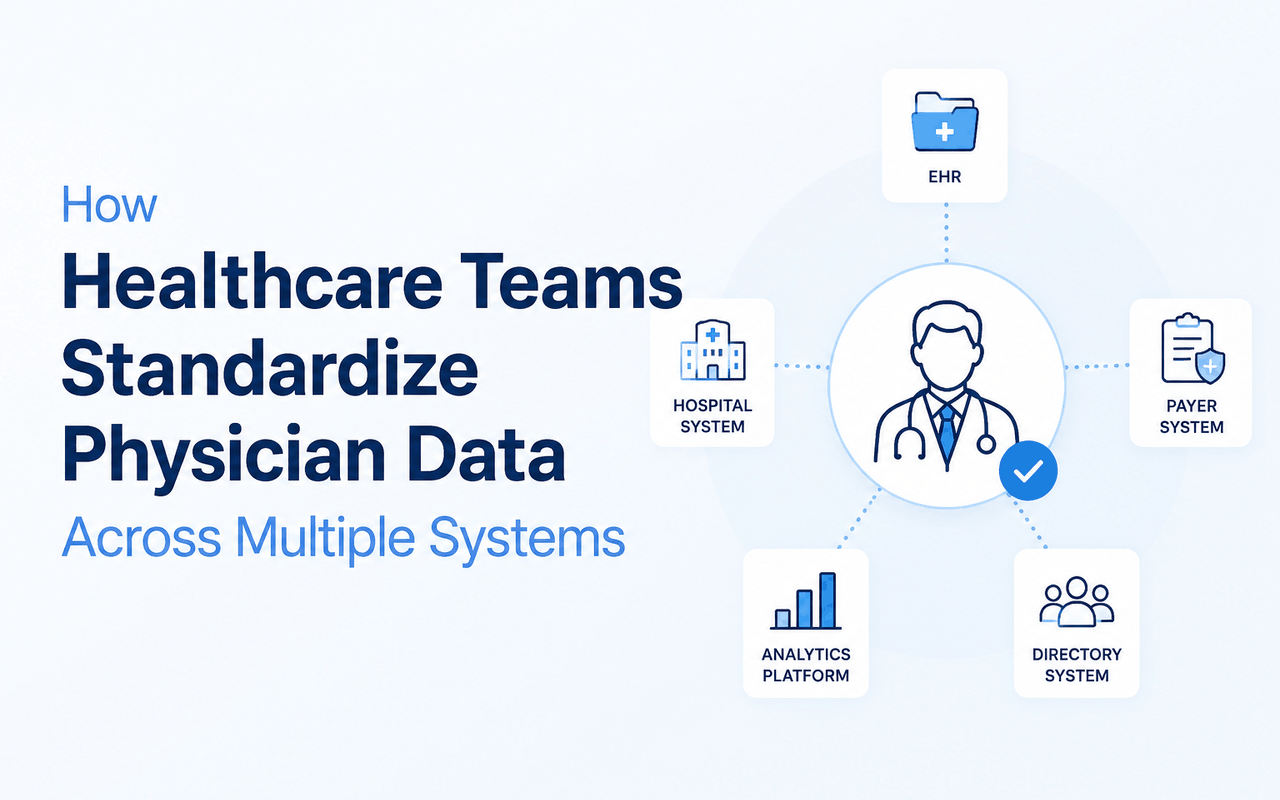
Physician data standardization is the work of forcing those scattered records to describe the same person the same way, anchored to something that does not change.
Why the Same Physician Has a Different Record in Every System
The disagreement is structural. Each system captures provider data at a different time, from a different source, in a different format, and with no shared key linking back to the same person.
So the records were never going to line up on their own.
Every System Captures the Provider at a Different Moment
A CRM record reflects whatever was true when the rep first entered it. A marketing list reflects the day it was purchased or scraped.
Provider attributes change underneath all of them. Physicians change group affiliations, practice addresses, and even legal names, and the federal record itself lags reality.
The taxonomy and demographic fields are self-reported and updated unevenly, so by the time a record reaches a downstream system it is often describing a state that no longer holds.
Multiply that across the EMR-adjacent feeds, the NPPES registry, claims systems, credentialing platforms, and external directories most teams pull from, and the same physician ends up frozen at five different points in time.
No Shared Key Links the Records Together
Name and location feel like enough to identify a doctor. They are not. A common surname plus a state can return dozens of candidate providers across different specialties and practice types, and matching on those fields alone produces both false merges and missed matches.
Without the NPI carried on every record, no system can prove that its “Dr. Hansen, Texas” is the same person as another system’s “K. Hansen, Houston.” The records sit in separate silos with no reliable way to confirm consistency between them.
Manual Entry Produces Conflicting Values
Even when two systems hold the same physician, the fields rarely match character for character. Names arrive with and without credentials and suffixes, addresses follow different formatting conventions, and specialty gets entered as free text rather than a coded value.
The NPI itself is supposed to be the clean anchor, yet typos and mistyped digits creep in during manual entry.
The cost of this surfaces in directory data, where a peer-reviewed review of five national health plans found that the consistency of address information for the same physicians ranged from 16.5% to 27.9% across insurers.
If insurers with compliance teams cannot keep one physician’s address consistent, a lean commercial team running four tools will not either.
What a Standardized Provider Record Actually Looks Like
Standardization has a clear target, and it helps to define that target before discussing how to reach it.
A standardized provider record is one agreed version of a physician that every system points to, built on a stable key and a fixed set of canonical attributes. This is the discipline of provider master data management, applied to the commercial stack rather than the clinical one.
One NPI as the Anchor Field
The record is keyed to a single National Provider Identifier. Individual clinicians carry a Type 1 NPI and organizations carry a Type 2, keeping the two straight matters because a rep sells to people while a contract attaches to entities.
The NPI is the one attribute that does not change when a physician moves practices or rebrands, which is why it functions as the unique identifier that everything else hangs from.
Canonical Values for Every Attribute
Each attribute on the record has one agreed value and a known source. The name follows one format, the primary practice address is normalized, the specialty is stored as a coded taxonomy value rather than a typed phrase, and affiliations are tied to organizational NPIs.
When two systems disagree, the canonical record states which value wins and where it came from, so the disagreement gets resolved once instead of being relitigated every time someone runs a report.
A Logical Record
The standardized record does not have to live in one mega-system. It can be a logical construct that every system references, so the CRM, the marketing platform, and the reporting layer all resolve to the same trusted version without being forced into one tool.
Teams often assume standardization requires ripping out their stack and consolidating everything, when what they actually need is a shared reference the existing systems can align to.
The Steps That Align Records Around a Single NPI
Getting from scattered records to one canonical version is a repeatable process. The sequence below moves from internal cleanup through matching and conflict resolution to integration, and each step depends on the one before it.
Clean Internal Records Before Matching
Matching works better against records that are already tidy. Before touching any external registry, the team deduplicates obvious internal copies, standardizes name formats, and corrects known address and field errors.
Feeding messy records into a matching engine produces low-confidence results and forces more manual review later, so the cleanup pays for itself.
Alpha Sophia’s guidance on NPI list matching makes the same point, since the quality of the input sets the ceiling on the quality of the match.
Match Each Record to a Single NPI
With internal records cleaned, each one gets matched to its correct NPI. Exact matching on name and identifiers handles the clean cases. Physician record matching then uses fuzzy logic for name variants, abbreviations, and misspellings, narrowed by geography and specialty to separate the real candidate from the dozens who share a name.
Ambiguous rows get flagged for human review rather than forced into a guess, because a wrong match is more damaging than an unmatched record left for follow-up.
Normalize Specialty Against the NUCC Taxonomy
Specialty is one of the messiest fields because it is entered as free text and means different things to different teams. The fix is to map it to the NUCC Health Care Provider Taxonomy, a coded set structured into provider grouping, classification, and area of specialization.
Part of why specialty disagrees across systems is that the codes are self-selected by the provider at NPI application and a provider can carry more than one, so the same doctor can legitimately appear under two labels.
Standardizing to the taxonomy code, with one designated as primary, removes that ambiguity.
Resolve Conflicts With Survivorship Rules
When two cleaned records still disagree on a field, something has to decide which value survives. Survivorship rules set that policy in advance.
The most recent verified value might win for address, the most authoritative source might win for specialty, and the field with provenance beats the one without.
Writing these rules down once means conflicts get settled by policy instead of by whoever happens to be editing the record that day.
Write the NPI and Canonical Values Back to Every System
The final step is provider data integration. The agreed NPI key and canonical values get written back into each system, so the CRM, the marketing tool, and the reporting layer now share the same identifier and the same field values.
The direction of that sync is worth deciding deliberately. One system holds the canonical record, and the others receive updates from it rather than writing their own changes upstream, which prevents the stale local edits that recreated the problem in the first place.
From that point, the systems can be reconciled against each other automatically, because they finally have a key in common rather than a tangle of free-text fields.
Why Standardization Fails Without an Owner and a Refresh Cycle
A clean dataset on the day of the project is not the same as standardized data six months later. Provider attributes keep changing, and a one-time cleaning decays into the same mess it replaced unless someone is responsible for keeping it current.
Provider Data Decays Faster Than Most Teams Refresh It
A CAQH survey of physician practices found that the average practice updates information for around 20 health plan contracts and spends close to one staff day per week on directory upkeep, at roughly 998 dollars a month and 2.76 billion dollars nationally.
That is the cost of keeping data current at the source. Downstream systems that refresh once a year fall behind quickly.
The persistence of stale records shows up in regulatory reviews, where a 2025 OIG analysis found that 72% of inactive providers listed in Medicare Advantage and Medicaid directories should not have been there at all, despite a standing 85% accuracy threshold.
Someone Has to Own the Record
Healthcare data governance is what keeps the standard from eroding. It names an owner for the provider record, gives that owner authority to set and enforce survivorship rules, and assigns the refresh cadence.
Without a named owner, each system slowly reverts to its old habits, and the next person to import a list reintroduces the duplicates the team spent a quarter removing.
It is simple to state and easy to skip. New records get matched to an NPI before they enter any system, existing records get re-checked against the external reference on a fixed schedule, and any field that fails its survivorship rule gets flagged for the owner to resolve.
The schedule matters more than its exact frequency, because data that is reconciled quarterly stays usable while data reconciled once stops being trustworthy within a year. Governance is the difference between standardization as a project and standardization as a maintained state.
The Cost of Skipping the Cycle
In the directory world, a survey found that more than half of physicians see patients hit coverage problems caused by inaccurate listings.
For a commercial team the analog is wasted rep time on a doctor who moved, a territory count that double-counts one physician across two records, and campaign reporting that no one trusts. Healthcare CRM data quality is not a static asset. It degrades on a schedule, and only a refresh cycle holds the line.
How Alpha Sophia Anchors Every System to One Provider Reference
Standardization needs something stable to standardize toward, and that reference cannot itself be one of the drifting internal systems. This is where Alpha Sophia fits, and it is worth being precise about the role.
An External NPI-Anchored Reference
Alpha Sophia sits outside the stack as an external provider reference keyed to NPI. The team keeps its own system of record, whether that is a CRM, a master data platform, or a designated source-of-truth table.
Alpha Sophia supplies the authoritative external version of each provider that those systems reconcile toward.
Bulk NPI Lookup and Physician Matching
The practical entry point is matching. With Bulk NPI Lookup, a team uploads an Excel or CSV list of physicians that has no NPI on it, and each row is matched to the correct National Provider Identifier.
Physician Matching handles the same work for records flowing in from conferences, partner lists, and existing CRM exports.
Because every returned record is keyed by NPI, the cleaned list deduplicates and merges cleanly against the records the team already holds, which is the mechanism that lets separate systems finally line up.
Canonical Attributes From One Maintained Source
Once a provider is keyed to its NPI, the attributes the team reconciles toward come from one regularly refreshed reference rather than four stale ones.
Alpha Sophia supports filtering and enrichment across CPT, HCPCS, ICD-10, and taxonomy, with coverage spanning Medicare, Medicaid, and commercial payors.
So the specialty, affiliation, and billing context attached to a record carry the same values everywhere, instead of one definition in the CRM and a different one in the reporting layer.
Getting the Reference Into Your Systems
Aligned records have to land back in the tools the team actually uses. Cleaned, NPI-keyed lists export to Excel or CSV, sync through the native HubSpot integration, and through export and the open API.
Once every system carries the same NPI and the same canonical values, a territory count means the same thing in the CRM as it does in the marketing platform, and a rep stops working two records for one doctor.
That is the entire point of standardization, and it holds only as long as the reference stays current and someone owns the cycle.
Conclusion
Physician data standardization is a discipline. To anchor every record to an NPI, resolve conflicts by policy rather than habit, and assign someone to hold the line as provider attributes shift beneath the stack.
The cost of skipping that work shows up in wasted rep time, broken territory counts, and campaign data no one believes. The fix is one key, one canonical record, one owner, one refresh cycle and the teams that treat it that way stop relitigating the same data problems every quarter.
FAQs
What is provider data standardization?
Provider data standardization is the process of making every system describe the same physician the same way, keyed to a single NPI. It covers matching records, normalizing fields like specialty and address, and resolving conflicts so one provider maps to one agreed record. The aim is ongoing consistency across systems rather than a one-time cleanup.
How do duplicate physician records affect healthcare CRM data quality?
Duplicate physician records split one provider’s history across several entries, so activity, ownership, and engagement get counted against the wrong record or double-counted. This distorts reporting, misroutes outreach, and erodes trust in the CRM. Keying records to NPI lets the team merge duplicates into one accurate record.
What role does NPI matching play in healthcare provider data management?
NPI matching assigns each record the correct National Provider Identifier, which becomes the shared key across otherwise disconnected systems. Name and location alone cannot reliably tell two physicians apart, so without the NPI the records stay siloed. With it, records from different systems can be linked, deduplicated, and reconciled.
How does provider data integration work across multiple systems?
Provider data integration aligns records by matching each to a single NPI, normalizing shared fields, and writing the agreed key and values back to every system. Once each system carries the same NPI, the same provider is tracked consistently across the CRM, marketing tools, and reporting. Integration depends on that shared identifier rather than on matching free-text fields.
What is healthcare data governance for provider records?
Healthcare data governance for provider records is the set of owners, rules, and refresh cycles that keep standardized data accurate over time. It assigns responsibility for the record, defines which source wins when fields conflict, and schedules regular updates because provider data changes constantly. Without governance, standardized records degrade back into inconsistency.
