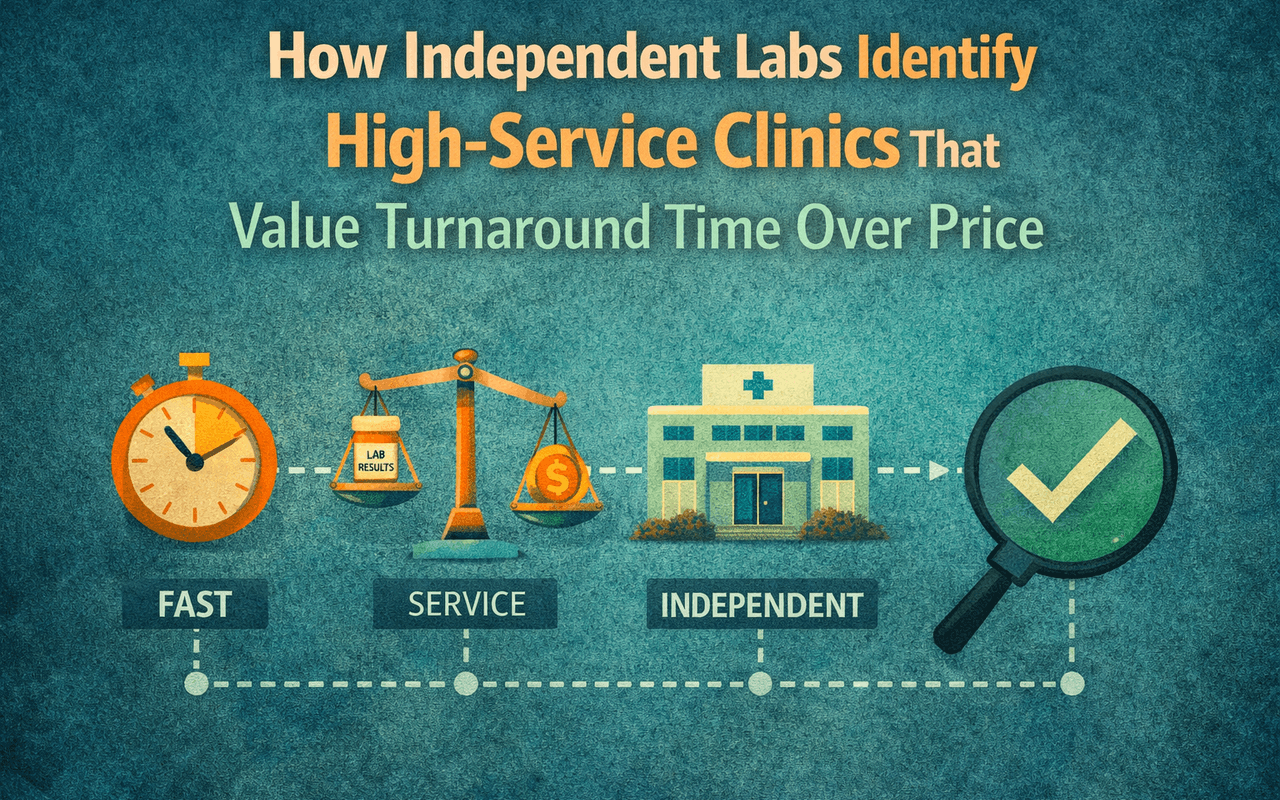
How Independent Labs Identify High-Service Clinics That Value Turnaround Time Over Price
On this page
Most independent labs are taught to think about growth in terms of coverage. For example, more clinics, more meetings, more accounts in the funnel. But that is not always the real commercial problem.
The harder question is whether a clinic has a reason to change labs at all.
A lot of clinics do not. Laboratory relationships are embedded in ordering workflows, specimen collection and pickup routines, reporting patterns, and follow-up processes, so even a cheaper offer may not be enough to justify change on its own.
That is an important point because the operational cost of poor lab performance often shows up indirectly, through delayed follow-up, added staff coordination, and missed workflow continuity, rather than as a clean line-item comparison in a pricing conversation.
In ambulatory care, failures in test-result follow-up remain common, with systematic reviews finding substantial rates of missed or delayed follow-up for abnormal laboratory results. That helps explain why clinics do not always switch labs over small pricing differences alone, the real issue is not test cost, but whether the lab relationship supports reliable day-to-day care delivery.
The stronger opportunities tend to sit elsewhere. They come from clinics where lab performance affects how the practice runs day-to-day. If test results arrive late, staff have to chase updates, patients need extra callbacks, follow-up decisions get delayed, and the clinic absorbs the problems. In that kind of setting, the lab becomes part of the clinic’s operating rhythm.
That changes how independent labs should think about targeting.
The goal is not to find every clinic that orders tests. It is to find the clinics where speed, consistency, and responsiveness have clear operational value.
That often means accounts where testing is closely tied to next-step decisions, such as OB-GYN clinics running prenatal or hormone-related panels, endocrinology practices managing thyroid or HbA1c follow-up, rheumatology clinics monitoring inflammatory markers, oncology offices tracking treatment-related labs, or primary care groups with heavy chronic-disease follow-up.
Geography matters too. A regional lab is usually in a stronger position when the account is within a tight pickup-and-courier footprint, where same-day specimen movement and predictable reporting are operationally feasible. That is where a smaller lab can compete without falling into a blunt price comparison, because the commercial case is tied to workflow reliability rather than the fee schedule alone.
This article looks at how independent labs can identify clinics that care less about the cheapest possible rate and more about reliable turnaround time. More specifically, it looks at the signals that suggest a clinic is buying for service, the patterns that make those accounts more attractive, and how a more selective outreach model can support healthier growth.
Why Competing on Price Alone Is Unsustainable
Price looks like the obvious lever in lab sales because it is easy to explain. It gives reps something concrete to lead with, and it gives prospects a quick comparison point. But for most independent labs, it is also the weakest foundation for growth.
Lower Pricing Does Not Automatically Create Switching Intent
Most clinics do not change lab partners for a small difference in cost alone. A lab relationship touches more than billing. It affects ordering patterns, specimen pickup, staff habits, reporting workflows, and day-to-day coordination.
Even when a clinic notices a cheaper offer, the savings may not be large enough to justify changing a process that already works well enough.
That is an important distinction. A clinic can be open to hearing a better price without being genuinely ready to switch.
Price-Led Accounts Are Usually Less Stable
Even when a lower rate helps win the account, it does not always create a strong commercial foundation.
If the clinic chose the lab mainly because it was cheaper, the relationship remains easy to challenge. Another lab can enter later with slightly better pricing, bundled offers, or a broader network agreement, forcing the account back into comparison mode.
In that situation, the independent lab is constantly defending a business that it never fully secured on operational value.
That makes price-led growth fragile. It fills the pipeline, but it does not always build durable revenue.
The Real Cost of Poor Service Shows Up Inside the Clinic
The bigger problem is that fee comparisons often ignore what poor service costs the practice.
When results are delayed, the impact is rarely confined to the lab report itself. Staff may need to follow up with patients again. Providers may have to wait before adjusting treatment or confirming next steps. Office teams spend more time managing loose ends that should have been closed earlier.
None of that appears clearly in a per-test price conversation, but the clinic still pays for it through lost time and added friction. That is why a cheaper lab is not always the lower-cost choice in practice.
Many Clinics Are Buying Workflow Reliability
Some clinics are not comparing labs as interchangeable vendors. They are comparing them based on how well each one supports the pace and structure of the practice.
If fast turnaround helps the clinic complete follow-up faster, reduce staff burden, or support a smoother patient experience, then service quality carries real financial and operational value. In those cases, the lab is not just selling testing capacity. It supports how the clinic functions.
Independent Labs Usually Cannot Win a Pure Pricing Fight
There is also a structural reason why price-based competition is risky. Large national laboratory networks are usually in a better position to absorb aggressive pricing across broad account bases.
Independent labs do not usually have the same room to keep cutting rates without weakening margin or putting pressure on service quality. If they try to compete only on price, they often end up playing the one game least suited to their strengths.
Their stronger commercial position usually lies elsewhere, such as responsiveness, flexibility, local support, clearer communication, and a service model that works better for clinics with more demanding workflows.
So, price still matters, it always will. But price alone is rarely a durable reason to win. The more useful question is which clinics would actually feel the difference between an average lab partner and a highly responsive one. Once that becomes the focus, the targeting improves. The sales conversation improves, too.
Characteristics of High-Service Clinics
Not every clinic evaluates a lab partner in the same way. Some are comfortable with a service model that is predictable enough and priced competitively enough. Others feel the effect of delays, poor communication, or inconsistent support much more directly in their daily operations. Those are the clinics that tend to place a higher value on responsiveness and turnaround time.
To identify them well, independent labs need to look beyond broad specialty labels or account size and understand the operating traits that make service matter more.
They Run on Tighter Decision Timelines
Some clinics can absorb a delay more easily than others. High-service clinics usually cannot.
These are practices where lab results affect what happens next within a short window. A provider may be waiting to confirm a treatment plan, rule out a complication, adjust medication, or decide whether a patient needs another visit.
In that kind of setting, delayed reporting creates immediate friction. It slows down decisions that the clinic is trying to make quickly and confidently. That is why turnaround time matters more in these accounts. It is tied to the pace of care.
They Feel the Operational Cost of Delays More Sharply
In some practices, a late result creates a minor inconvenience. In others, it creates admin work, patient follow-up burden, and avoidable disruption across the day. Staff may need to call patients again, reschedule next steps, follow up on updates, or explain delays they did not cause. The lab issue turns into a clinic workflow issue.
High-service clinics tend to notice this cost more clearly because their teams are already managing a high volume of moving parts. They have less tolerance for avoidable delays.
They Serve More Complex or Time-Sensitive Patient Needs
These clinics are not always large, but they often deal with care situations where timing matters.
That may include specialty practices, faster-paced outpatient settings, or clinics managing patients who need closer monitoring and more active follow-up.
In these environments, the value of the lab lies not only in producing a result. The value also lies in how reliably the result supports the next clinical step.
That makes service quality easier to defend commercially. The clinic is not buying speed for its own sake. It is buying smoother care delivery.
They Care About Staff Efficiency, Not Just Test Pricing
A clinic may not object strongly to current test pricing, but it may still be unhappy with the operational burden around the lab relationship. High-service clinics often think more carefully about staff efficiency because small inefficiencies compound quickly.
If the current lab creates repeated follow-up work, missed expectations, or communication gaps, the clinic pays for that through staff time.
They Expect Responsiveness When Something Goes Wrong
High-service clinics usually place greater value on responsiveness in those moments because they do not have the luxury of waiting for a generic support process to catch up.
That is one reason independent labs can compete well in these accounts. A clinic that values quick resolution and direct communication is often more open to a partner that can solve problems without layers of escalation.
They Are Better Evaluated by Workflow Fit Than by Size Alone
A high-service clinic is not always a large clinic. It is not always in a premium location. It is not always part of a big specialty group. Sometimes, a smaller practice with the right workflow pressures is a stronger fit than a larger account that buys almost entirely on routine pricing and habit.
That is why labs should not define these prospects too broadly. The goal is to find clinics where better service has practical value in the way the practice actually works.
That is what makes them commercially attractive. And that is what should shape the targeting model that follows.
Data Signals That Indicate Service-Oriented Clinics
Not every service-focused prospect announces itself. Most do not. You usually have to infer it from how the clinic operates, what kinds of patients it sees, and what types of testing activity show up around that account.
That is where targeting gets more useful. Instead of relying on broad assumptions like specialty or clinic size, independent labs can look for signals that suggest a practice is more likely to care about speed, consistency, and support.
Higher Follow-Up Dependency Around Testing
Some clinics depend on lab results to keep patient follow-up moving. In those settings, a delayed result slows the next action.
That could mean medication changes, further diagnostic work, care-plan confirmation, patient callbacks, or escalation decisions.
When a clinic’s workflow involves frequent follow-up tied closely to testing, turnaround time starts to matter more. The lab is no longer a background vendor. It becomes part of the clinic’s ability to keep care progressing without extra friction. That makes these accounts more likely to notice and value service quality.
Procedure Patterns That Suggest Time-Sensitive Workflows
This is one of the clearest signals. If a clinic’s procedure mix points to ongoing diagnostic activity tied to active treatment decisions, monitoring, or more involved patient management, that account is more likely to feel the operational value of a strong lab partner.
This is where CPT-based targeting becomes especially useful. It helps commercial teams move beyond broad labels and look at the actual kinds of work happening in the practice.
The point is to identify who orders tests in a workflow where timing matters.
Signs of Administrative Pressure Inside the Practice
Service-oriented clinics often reveal themselves through operational strain. Practices with lean staff, high patient throughput, tighter appointment flow, or heavier coordination demands usually have less room for avoidable disruption. They are more likely to care about missed pickups, unclear communication, inconsistent reporting windows, or any lab issue that creates extra staff work.
This may not show up as a neat field in a database, but commercial teams can still approximate it through account type, clinic model, care setting, and how the practice appears to function.
Geographic Fit Within a Real Service Footprint
Fast turnaround and responsive support are only commercially meaningful if the lab can back them up with route logic, pickup reliability, and practical coverage.
That means geography should be treated as a service variable. A promising clinic outside a workable footprint may still be a poor target for now. A slightly smaller account inside a strong operational zone may be far more attractive.
Evidence That the Account Is Not Fully Locked Into One Lab
Some clinics may fit the service profile but still be difficult to win because the account is deeply tied to an existing partner through a long-standing process, contract structure, or embedded ordering habits.
Others may already be splitting work across multiple labs, using different partners for different needs, or showing signs that the current setup is not fully meeting the clinic’s needs.
Provider-Level Activity That Supports a More Precise View
Two providers in the same organization may not behave the same way. One may drive most of the relevant diagnostic volume. Another may barely touch the categories that matter to your lab.
Looking at provider-level activity makes it easier to identify who is most likely to feel the service problem, who may influence the lab relationship, and where outreach should actually begin.
The point of the whole exercise is workflow value instead of just volume. High volume alone is not enough. Large testing activity can still come from accounts that buy mostly on habit, convenience, or existing network ties.
Moving from Door-Knocking to Surgical Outreach
The old outreach model in lab sales was built for a simpler market where you picked a territory, printed a list, visited enough clinics, and assumed that volume would eventually produce wins.
That approach is harder to justify now. Margins are tighter, health systems are more consolidated, and access to the right decision-maker is less predictable than it used to be.
Broad Territory Coverage Creates False Pipeline
One problem with broad field outreach is that it can make activity look like progress.
A rep can log visits, leave material, and even get a polite follow-up without learning whether the clinic actually has the testing profile, service need, or commercial openness that makes a deal realistic. That produces a familiar problem in diagnostics: a full pipeline on paper, but too many accounts with weak conversion logic underneath.
This is where door-knocking starts to fail as a growth model. It is built to maximize contact volume, not account quality. And in a category where not every clinic is worth pursuing, that is a costly mismatch.
Access Is Harder Than It Looks
Another reason the old model struggles is that getting in front of clinicians is not as easy as many outreach plans assume.
Across healthcare, in-person access to providers has become more controlled, more inconsistent, and more dependent on relevance.
A rep who walks in with a generic pitch may never get beyond the front desk. A rep who arrives with a clear view of the clinic’s likely testing activity, specialty fit, and operational pain point has a better chance of earning attention because the outreach feels specific rather than interruptive.
That sounds obvious, but it changes the economics of field selling. When access is limited, every first touch has to carry more weight.
Precision Improves the Message
McKinsey has argued for years that personalization improves commercial performance when the message is relevant to the buyer’s actual context, rather than broadly segmented by category alone. That principle applies neatly here.
A clinic does not care that your lab serves providers in the region. It cares whether your lab can address the kinds of delays, follow-up burden, or workflow friction that practice is likely dealing with.
So the goal of surgical outreach is sharper communication. The lab can lead with a more credible point because it has a more grounded view of the account.
The Real Shift Is From Account Lists to Account Hypotheses
Traditional prospecting starts with a list of names. Better outreach starts with a hypothesis. This clinic appears to have relevant diagnostic activity. These providers seem tied to the procedure patterns that fit our menu. The geography works for our service model. There may be enough workflow sensitivity here for turnaround time to matter.
Better Outreach Also Means Quicker Disqualification
A more precise sales motion does something else that is just as valuable: it helps labs walk away sooner.
That matters because not every plausible account deserves months of follow-up. If the claims pattern does not match the lab’s strengths, if the service footprint is awkward, or if the provider activity suggests very little relevant opportunity, the account can drop lower in priority before the rep spends weeks trying to manufacture interest.
It Brings Field Sales Closer to How Diagnostics Actually Works
Diagnostics is already a data-heavy category. Laboratories operate through volumes, code-level activity, routing logic, and service thresholds. Yet many sales teams still prospect as if the market is invisible until someone answers the phone.
That gap is strange when you think about it. Commercial teams are often making territory decisions with far less precision than the lab itself uses to run operations.
That is why moving away from door-knocking makes outreach more consistent with the realities of the market and with the way independent labs already have to think about service, route density, and profitable growth.
Strategic Benefits for Independent Labs
A more selective targeting model does more than improve prospecting efficiency. It changes the economics of growth for an independent lab.
It Connects the Lab to Clinical Throughput
One of the biggest strategic advantages of winning service-oriented clinics is that the lab stops being treated as a background supplier and starts affecting how the clinic moves patients through care.
That is important because turnaround time changes how quickly clinicians can make decisions, close follow-up loops, and move to the next step in care. Reviews of laboratory turnaround time note that clinicians often use TAT as a practical measure of service quality, and delays are associated with slower treatment and longer stays in acute settings.
In an often-cited 11-hospital study, reducing lab turnaround-time outliers was linked to shorter emergency department length of stay.
For an independent lab, that changes the commercial conversation. The account is no longer buying only test execution. It is buying a smoother clinical process. That is a stronger position than simply being cheaper on a requisition.
It Makes the Value Story Easier to Quantify
If a clinic depends on timely results for treatment decisions, monitoring, or patient callbacks, the effect of good service becomes visible in day-to-day operations.
Faster reporting reduces waiting, reduces extra coordination, and makes the lab’s contribution easier to explain internally. The literature on lab performance keeps returning to the same point that TAT is one of the most visible markers of laboratory service and is widely used by clinicians as a quality indicator.
It Positions the Lab Closer to Diagnostic Quality and Patient Safety
This is a more serious point, and it is usually underplayed in commercial writing. The value of timely lab support also sits closer to diagnostic quality than many sales teams acknowledge.
The National Academies definition of diagnostic error explicitly includes failure to establish an accurate or timely explanation of the patient’s health problem, and reviews in laboratory medicine have argued that lab-related delays and failures are part of the wider diagnostic safety problem.
That does not mean every delayed result creates diagnostic harm. But it does mean that service quality has a more serious clinical dimension than good customer service does.
For independent labs, that creates a stronger strategic position in specialties and care settings where timing has direct consequences. The lab is not merely promising convenience. It supports a more dependable diagnostic process.
It Supports A Stronger Client Experience
Lab leaders sometimes treat service as an internal operating issue and forget that clients experience it emotionally as well as operationally.
But patient and client experience research suggests that responsiveness, clarity, and report delivery shape how laboratory services are perceived. A 2023 study on clinical laboratory experience found that factors such as staff responsiveness, information clarity, and reporting results contributed to customer delight and favorable future intentions.
Clinics that care about service are not just reacting to delays in a technical sense. They are reacting to the downstream effect those delays have on trust, communication, and perceived reliability.
It Gives Growth a Better Fit With Where the Market Is Heading
There is also a broader market argument. Healthcare is moving toward more specialized diagnostics, more distributed care, and greater scrutiny on whether results are available when decisions need to be made.
Reviews on access to diagnostics at the primary care level and in underserved settings continue to point to the same operational needs that reliable access to testing, workable referral pathways, and transport systems that do not disrupt the care process.
That makes service-oriented account selection more than a tactical sales choice. It is a way of building growth around the parts of the market where independent labs can remain genuinely relevant.
How Alpha Sophia Supports Data-Driven Lab Targeting
Alpha Sophia helps labs narrow the market using billing activity, not just broad filters like specialty or geography. Teams can search by CPT and HCPCS activity and filter by provider, organization, and location to build more focused target lists.
That gives independent labs a more practical starting point for outreach. Instead of beginning with a generic list of clinics in a territory, they can prioritize accounts based on diagnostic activity most relevant to their testing menu.
Alpha Sophia also offers exports, integrations, and APIs that help teams integrate those target lists into day-to-day commercial workflows.
Conclusion
Independent labs do not need to win every clinic. They need to focus on the ones where turnaround time, responsiveness, and support actually matter.
That is where service-led targeting becomes more useful than broad outreach. It helps labs prioritize accounts that are a better fit for what they do well and build growth around stronger commercial logic.
Alpha Sophia supports that process by helping labs narrow the market using CPT and HCPCS activity, as well as provider, organization, and geographic filters.
FAQs
Why do some clinics prioritize turnaround time over price?
Because delays create follow-up work, slow decisions, and add friction to daily clinic operations.
How can independent labs compete against national laboratory networks?
By focusing on clinics that value responsiveness, consistency, and service quality, not just lower pricing.
What data signals indicate high-value diagnostic prospects?
Relevant CPT activity, specialty fit, provider-level testing patterns, and territory fit.
How do CPT codes support lab sales targeting?
It helps labs identify providers and clinics linked to the types of diagnostic activity that match their menu.
What types of clinics benefit most from independent lab partnerships?
Clinics where fast reporting and reliable support make a practical difference to workflow.
How can labs avoid wasting time on locked-in accounts?
By filtering for activity, fit, and geography before outreach begins.
What role does specialty alignment play in diagnostic targeting?
Because not every specialty has the same testing patterns or service needs.
How can data-driven targeting improve conversion rates for labs?
It helps reps focus on more relevant accounts instead of working broad territory lists.
What differentiates service-focused lab partnerships?
Faster communication, more reliable turnaround, and better day-to-day support.
How does Alpha Sophia help identify high-service clinics?
Alpha Sophia helps labs narrow the market using CPT and HCPCS activity plus provider, organization, and geographic filters.
