How to Know Which Physicians Are Worth Targeting
On this page
You have a list of 400 physicians who treat the exact condition your device is built for. Six months later, 12 have taken a meeting. The list wasn’t wrong. It was never the problem in the first place.
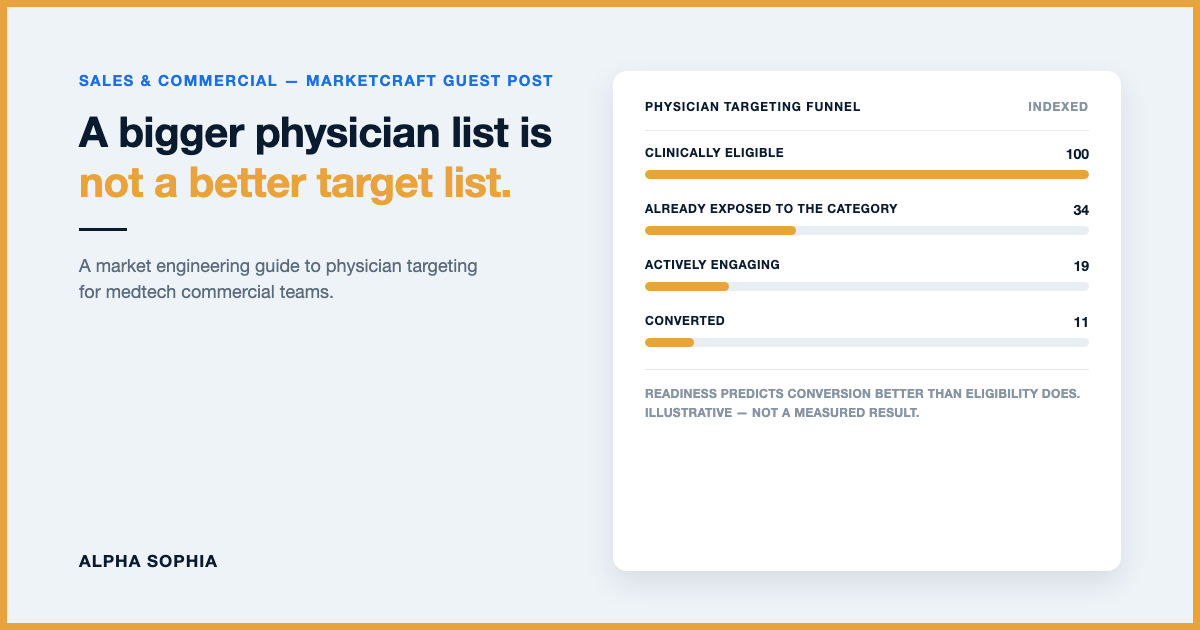
A physician is worth targeting when the category around your device has already reached them, not just when their patient population matches your indication. Clinical fit tells you who could prescribe. It says nothing about who’s ready to.
Key takeaways
- Clinical fit and procedure volume tell you who could adopt your device. They don’t tell you who’s ready to.
- A shorter list of physicians already primed by peer signal or clinical validation converts faster than a broad list of eligible ones.
- The category’s belief curve says more about a physician’s readiness than specialty or case volume ever will.
- FDA clearance is the starting line, not the finish line. It qualifies a physician clinically. It does nothing to make them ready commercially.
- Expanding the target list too early spreads a sales team thin against physicians who were never going to move first.
Why a Bigger Physician List Rarely Means a Better One
I’ve watched this play out again and again with medtech founders. The device gets cleared, the market map goes out to data, and the instinct is to make the list as big as the specialty allows.
More names feels like more opportunity. In my experience, it’s usually the opposite.
A list built purely on specialty and procedure volume treats every physician on it as equally reachable. They aren’t.
Some have already heard about the category from a peer, a conference talk, or a KOL they trust. Others haven’t heard anything at all, and no amount of outreach volume changes that on its own.
When a founder tells me their sales team is “not getting through,” the list is rarely the diagnosis. The list was built for eligibility, not for readiness. Those are different questions, and only one of them predicts what happens after the first call.
What Makes a Physician Ready to Adopt a New Device
Readiness isn’t a demographic but rather a position in the category’s belief curve.
A physician is closer to ready when they’ve already encountered the category from a source they trust:
- A colleague who’s used the device
- A session at a conference they respect
- A reference customer at a hospital they benchmark against
None of that shows up in a claims dataset filtered by specialty and geography. It shows up in how the category has moved, not in who’s clinically eligible to prescribe.
This is the difference between push-driven outreach and pull-driven demand. Push-driven outreach treats every eligible physician the same and tries to talk each one into belief from zero. Pull-driven demand finds the physicians where belief is already partway built and meets them there first.
The physicians who convert fastest are rarely the ones with the highest procedure volume. They’re the ones already standing closest to the category when your team shows up.
How to Segment Physicians by Belief Stage
Most segmentation models stop at specialty and geography, maybe procedure volume if the data is good. None of that is a commercial filter.
The more useful cut is belief stage. Put physicians into three rough groups:
- The first has already been exposed to the category and is primed to engage.
- The second is clinically eligible but hasn’t encountered it yet.
- The third won’t move until the first two have proven it out.
Start with the first group. It’s almost always the smallest of the three, and it’s the one a founder’s first sales hires should be pointed at.
Chasing the third group before the first two exist wastes the exact motion that would have built belief for everyone else.
This is what a minimum viable category looks like at the physician level: not the whole addressable list, but the smallest group whose adoption makes the rest of the list easier to move.
When to Expand the Target List, and When It’s Too Early
Expand once the first group is converting and the second group is starting to ask questions unprompted.
That shift, physicians in the “haven’t encountered it yet” group reaching out on their own, is the signal that the category is doing some of the work the sales team used to have to do alone.
Expand before that signal shows up, and the list just gets longer without getting easier to move. A sales team spread across 400 physicians who are all equally cold closes slower than one working 60 who were never cold to begin with.
What This Means for Medtech Founders
In my experience working with medtech founders, the instinct to widen the list comes from the right place. It feels like more surface area, more shots on goal.
But a target list is not a funnel input. It’s a bet on where belief already exists or can be built fastest.
The founders who get commercial traction early aren’t the ones with the biggest lists. They’re the ones who can tell you, physician by physician, why that name is on the list before the second one.
Frequently Asked Questions
What makes a physician worth targeting?
A physician is worth targeting when the category around your device has already reached them, not just when their patient population matches your indication. Clinical fit tells you who could prescribe. It says nothing about who’s ready to.
Why does a bigger physician list rarely mean a better one?
A list built purely on specialty and procedure volume treats every physician on it as equally reachable. They aren’t. Some have already heard about the category from a peer, a conference talk, or a KOL they trust. Others haven’t heard anything at all. The list was built for eligibility, not for readiness. Those are different questions, and only one of them predicts what happens after the first call.
How should you segment physicians by belief stage?
Put physicians into three rough groups: the first has already been exposed to the category and is primed to engage; the second is clinically eligible but hasn’t encountered it yet; the third won’t move until the first two have proven it out. Start with the first group. It’s almost always the smallest of the three, and it’s the one a founder’s first sales hires should be pointed at.
When should you expand the physician target list?
Expand once the first group is converting and the second group is starting to ask questions unprompted. That shift, physicians in the “haven’t encountered it yet” group reaching out on their own, is the signal that the category is doing some of the work the sales team used to have to do alone. Expand before that signal shows up, and the list just gets longer without getting easier to move.
How many physicians should a medtech company target at launch?
Fewer than the full addressable list. Specifically, the physicians already closest to the category through peer signal, KOL exposure, or a reference site they trust.
A tight, high-conviction list of 20 to 30 outperforms a broad list of hundreds built on specialty and volume alone.
Is physician targeting a sales problem or a marketing problem?
Neither on its own. It’s a market engineering problem: building belief in the category before or alongside outreach, so the physicians a sales team reaches are already primed to listen instead of being talked into it from zero.
About the Author
Omar Khateeb is the founder of MarketCraft, a market engineering agency for medtech companies, and host of The State of MedTech, the industry’s leading podcast.
He started his career as a clinical sales rep at Mazor Robotics before the company’s acquisition by Medtronic, and has since worked with medtech founders and commercial leaders on building markets, not just pitching into them.
