Inside Sales vs. Field Sales in MedTech: How Data Intelligence Aligns Teams for Better HCP Engagement
On this page
U.S. physicians have settled into a permanently hybrid buying rhythm. The American Medical Association’s Benchmark Survey shows 71.4% of doctors still use telehealth tools in 2024, almost the same level recorded at the pandemic peak.
On the supplier side, remote sellers reach four times more accounts and can drive up to 50% more revenue when folded into a hybrid model, according to McKinsey’s longitudinal B2B-sales study.
Those numbers justify a clear division of labor in MedTech:
- Inside sales: fast, high-volume digital touches that surface interest and educate.
- Field sales: in-person influence that clears hospital hurdles and supports first cases.
But division without coordination is a revenue leak. LinkedIn’s enterprise-alignment analysis tallies roughly $1 trillion in lost global revenue each year from poor hand-offs and duplicate outreach.
Add the multi-month slog of hospital Value Analysis Committees (VACs), and a single data miss can stall a launch quarter.
Against that backdrop, data intelligence is the common language that tells every rep which physicians matter today, which hospitals are ready to evaluate, and who already touched the account last week.
Understanding how inside and field roles diverge and where they collide without shared data is the first step toward closing those leaks. First, let’s clarify exactly what each team must own for a hybrid model to work.
The Distinct Roles of Inside vs. Field Sales in MedTech
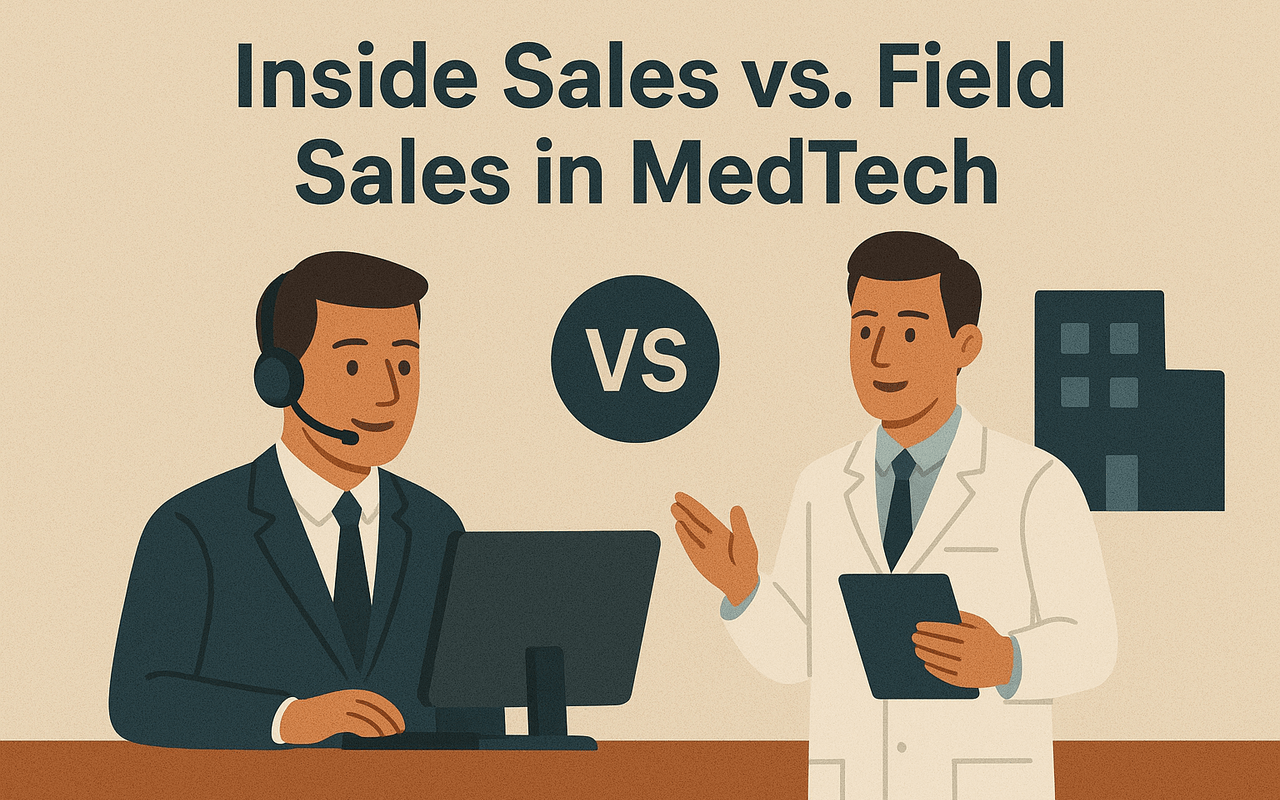
Great hybrid engines treat inside reps as force multipliers and field reps as depth specialists.
Inside sellers work the top of the funnel at speed. A typical rep might cycle through 60 calls, 40 emails, and a handful of short video demos in a single day, seeding clinical abstracts, answering basic reimbursement questions, and flagging surgeons whose procedure mix suggests unmet need.
The payoff here is reach. The same McKinsey study that quantified hybrid revenue lift also notes that 85% of B2B companies expect hybrid to be their dominant model within three years.
That forecast rests on the cold math of coverage cost. Digital touches run pennies on the dollar compared with the time required for travel, so inside teams can blanket mid-tier accounts that once languished.
Field sellers come in when the stakes and the scrutiny jump. They quarterback value-analysis submissions, guide first cases, and troubleshoot until scrub-tech confidence is unshakable.
Hospitals still bank on face-to-face reassurance when a device can change surgical workflow or add six figures to the capital budget. Even the cleanest virtual pitch can’t replace a field specialist setting up the tower in pre-op.
So, neither role works in a vacuum. If inside reps fire off webinar invitations to Dr. Hall while the field rep is en route for a demo Dr. Hall hasn’t requested, credibility sinks. Conversely, if field sellers spend a full travel day only to discover that Dr. Hall’s volume has dropped 40% since last quarter, resources go down the drain.
In the next section, we’ll show you how small data gaps between those roles snowball into months-long revenue delays and why MedTech can’t afford them.
Where Misalignment Happens and Why It Hurts Revenue
Modern MedTech sales engines rely on two parts that is inside reps who work at digital speed and field reps who work at OR depth.
When those parts grind against each other rather than mesh, the damage shows up in longer sales cycles, higher acquisition costs, and territories that never reach their full potential. Below are the four failure points that do the most harm.
Conflicting Target Lists Stall Momentum
Inside reps often pull their call lists from a marketing file ranked by procedure volume, while field reps stick to personal spreadsheets built on fellowship ties or past demos.
The split means the same surgeon can receive three different introductions or none at all within a week. Every duplicated outreach erodes trust and burns time that should be spent on net-new accounts. Industry analyses tie this kind of misalignment to revenue leaks of 10% or more annually.
Silent Hand-Offs Sink Qualified Leads
A webinar attendee who clicks “book demo” on Tuesday may never hear back if their engagement data lives in the marketing stack while the field team lives in the CRM.
The gap is huge. Studies tracking B2B funnels show 79% of marketing leads never convert because no one follows up with the right next step. In a market where a single converted account can represent hundreds of procedures a year, every lost hand-off is a direct hit to quota.
Data Gaps Extend Hospital Approval Clocks
Hospitals use Value Analysis Committees to weigh clinical benefit against cost, and those reviews already move at a glacial pace, three to six months is typical for routine submissions.
When field reps arrive without accurate utilization figures, peer-review evidence, or updated capital budget timelines, committees punt decisions to the next cycle. Each delay not only postpones revenue but also opens the door for a competitor who walks in better prepared.
The Compounded Cost
None of these failures happens in isolation. A bad list creates a silent hand-off, a silent hand-off means incomplete data when the hospital committee meets, the committee delay pushes the deal into a new fiscal year. Layer that sequence across dozens of territories and the lost upside grows quickly.
The same research that pegs misalignment at a 10% drain on revenue notes that nearly half of large enterprises still struggle to fix it, proving that the problem is systemic, not anecdotal.
Next, we’ll map out how a single, shared data layer turns those weak links into a coordinated workflow that keeps every rep focused on the right physician at the right moment.
How Shared HCP Data Intelligence Aligns Teams
When your inside and field sellers work from a single, verified map of the U.S. provider landscape, the hand-offs that used to stall now land cleanly, and revenue shows it.
Alpha Sophia brings inside and field sellers onto one regularly refreshed map of 3.9 million U.S. providers, so hand-offs that used to stall now land cleanly and revenue shows it. It lets you filter by specialty, CPT/HCPCS procedure codes, and hospital affiliation, then export those lists straight into your CRM for joint follow-up. That one source of truth does three jobs at once.
First, it settles the target-list debate before it starts. Inside reps can pull orthopedic surgeons who performed≥ 30 CPT 23472 procedures last year and know that the field rep will see the same cohort when planning on-site demos.
Second, it forces both teams to speak the same segmentation language. Procedure volumes, billing patterns, and territory slicing all live in the same profile, so a surgeon who drops below the threshold automatically rolls off everyone’s dashboard.
Third, shared data preserves context. Because Alpha Sophia lists can be pushed into any modern CRM, every email open, call note, and meeting outcome attaches to the same physician record. That alone plugs the 79% of marketing leads that normally die for lack of nurturing.
The financial lift is well documented. Companies that align outreach around a single customer view generate 32% higher revenue and win 38% more deals than peers that keep data in silos.
In MedTech, where one converted hospital can add millions in lifetime sales, that alignment is the margin between hitting and missing the operating plan.
With the data foundation in place, the next step is the process, which is building a repeatable playbook that tells every rep, remote or in-person, what happens after a surgeon raises a hand.
A Practical Framework for Coordinated Inside + Field Engagement
A framework works only if it survives Monday-morning reality. Below is a proven five-stage sequence you can slot into your existing CRM. We have assumed that your lists originate in Alpha Sophia, but the rhythm is universal.
1. Weekly Target Refresh
Start each Friday by exporting a fresh cohort. Let’s say, shoulder arthroplasty surgeons with ≥30 Medicare CPT codes in the past year and practicing at hospitals within 90 minutes of your regional airports.
Save the query so you can rerun it in seconds. Field leaders know exactly which names will populate by Monday.
2. Digital Warm-Up (Days 1-14)
Inside reps send a concise intro email, follow with a resource link, and close with a two-minute video snippet.
Every touch lives in the CRM so that field reps can see open rates and call outcomes. A study found that 79% of B2B leads die from a lack of nurturing, forcing each touch into the record to keep prospects alive.
3. Qualification & Handoff (By Week 3)
If the surgeon replies, schedules a virtual demo, or hits an engagement threshold you set. Let’s say, two content clicks plus a positive call, then the inside rep flags “Field Action Needed” and books a joint call.
4. In-Person Evaluation (Weeks 3-8)
Field reps arrive with context in hand, like the last email opened, the latest procedure count, and the hospital’s capital budget quarter. That prep matters because Value Analysis Committee approvals can take 3 to 6 months, and a single incorrect data point restarts the clock.
5. First-Case Support & Expansion
After approval, inside reps drip post-case resources while field reps proctor the first surgeries. Both update the same account record, so management can see time-to-first-case, the adoption curve, and cross-sell triggers without having to hold reconciliation meetings.
Run this cycle every month. The cadence forces continuous list hygiene, predictable hand-offs, and transparent performance metrics.
FAQs
What’s the primary difference between inside and field sales in MedTech?
Inside reps cover hundreds of digital touches, calls, emails, and short video demos. In contrast, field reps handle high-stakes, in-person work such as hospital walk-throughs, Value Analysis Committee presentations, and first-case support. Hybrid models that blend the two can reach four times more accounts and generate up to 50% more revenue when executed well.
Why do inside and field teams often become misaligned?
They typically work from different target lists and CRMs. IDC reports that this kind of go-to-market friction can drain 10% or more of annual revenue.
What types of HCP data help unify sales team strategies?
Shared, verified basics, specialty, CPT/HCPCS procedure counts, hospital affiliations, and location give both teams a single “source of truth.” Alpha Sophia’s platform exposes those exact attributes across 3.9 million U.S. providers and lets users export the lists straight into their CRM.
How should inside sales qualify HCPs before handing off to field reps?
A simple scoring gate works: threshold procedure volume (e.g., ≥ 30 annual cases), positive digital engagement (e-mail opens, replied call), and hospital affiliation within installed capital reach. Leads that cross the line move to a field-scheduled demo.
How can field reps use data to plan more effective in-person engagements?
By filtering the same database for hospital affiliations and recent procedure mix, field reps can time site visits to surgeons who meet volume criteria and practice in areas with open capital budgets, cutting “dead-on-arrival” demos.
How often should target lists be refreshed to maintain alignment?
Monthly updates are practical for most MedTech orgs, new CMS and commercial claims batches arrive on roughly that cadence, and a 30-day refresh keeps rising surgeons from slipping past your radar.
Does data intelligence replace rep judgment and relationships?
No. Data narrows the focus so reps invest relationship time in the surgeons and hospitals most likely to move the market. Clinical trust and negotiation skills still close the deal.
How does using shared data improve territory planning?
When the same procedure and location filters rank every account, leadership can draw territory lines around real opportunity density instead of legacy ZIP codes, reducing travel spend and overlap.
How can medical affairs teams support aligned sales workflows?
They can feed new clinical-evidence decks into the shared CRM record, host virtual peer-to-peer sessions that inside reps can scale, and brief field reps on trial data before VAC meetings, ensuring a single, coherent message.
What KPIs help measure the success of aligned sales engagement?
Look at lead-to-demo cycle time, demo-to-first-case conversion rate, revenue per hospital, and overall quota attainment. High-alignment companies outperform peers by more than 30% in revenue growth and deal size.
Conclusion
Inside and field teams thrive when they share one map of the market and a playbook that dictates who moves first. Skip either piece and the friction erodes revenue, lock them both in place, and you compound gains quickly.
Research shows that companies with tight sales-marketing alignment post 32% more revenue and 38% better win rates, results that no budget increase can match on its own.
Alpha Sophia doesn’t ask you to stitch data together, it hands you a ready-made provider universe with filters deep enough for niche specialties and exports clean enough for any CRM. The combination gives inside reps the speed to cover ground and field reps the insight to close, all while leadership tracks a single source of truth.
