How Top Medical Field Teams Balance Coverage and Focus in Complex Territories
On this page
Walk into any MedTech sales meeting, and someone will say the territory is too big. There aren’t enough hours, too many accounts, too much ground to cover. That diagnosis is usually wrong.
The territory isn’t too big. The account list driving the territory plan is unfiltered, built on geography alone, without clinical prioritization layered on top of it.
According to Salesforce’s State of Sales research, sales reps spend roughly 60% of their time on non-selling tasks, a figure that has barely changed in years. In the healthcare field sales, that structural drain is compounded by a second problem, which is that a significant share of actual selling time gets directed at the wrong accounts.
Reps are busy in the wrong rooms, visiting physicians who don’t have the procedure volume to justify the call, while high-value surgeons across the county haven’t been seen in weeks.
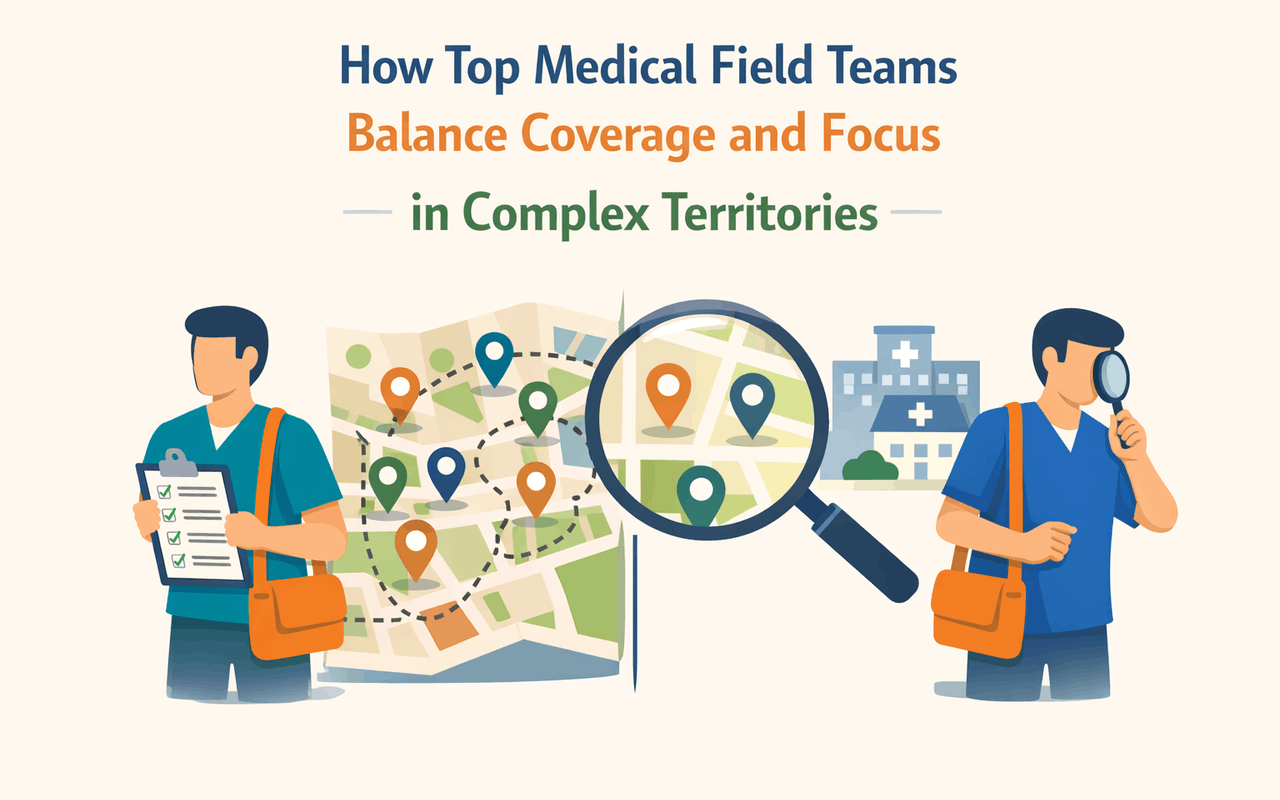
The tension between coverage and focus in medical field sales territory management is real, but it’s resolvable. The best field teams in MedTech don’t split the difference between the two. They use clinical data to define where focus belongs, then build efficient geographic coverage of those specific accounts into how their territories actually operate.
That shift starts long before a rep gets in the car.
The Coverage vs. Focus Dilemma in Healthcare Sales
A medical device sales territory can span hundreds of miles and thousands of potential accounts. Comprehensive coverage means touching every physician who could theoretically use your product. Focused execution means spending most of your time with the accounts most likely to drive volume.
The instinct is to pursue both. But teams that try end up doing neither well.
Unoptimized territory assignments and imbalanced workloads lead directly to wasted resources and missed opportunities in high-potential areas.
In concrete terms, a rep making five calls in a day, three of which are to physicians performing fewer than two relevant procedures per month, while a high-volume surgeon two cities away hasn’t had a visit in six weeks. The coverage metrics look fine. The commercial output does not.
The Two Assumptions That No Longer Hold
The coverage-first model rests on two premises that don’t hold up to scrutiny. The first was that rep time is the primary scarce resource to optimize. The second was that broad geography is a sufficient substitute for clinical prioritization when building an account list.
On the first point, physician attention is scarcer than rep time. Stricter credentialing systems and packed clinical schedules mean less face time with physicians than at any point in the industry’s history.
Getting in front of a physician is harder than it used to be, which means the question is no longer how many doors a rep can knock on, but whether the doors they knock on are the right ones. A wasted visit is a credentialing slot consumed, a calendar opening that won’t recur for weeks, and a relationship with a low-fit physician that now requires management time.
On the second, procedure volume, patient density, and clinical behavior cluster in ways that raw geographic boundaries don’t reflect. A state line or ZIP code boundary drawn on a map has no relationship to where relevant clinical activity concentrates.
Two physicians in the same specialty and the same city can have procedure volumes that differ by a factor of ten. A territory drawn by geography alone will include both of them with equal weight.
One deserves quarterly visits. The other may not deserve a visit at all. Without CPT-level billing data to distinguish between them, a rep has no basis for that call, so they default to whoever is most accessible, which is usually not the one who matters most.
Why “More Coverage” Doesn’t Always Mean Better Performance
There is an intuitive logic to maximum coverage. If you see everyone, you miss nobody. But it dilutes the interactions that generate results, creating activity that looks productive on a dashboard but moves nothing.
Pharmaceutical companies that implement strategic territory design typically see 18-25% improvements in sales force productivity, the inverse of what happens when teams default to broad coverage without clinical prioritization guiding the account list.
The Convenience Trap
When reps operate without precise account prioritization, they default to what’s accessible. Accounts near a hospital that they already service. Physicians who responded to a recent email. Offices that happen to be on the route between two existing customers.
None of these selection criteria has anything to do with clinical fit or procedure volume.
The accounts worth owning, like high-volume proceduralists, early adopters with growing practices, physicians treating the exact patient population a device addresses, often sit outside the convenient cluster.
Identifying them requires clinical data. Reaching them efficiently requires geographic planning built around where they actually are. Both steps matter, skipping the first means the second produces nothing of value.
The Efficiency Mandate
BCG’s 2025 analysis of the MedTech sector shows companies are under pressure to cut 7% to 12% off their total cost baseline, with investors now demanding commercial efficiency over growth at any cost.
Field activity metrics have always been a lagging indicator of whether a territory model is working. In the current environment, they are especially unreliable. The question commercial leaders are being asked is not how many calls the team made. It’s what revenue those calls produced per hour spent in the field.
Defining High-Value Accounts Using Clinical and Practice Data
The central problem with territory planning built purely around “potential” is that potential is generally estimated rather than measured.
Reps inherit a list, apply intuition about which accounts seem promising, and build their coverage model from there. The intuition isn’t useless, but it doesn’t scale, and it leaves meaningful revenue sitting in accounts the rep never thought to prioritize.
In MedTech, high-value accounts have observable, measurable attributes. The data exists to identify them before the first visit.
What the Data Actually Shows
Procedure volume by CPT code tells you which physicians are already billing for the procedures your device supports or replaces, meaning they have the patient population, the clinical workflow, and the billing infrastructure already in place.
ICD-10 diagnosis data tells you which clinicians are managing the specific patient populations that generate demand for your product. NPI data anchors both to an individual provider and their practice setting, so you know exactly who you’re targeting and where they operate.
A cardiovascular device company that rebuilt its target list around weekly claims data unlocked $26.5 million in incremental sales in a single launch cycle by reaching fewer physicians more precisely, rather than expanding coverage.
A Three-Dimensional Account Assessment
A high-value account in healthcare field sales satisfies three criteria.
- Clinical relevance: Does this physician treat the patient type the product is designed for?
- Volume: Does their procedure frequency justify the acquisition cost and ongoing rep time?
- Accessibility: Is this physician reachable, and are they free of a competing health system contract that forecloses the conversation?
Anaplan’s medical device sales research finds that an effective, structured sales plan is four times more likely to achieve its objectives than one without formal account prioritization, which is precisely what the three-filter framework above is designed to produce.
Alpha Sophia’s territory management capability lets field teams filter simultaneously across CPT and HCPCS procedure codes, ICD-10 diagnosis data, taxonomy, location, and practice size to surface accounts meeting all three criteria.
The output is a ranked prioritization that a rep can act on the same week, not a raw list that requires another round of manual research.
The shift in field behavior is practical. Instead of visiting every orthopedic surgery group in a region, a rep targets the specific subset already billing for adjacent procedures at volumes that signal genuine demand.
The conversation is different because the rep arrives with a clinical context the physician didn’t expect, an informed observation about the physician’s own patient volume and procedure mix.
Structuring Tiered Coverage Models
Applying equal effort to unequal opportunities is itself a form of misallocation. A tiered model gives the territory plan an internal logic that rep time investment is calibrated to account for potential and conversion probability, not to how long the account has been on the list.
A functional three-tier model in healthcare field sales looks like this.
Tier A: Core Accounts
These are the highest-volume, highest-potential accounts in the territory, physicians performing significant procedure volumes relevant to the device, with demonstrated openness to new technology and no hard institutional contract locking them into a competitor.
Effective territory planning explicitly prioritizes these accounts, like large hospital networks, specialized physician groups, and high-referral practices, which warrant structured, frequent engagement.
What makes Tier A accounts worth the investment is not only their current volume, but also their influence. A high-volume surgeon at a regional referral center shapes the purchasing decisions of the entire department. An interventional cardiologist who trains new fellows introduces a device to the next generation of proceduralists.
When a rep clusters several Tier A accounts within a tight geographic radius and visits consistently, the compounding effect of that local presence extends well beyond the individual accounts. Referrals flow, informal recommendations happen in hallways, and the rep becomes a known resource across a clinical community rather than just a visitor to individual offices.
Tier B: Development Accounts
Physicians showing emerging volume trends, smaller practices with growth potential, or clinicians adjacent to the core indication who represent future expansion opportunities. These accounts receive less frequent in-person visits, typically once per quarter rather than monthly, but should not fall entirely off the rep’s radar between visits.
Consistent digital outreach through LinkedIn or Doximity, relevant clinical content sent via email, and periodic check-ins at conferences or local events keep the relationship warm without consuming field time.
The goal is to be present enough that when a Tier B account’s volume grows, or when the rep identifies a trigger event like a new physician joining the practice or a shift in procedure mix, the transition to Tier A engagement can happen without starting the relationship from scratch.
Tier C: Monitored Accounts
Accounts not worth active rep time at present, but are worth tracking for changes that could upgrade their status.
A physician who joins a new practice, adds a partner, or starts billing for adjacent CPT codes can move from low to high priority within a quarter. The monitoring here is data-driven, rather than relationship-driven, which means setting up the right filters in a platform like Alpha Sophia to flag billing activity changes, affiliation updates, or new NPI registrations in a given geography and reviewing those signals on a regular cadence rather than waiting for a rep to stumble across the change in the field.
The discipline the tiered model requires is worth stating plainly. An effective, structured sales plan is four times more likely to achieve its objectives than one without formal account prioritization.
That means accepting that some accounts receive less service than reps might be accustomed to providing, and ensuring that activity metrics reflect the quality of engagement rather than raw call volume.
Balancing Geography with Opportunity
Geography and clinical prioritization are not competing inputs to territory design. They are sequential ones.
Clinical data identifies which providers are worth reaching. Geographic planning determines how to reach them efficiently and at a frequency that actually moves accounts through the pipeline. Both are necessary, but the sequence matters.
When Map Boundaries Mislead
The error most territory designs make is running the sequence backward, drawing geographic boundaries first, then searching for relevant providers inside them.
A territory covering three rural counties might contain one-tenth the relevant physician density of a single urban zip code immediately across the boundary line.
The rep in that rural territory works just as hard and produces materially less. In medical device sales specifically, unoptimized territory assignments and imbalanced workloads lead to wasted resources and missed opportunities in high-potential areas, which is a structural problem that no amount of rep effort resolves without redesigning the territory itself.
The better approach is to start with the universe of clinically relevant providers, filtered by CPT code, ICD-10 diagnosis data, and procedure volume, and then identify where those providers cluster geographically.
Territories get drawn around dense pockets of high-fit accounts. Alpha Sophia’s interactive map view plots provider density and procedure volume by region, so commercial teams can see where relevant physician clusters are located before assigning accounts or building routes.
Route Efficiency Follows Account Selection
Once the right accounts are identified, proximity planning becomes one of the highest-leverage things a rep can do. A tightly clustered set of Tier A accounts enables multiple face-to-face meetings in a single day, same-week return visits when a clinical question arises, and the kind of repeated local presence that builds referral compounding within a clinical community.
Surgeons talk to their partners. A rep who is a consistent presence within one hospital’s specialty group becomes a known quantity across that group’s wider referral network, and that influence doesn’t develop at a distance.
Regions with higher concentrations of clinically relevant providers warrant more allocated rep resources, whereas lower-density areas may be better served through digital outreach and lighter-touch cadence, freeing field capacity for the accounts and geographies where in-person visits generate real returns.
Turning Strategy into Daily Execution
A tiered coverage model with clinical prioritization only matters if it survives contact with the actual week.
A strategy that exists in a planning document but dissolves by Tuesday is a planning exercise, not a commercial advantage. The breakdown between territory strategy and field execution in healthcare sales typically happens in one of three places.
Data Currency
A surgeon who was a Tier A priority six months ago may have joined a health system with an exclusive contract. A Tier C account may have added a high-volume partner who now belongs in Tier A. These changes happen continuously, and they don’t announce themselves.
Territory optimization in pharma and healthcare sales directly translates to field output. Teams using route and territory optimization see up to 12% revenue growth and a 30% increase in productive field time.
The field teams with the most consistent execution treat account prioritization as a living document rather than a planning artifact, refreshing it often by filtering current claims data against the existing tier assignments and flagging accounts whose volume or affiliation status has materially changed.
That refresh cycle doesn’t require rebuilding the territory from scratch. It requires a systematic check against a defined set of signals. Platforms that surface these signals automatically make the process fast enough to actually happen on schedule, rather than getting deferred when the quarter gets busy.
CRM Discipline
Reps who don’t log what happened at every interaction can’t identify patterns in account behavior, can’t flag accounts going cold, and give managers no visibility into territory-level issues before they affect quota.
The time immediately following a physician meeting is the right moment to capture notes, products discussed, surgeon feedback, and follow-up actions, details that are easily lost if logging gets deferred.
The deeper value of consistent CRM discipline is what that record enables. A rep who has logged six months of interactions with a Tier A surgeon can identify exactly what objections recur, what clinical questions remain unresolved, and what the next meaningful conversation should address.
A sales manager reviewing that record can spot when an account that used to generate regular activity has gone quiet, and intervene before the silence becomes a lost deal.
Territory intelligence only accumulates when it gets captured. A CRM with six months of spotty entries doesn’t tell you much. One with six months of complete, structured entries tells you nearly everything you need to manage the territory intelligently.
Protecting the Call Plan
Many reps start the week with a clear plan and abandon it by midweek. This is the most common and most preventable form of territory underperformance.
A systematic weekly planning approach that explicitly allocates time between core accounts and development prospecting replaces reactive scheduling with a structure that keeps the pipeline moving.
That means treating Tier A visit slots as committed appointments that require a genuine reason to move. It means building geographic clusters into the weekly structure so that travel time between accounts is minimized and the day’s capacity goes to meetings rather than miles.
How Alpha Sophia Supports Smarter Territory Execution
The distance between good territory strategy and poor field execution usually comes down to one thing, which is data specific enough to make prioritization decisions defensible.
Without procedure-level intelligence, reps fall back on prior relationships and familiarity, working the accounts they already know rather than the ones the market data says they should be in front of.
Claims Data as the Foundation
Alpha Sophia provides MedTech field teams with a billing-level view of clinical activity for approximately 80% of US medical claims, covering Medicare, Medicaid, government, and commercial payors, and more than 300 million patient lives.
This is the data that shows which providers in a territory are already billing for the procedures a device supports, at what volume, in what setting, and at what trend over time.
From Specialty Targeting to Indication Targeting
With ICD-10 diagnosis data now available on the platform, the targeting precision extends beyond procedure-level filtering.
Rather than identifying physicians by specialty category alone, a rep can isolate the clinicians managing patient populations with the specific diagnoses that generate demand for their device. The difference is that a specialty filter returns all orthopedic surgeons, but an indication-level filter returns the orthopedic surgeons whose patients have the conditions the device is designed to treat.
Alpha Sophia’s filters span CPT and HCPCS codes, ICD-10 diagnosis data, taxonomy, practice size, and location, with results surfaced in minutes rather than days of manual research.
The platform’s comprehensive provider profiles include manufacturer payment history, show existing device relationships to flag competitive accounts, and include institutional affiliations, procedure volume trends, and social profiles on LinkedIn and Doximity for outreach planning.
Connecting Territory Design to Field Execution
The most effective commercial teams keep their HCP target lists updated on a rolling schedule and feed them directly into the tools reps and managers use daily.
Alpha Sophia’s Territory Manager is where that connection becomes operational. Commercial teams can build, edit, and manage territories nationwide using actual driving distance in miles rather than straight-line geographic estimates or ZIP code proxies.
The starting point is clinical, filter by CPT code, ICD-10 diagnosis data, or procedure volume to surface the providers that matter, then see immediately where they cluster on a map. The clinical question and the geographic question get answered in the same workflow.
From there, the territory manager allows teams to set a starting point and an end point for a rep’s coverage area, structuring the day around a logical geographic arc rather than a scattered list of accounts.
A rep who begins at a home base, moves through a cluster of Tier A accounts, and finishes at a point that positions her for the next day’s calls is executing a plan. A rep driving reactively between whoever responded to a last-minute confirmation is not. That structural difference compounds across a quarter.
Within a defined territory, the driving distance data lets reps identify which priority accounts sit within a 60- or 90-minute radius, rank them by procedure volume, and sequence visits to minimize backtracking.
The result is a week built around geographic clusters rather than alphabetized CRM entries, with longer surgeon meetings anchoring the day and shorter follow-up visits filling the gaps efficiently.
Alpha Sophia supports the full loop through its built-in CRM functionality, export to Excel, and native integrations with Salesforce and HubSpot. The territory map built in planning becomes the call list used in the field, which means the strategic prioritization logic doesn’t get lost in translation between planning and execution.
The result is a field model in which Tier A accounts are Tier A because the data says so, and in which geographic routing is built around those accounts rather than determining which accounts make the list in the first place.
Conclusion
The coverage-versus-focus debate tends to surface whenever a team is struggling. Too many accounts, too little time, quota pressure from above. The instinct is to work harder and wider.
In most cases, the correct move is to narrow intelligently, fewer accounts, higher-quality engagement, clinical data driving the account selection, and geographic planning guiding the execution.
That shift requires upfront precision in how the account list gets built and how the territory gets tiered. It also requires a willingness to accept that some physicians in the territory won’t be visited on a given cycle and that this is a deliberate decision, not a gap in coverage.
Alpha Sophia gives lean MedTech commercial teams the data infrastructure to make those decisions with confidence, the same billing-level intelligence, CPT and ICD-10 filtering, and territory mapping capability that was previously accessible only to enterprise operations with large data budgets.
FAQs
What does coverage vs. focus mean in healthcare field sales?
Coverage means touching every physician who could theoretically use your product. Focus means concentrating rep time on the accounts with the highest procedure volume and conversion probability. The right approach is neither in isolation, it’s using clinical claims data to define where focus belongs, then building geographic coverage efficiently around those specific accounts.
Why do field sales teams struggle with large territories?
Large territories create a prioritization problem before they create a logistics one. Without a clinical prioritization framework, reps default to familiarity and proximity rather than procedure volume and fit, and activity metrics look acceptable while quota attainment suffers, because the activity is directed at the wrong accounts.
How can reps prioritize high-value accounts?
Filter by CPT and HCPCS codes specific to the device category to identify physicians already billing for relevant procedures at meaningful volume. Cross-reference with ICD-10 diagnosis data to confirm the right patient population, then assess accessibility. That three-part filter, clinical relevance, volume, and accessibility, produces a shortlist worth building the territory around.
What are common mistakes in territory coverage planning?
Building territory boundaries from geography alone without filtering for clinical relevance first, failing to tier accounts, which spreads equal effort across unequal opportunity, and treating geography and clinical fit as substitutes for each other rather than the sequential inputs they are.
How can sales leaders improve field execution consistency?
Three things, a weekly call planning discipline that protects priority account slots from reactive scheduling, a CRM logging habit that captures every interaction with enough detail to identify patterns over time, and a regular data refresh cycle that updates account tier assignments based on current billing activity rather than last cycle’s assumptions.
