How MedTech Teams Analyze Procedure Mix at Healthcare Organizations
On this page
A MedTech team evaluating a hospital or physician group usually starts with what is easy to see, such as the name of the system, the bed count, the specialty listed on the website, and the ZIP code.
None of that tells you whether the account is a real fit for a specific device, diagnostic, or implant.
Two orthopedic groups a mile apart can run very different clinical operations, and a 300-bed community hospital can perform more of your target procedure than an academic center three times its size.
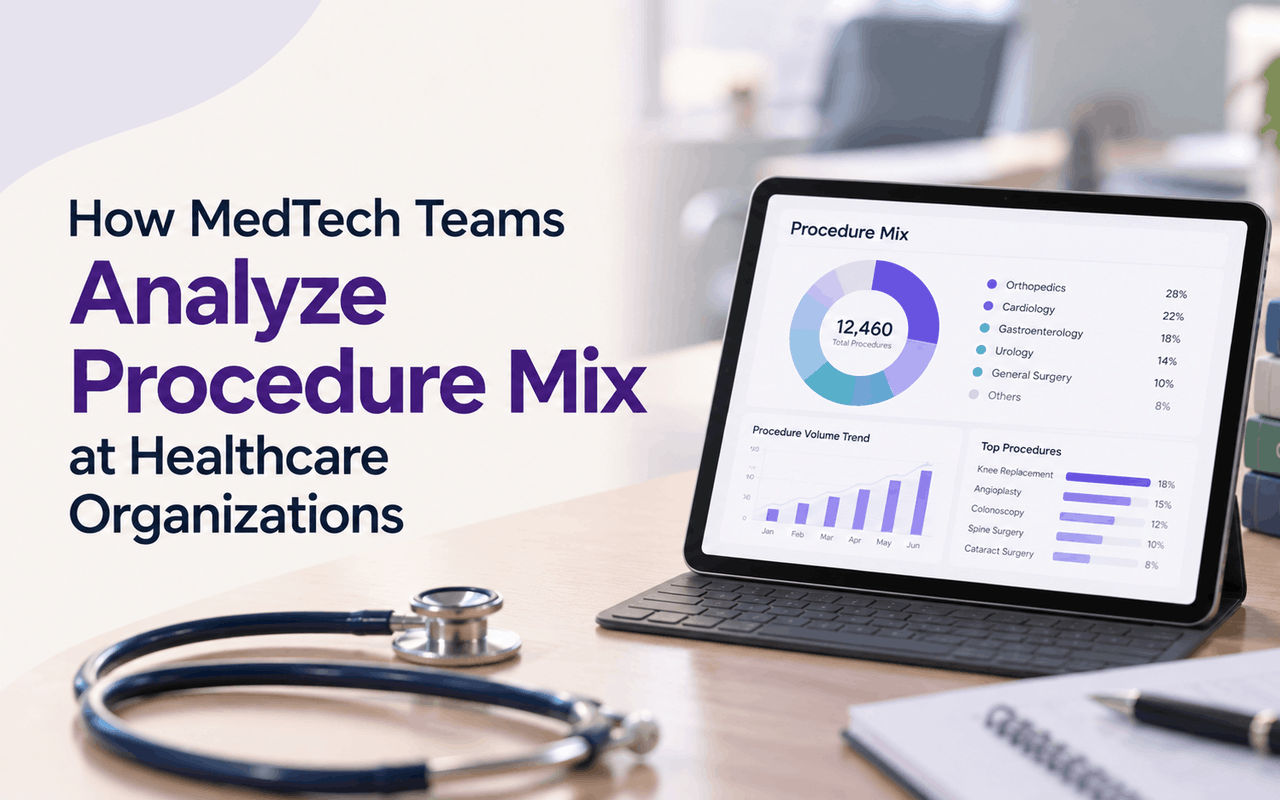
The signal that predicts fit sits underneath the label, in the procedures the organization performs and the proportions it performs them in. That composition is its procedure mix, and reading it is how commercial teams decide which accounts deserve a rep’s time and which ones do not.
A mix can also reveal how an organization practices, not only what it treats, which is often the more useful signal when launching something new.
A site billing a high share of robotic-assisted or minimally invasive approaches while its peers still code the open equivalents is showing early technology adoption, and early adopters tend to be the natural first customers for a new device.
Category III CPT codes work as the same kind of leading indicator, since the AMA reserves them for emerging technologies, so an organization already billing them is one that trials new techniques ahead of the market.
A mix that concentrates heavily in a narrow, high-acuity sub-procedure marks a de facto center of excellence, the kind of account whose adoption carries reputational weight with peers.
None of these signals appears in the organization’s name, and all of them are legible in its code composition.
Why Procedure Mix Matters When Evaluating Healthcare Organizations
The category an organization falls into has become a weak proxy for what it actually does. Ownership and structure have shifted underneath the labels teams still rely on.
The share of physicians working in private practice fell from 60.1% in 2012 to 42.2% in 2024, while the share in hospital-owned practices rose from 23.4% to 34.5%.
So a name like “hospital,” “health system,” or “orthopedic group” now covers a wide range of clinical realities, and two organizations with the same descriptor can look nothing alike once you see their case volumes.
Procedure mix cuts through that ambiguity because it measures activity rather than identity. For a product tied to specific procedures, fit is a direct function of whether those procedures happen inside the account, and at what scale.
An organization can carry an impressive name and still perform almost none of the procedures your device supports. Another can look unremarkable on paper and turn out to be one of the busiest sites in the region for exactly the work you care about.
There is also a hard resourcing reason to lead with mix. Field reps and marketing budgets are finite, and every call spent on a low-relevance account is a call not spent on a high-relevance one. Prioritizing by procedure mix replaces broad geographic assumptions with a ranked view of where the clinical activity actually concentrates, which is the difference between covering a territory and working it.
Analyzing Procedure Volume Across Healthcare Organizations
The unit of analysis for all of this is the code. CPT and HCPCS codes describe what was done, and claims records tie each code to the provider who performed it and count how often. Roll those provider-level counts up to the organization and you have volume, the raw magnitude of a procedure inside an account.
Layer diagnosis context from ICD-10 and you can separate the clinical scenarios where a procedure is indicated from the ones where it is incidental.
Why Mix Adds a Signal That Volume Alone Misses
Volume and mix are related but distinct. Volume is how much of a procedure an organization does. Mix is how that volume is distributed across procedure types, which reveals the organization’s clinical character rather than just its size.
A large account with high absolute numbers spread thinly across many service lines can be a worse fit than a smaller account that concentrates on your target procedure.
What Procedure Composition Reveals That a Label Can’t
Read closely, that composition tells you three things a label cannot. The most immediate is clinical focus.
A site running high volumes of spine fusion and joint replacement is a fundamentally different account from one built around diagnostic endoscopy, even when both are classified as hospitals.
Case complexity is a second reading. A mix weighted toward high-acuity, resource-intensive procedures signals a different capability, and a different buying committee, than a mix of routine outpatient work, and that distinction often decides which stakeholders a rep needs to reach.
Care setting is the third, and it has become harder to read from the outside and more valuable to read from the data. The same procedure increasingly happens across inpatient wards, hospital outpatient departments, and ambulatory surgery centers.
CMS began phasing out its Inpatient-Only list over three years starting in January 2026, and for 2026 alone it removed 285 HCPCS codes, most of them musculoskeletal, and added 271 of them to the ASC covered-procedures list.
Complex cardiovascular, spine, and advanced orthopedic cases are moving into ambulatory settings as well. An organization’s mix now tells you not just the work it does, but where that work is migrating.
Connecting Procedures With the Specialties and HCPs Performing Them
Volume at the organization level is a starting point, not an endpoint, because procedures are performed by individual clinicians with specific specialties and taxonomies.
Connecting a procedure line back to the HCPs behind it answers two questions at once. It confirms whether the organization has the specialist base capable of adopting your product, and it turns an account into a list of named, reachable people rather than a single entity.
Concentration is the reason this connection is worth making. Within a procedure family, activity often narrows to a thin set of providers. Unicompartmental knee arthroplasty has accounted for under 5% of knee replacements since 2015, and 93% of those cases are performed by surgeons who do 15 or fewer a year.
A device tied to a sub-procedure like that lives or dies on identifying the handful of surgeons inside an account who actually perform it, not the department they sit in.
Specialty also shapes where a procedure sits organizationally, which affects how you reach the people performing it.
Private practice remains far more common in some specialties than others, with roughly 54% of orthopedic surgeons and 70.4% of ophthalmologists still in private practice compared with far lower shares elsewhere.
So the same procedure can be concentrated in independent groups in one specialty and inside large hospital-owned departments in another, and your targeting has to follow the clinicians, not a generic org type.
Comparing Procedure Mix to Evaluate Account and Product Fit
Reading one organization’s mix prepares a single call. Building a territory means finding every organization that shares a matching profile, which is a filtering problem across a large universe.
There are roughly 6,300 Medicare-certified ambulatory surgery centers in the United States, with California alone home to 894, and that sits on top of thousands of hospitals and physician groups. No team can evaluate that landscape one account at a time.
Filtering by the CPT and HCPCS codes tied to your product narrows that universe to organizations that actually perform the relevant work, and screens out the ones that do not. The filter has to include a volume threshold, because presence alone is misleading.
An organization that bills a procedure a few times a year is not the same opportunity as one that does it weekly, even though both would show up on a simple yes or no search. Where care is delivered belongs in the filter too.
Surgical volume continues to shift from inpatient and hospital outpatient settings into ASCs, which means the organizations performing your target procedure this year are not necessarily the ones that performed it three years ago. A profile built only on hospital data misses the ambulatory centers that now carry a growing share of the work.
Narrowing to a candidate set is only half the work, because two organizations can both clear the filter and still represent very different opportunities. Performing a procedure and doing enough of it to be a genuine center are not the same thing.
Among hospitals that electively perform certain high-risk surgeries, fewer than 3% fully met the volume standard for open abdominal aortic aneurysm repair or esophageal resection in one national assessment.
An account that shows up in a procedure search may still be doing too little of the work to justify a commercial investment, and only a comparison against peers surfaces that.
Turning Organization-Level Procedure Data Into MedTech Sales Priorities
Analysis only earns its keep when it changes what reps do on Monday morning. Account tiering is the most direct translation. Ranking organizations by procedure fit and volume produces a defensible A, B, and C list, so the highest-fit accounts get worked first and the marginal ones stop absorbing time they do not deserve.
That ranking follows the same prioritization logic behind targeting the surgeons who already do high volumes of your relevant procedure rather than calling every practice in a specialty.
Territory design is the next step out. Organized around procedure activity rather than ZIP codes or headcount, territories can be built around where the relevant clinical work concentrates, which keeps reps in front of high-opportunity accounts and reduces the time lost to low-yield travel. Opportunity clusters, not geographic tidiness, drive the boundaries.
The conversation itself changes too. A rep who walks in knowing an organization performs a specific volume of a specific procedure opens with clinical relevance rather than a generic pitch. That grounding also tells marketing which accounts and personas to support with the right campaigns and materials.
Across all three, the payoff is efficiency. When rep capacity is fixed, directing it by procedure fit rather than by broad assumptions raises revenue per rep, the metric commercial leaders are increasingly held to.
How Alpha Sophia Helps MedTech Teams Analyze Procedure Activity at Healthcare Organizations
Alpha Sophia is an external, NPI-anchored, all-payor US medical claims reference layer covering more than 4 million providers across Medicare, Medicaid, and commercial payors. It gives commercial teams a single place to query procedure activity, so the mix, volume, and provider analysis described above becomes a set of filters rather than a data-engineering project.
The team owns the interpretation and segmentation; Alpha Sophia supplies the reference to work from.
For procedure mix specifically, teams filter providers and organizations by CPT and HCPCS codes, ICD-10 and CCSR diagnosis context, taxonomy, affiliations, open payments, publications, and clinical trials.
Provider profiles and affiliation data let individual HCP activity roll up to the organization, so an account can be read as the sum of the clinicians inside it. Cohort analysis supports the peer comparison that separates genuine centers from occasional performers, and the Territory Manager turns those fit judgments into territories, driving-distance calculations, and rep routes across the country.
Access is built for how commercial teams actually work. Alongside the in-app assistant, teams can connect their own AI through Alpha Sophia’s MCP integration or run fully autonomous workflows, using tools such as Claude, ChatGPT, and Cursor.
For teams feeding procedure data into their own systems, the Provider API supports custom integration. The point throughout is to make organization-level procedure activity queryable in minutes, so a target list reflects clinical reality rather than a name on a directory.
Conclusion
Labels like system name, bed count, and listed specialty place an organization in a category, but they say little about whether it is the right account for a specific product. Its procedure mix answers that.
As ownership consolidates, care shifts across settings, and procedure activity concentrates in a thinning set of providers, those labels explain less and less about where the real opportunity sits.
Teams that read procedure mix at the organization level, connect it to the specific clinicians performing the work, and rank accounts by genuine fit end up spending finite rep time where the clinical activity actually is.
That is a more accurate and more efficient way to decide who to call, and it is available to any team willing to work from the data.
FAQs
What is procedure mix analysis?
Procedure mix analysis is the practice of reading the composition of procedures a healthcare organization performs, identified by CPT and HCPCS codes, along with the volume of each. It shows an organization’s clinical focus, complexity, and care setting rather than relying on its name or specialty label.
How can MedTech companies use procedure data?
MedTech companies use procedure data to find and qualify accounts, confirm that a target procedure actually happens at meaningful volume inside an organization, and identify the specific clinicians performing it. It also supports territory design and account prioritization.
Why analyze procedure mix at the healthcare organization level?
Purchasing and adoption decisions frequently happen at the organization level, so the organization is the natural unit for evaluating opportunity. Organization names and specialty labels reveal little about actual clinical activity, especially as ownership consolidates.
How does procedure volume help identify MedTech sales opportunities?
Volume in the codes tied to a product signals real demand and justifies the cost of a rep pursuing the account. Low or zero volume screens out organizations that would otherwise look plausible on paper.
How can MedTech teams compare procedure mix across healthcare organizations?
Teams compare procedure mix by benchmarking one organization against a cohort of similar organizations on the same set of relevant codes. This shows whether an account over-indexes or under-indexes on the target procedures relative to its peers.
How does Alpha Sophia help MedTech teams analyze healthcare organization procedure data?
Alpha Sophia is an external, all-payor claims reference layer that lets teams filter more than 4 million providers by CPT, HCPCS, ICD-10, taxonomy, and affiliations. Individual HCP activity rolls up to the organization, cohort analysis supports peer comparison, and the Territory Manager turns fit judgments into territories and routes.
