How Commercial Teams Create a Single Source of Truth for Healthcare Provider Data
On this page
Look up the same physician in your CRM, your claims-targeting tool, and your marketing automation, and you will often get three different answers.
The CRM lists Dr. Sarah Chen at a practice she left eight months ago. The claims-targeting tool has her at a hospital outpatient clinic under a slightly different spelling of her name. Marketing automation still treats her as a separate contact, because someone imported a vendor list last quarter and nobody reconciled it against what already existed.
Same doctor, one NPI, three records that don’t match.
This is the normal state of provider data inside a commercial organization, and it costs money in many ways. Reps work old addresses, campaign emails bounce, two account owners claim the same physician.
Leadership reports double-count revenue because the same provider sits under two internal IDs. None of it appears as a line item, but all of it drags on territory coverage and forecast accuracy.
The problem also gets worse on its own. Roughly 3% of provider demographic information changes every month, and somewhere between a fifth and a third of physicians change practice affiliations in a given year, according to provider data research.
Even by a stricter measure, a peer-reviewed analysis of Medicare billing in Annals of Internal Medicine put annual physician turnover at 7.6% by 2018, counting only those who stopped practicing or moved to a different practice.
A list that was accurate in January is measurably wrong by summer. A single source of truth is the standard response to this, and it is also one of the most misunderstood terms in commercial operations. Most teams treat it as software they can buy. It is closer to a discipline they have to maintain.
What Does a Single Source of Truth for Provider Data Mean?
A single source of truth is not one big database where you dump every provider list you own. A data warehouse can happily hold five conflicting versions of the same physician.
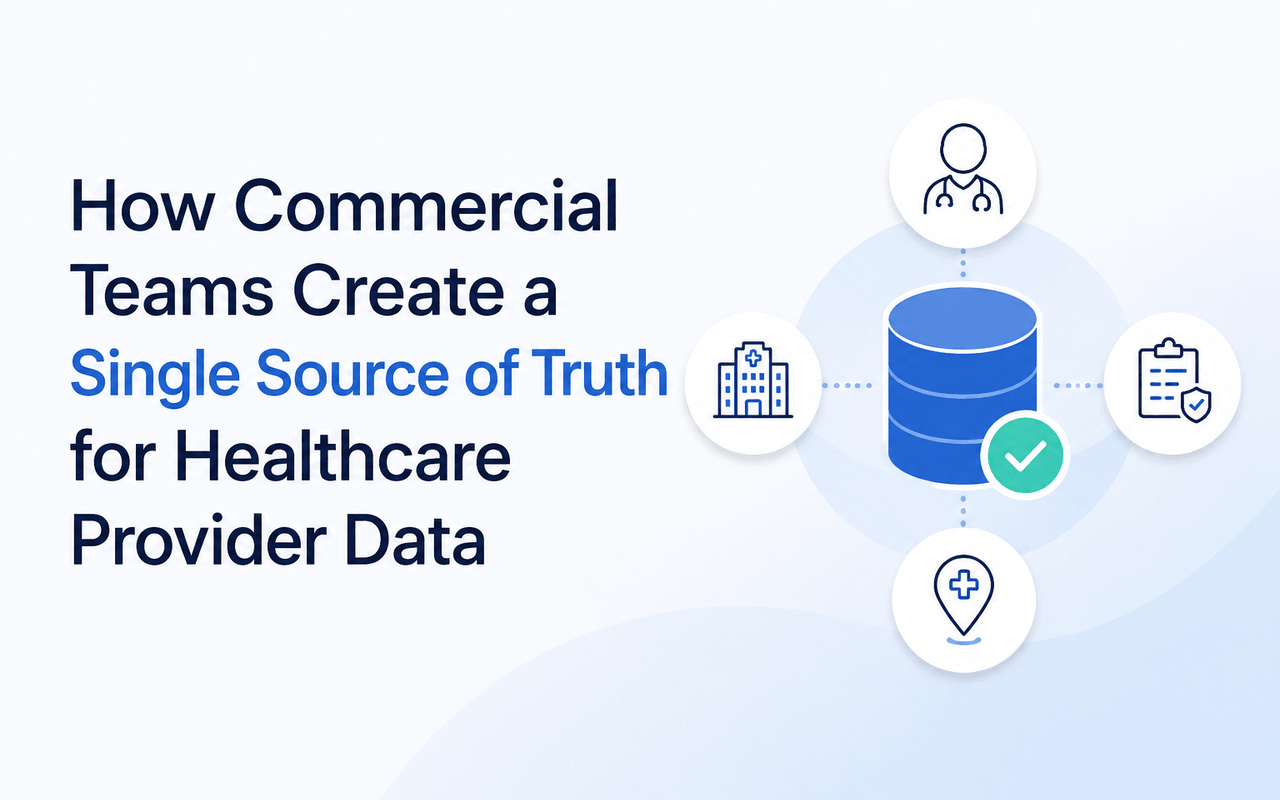
A single source of truth means that for any real-world provider, exactly one record is authoritative, and every downstream system agrees to defer to it.
That definition only holds up if three things are true at the same time.
First, There Is One Record Per Provider
Duplicates have been found and collapsed, so the same physician does not exist twice under two slightly different name spellings or two internal IDs.
This is the identity resolution problem, and it is harder than it sounds because the inputs are messy by the time they reach you.
Second, Authority Is Assigned At The Field Level
The address might be most reliable from your claims source, the specialty from a credentialing feed, the affiliation from an external reference set.
A real single source of truth records which system wins for each field, rather than letting the most recent import overwrite everything.
Third, The Record Stays Current
Provider data decays every month, so a truth that is set once and left alone stops being true. The source has to be reconciled against reality on a cadence, not cleaned once and declared finished.
The National Provider Identifier is the natural backbone for all of this. It is the federal, non-repeating identifier that every HIPAA-covered provider must carry, which makes it the obvious common key across otherwise siloed systems. But the NPI was deliberately built with, in the regulation’s own language, no intelligence encoded in the number.
As noted in an analysis of provider matching, the NPI tells you a provider exists and gives you a durable key, but it does not tell you how many internal records you already hold for that provider, which address is current, or whether two records should be merged or kept apart.
NPI matching is necessary for a single source of truth. It is not sufficient by itself.
Why Do Commercial Teams End Up With Multiple Conflicting Sources?
The fragmentation is not a sign that anyone did their job badly. It is the predictable result of how commercial systems get bought and used over time.
Understanding the actual causes matters, because a team that treats this as a one-time mess to clean up will watch the same mess regrow within a year.
Systems Were Bought At Different Times For Different Jobs
The CRM was bought to manage the pipeline. The claims-intelligence tool was bought later to target by procedure. Marketing automation came in on its own track.
Each one ingested a provider list separately, from a different vendor or export, with no shared key enforced between them. They were never designed to agree.
Manual Entry Introduces Duplicates
A rep types “Dr. Bob Smith” where the credentialing record says “Robert Smith, MD.” A territory list gets pasted in with a transposed suite number.
Small discrepancies like 123 Main Street against 12 Main Street are exactly the cases that automated matching struggles with, which is how one provider quietly becomes two records.
Purchased Lists Pile Up Without Reconciliation
A new campaign needs reach, someone buys a list, and it lands in the system as net-new contacts rather than being matched against providers already on file. Every unreconciled import widens the gap.
Providers Move Faster Than Systems Update
Even if two systems started identical, affiliation churn pushes them apart over the following months. One system gets updated when a physician changes hospitals, the other does not, and now they disagree through no data-entry error at all.
No One Owns Provider Data
Provider data is everyone’s input and no one’s responsibility. Sales ops, marketing, and field reps all write to it, nobody is accountable for whether it stays coherent.
That is the root cause that keeps regenerating the symptom, and it is why provider data management has to be framed as an ongoing function rather than a project with an end date.
How Do You Consolidate Provider Data Into One Trusted Source?
Consolidation is a sequence, and the order matters. Skipping the early steps is what produces a clean-looking master file that is confidently wrong.
- Set the primary key, then plan for the cases where it fails.
The NPI is the spine you build on. The catch is that it is unreliable in your raw data: more than 30% of provider records contain an inaccurate or missing NPI, per the analysis cited above.
You cannot simply join every system on NPI and trust the result. You need a plan for records that lack a valid NPI and a way to catch records that carry the wrong one.
- Run identity resolution in two passes.
Start with deterministic matching, where an exact, verified NPI collapses obvious duplicates. Then layer probabilistic matching for everything that did not resolve cleanly, scoring likely matches on name, address, taxonomy, and other attributes.
This second pass is the heart of physician record matching, and it is where you recover the duplicates that a naive NPI join leaves scattered.
- Write survivorship rules before you merge.
When two records disagree on an address, something has to decide which value survives. Make that decision by source reliability and recency rather than by whichever import ran last.
- Validate against an external reference.
Internal systems can agree with each other and still be unanimously out of date, because they share the same stale inputs and the same blind spots. Reconciling your resolved records against an outside source, one grounded in current provider activity rather than self-reported credentials, is what catches the affiliations that quietly changed underneath you.
- Write the result back and govern it.
Push the authoritative version into the systems that need it, and lock in a reconciliation frequency so the next round of changes gets caught. Provider data integration is only finished when the truth flows back to the systems of record, not when the merge completes.
What Keeps Teams From Going Back to Separate Lists?
The technical merge is the easy part. Staying merged is the hard part, and it is where most single-source-of-truth efforts quietly fail.
A team can spend a quarter consolidating provider data, ship a clean master file, and watch it fragment again within months because nothing was put in place to hold it together. A few practices are what keep that from happening.
Assign One Accountable Owner
One person or one function, usually commercial operations or a dedicated data steward, has to be accountable for provider data quality. Shared ownership means no ownership, and provider data is the field most prone to that gap.
Reconcile On A Schedule Against An External Source
Because roughly 3% of records change monthly, an annual cleanup is already obsolete by the time it ships. A standing cadence, tied to a reference set that reflects current provider reality, keeps the truth from drifting back into fiction.
Kill The Side-Lists
If reps keep private spreadsheets because the governed source is slower or harder to use, the single source of truth is already dead.
The governed record has to be the easiest thing to reach, not the most complete file that nobody opens. The fix is usually workflow, not policy: make the trusted source the path of least resistance.
Enforce Write-Back Discipline
Enrichment and corrections have to flow back into the system of record, not into a personal export that diverges the moment it is saved.
Measure Change As A Health Metric
Track match rates, duplicate counts, and email bounce or return-to-sender rates over time. When those numbers change, the single source of truth is degrading, and you want to know before leadership notices it in a misforecast.
Treating healthcare CRM data quality as something you monitor, rather than something you assume, is what turns a one-time project into a maintained asset.
How Does Alpha Sophia Serve as the External Anchor for a Single Source of Truth?
The piece that internal systems cannot supply on their own is the external check, the outside reference that tells you whether your resolved records match the provider world as it actually looks this quarter.
That is the specific role Alpha Sophia plays. It is not your CRM and not your master data platform. It is the external anchor you reconcile against.
A Clean Single NPI
Alpha Sophia’s provider database covers every NPI-registered HCP in the United States, with each record built around the NPI.
That gives you a complete, consistently keyed reference to match your messy internal lists against, which is exactly what identity resolution needs on the other side of the join.
Records Reflect Current Activity
What makes it an anchor rather than just another list is that the records reflect what providers actually do. The platform draws on claims data spanning more than 300 million patient lives across four payer types, Medicare, Medicaid, Government, and Commercial.
A provider’s stated specialty on a years-old credentialing document often has little to do with their current practice. Claims-derived activity shows the present reality, which is what catches the affiliation churn that quietly breaks internal records.
Survivorship Decisions
The fields you need to resolve disagreements are there too. When two of your internal records conflict, current affiliation, taxonomy, location, manufacturer payment relationships from Open Payments, and verified social profiles give you outside tie-breakers, so the surviving value is chosen against external evidence rather than by whichever system imported last.
API To Make Reconciliation Continuous
For teams maintaining a single source of truth at scale, the Alpha Sophia provider API turns reconciliation into a continuous process rather than a one-time event.
It lets you resolve NPIs and validate or enrich records programmatically, feeding the reconciliation cadence directly instead of relying on a manual export every quarter. Validated records can then be pushed back through CRM integration.
Conclusion
A single source of truth for provider data is a discipline. The part teams most often miss is the external check.
Internal systems can reach perfect agreement and still be wrong together, because they share the same stale inputs. An outside reference grounded in current provider activity is what keeps internal consensus honest.
Without it, a single source of truth slowly becomes a single source of confidently shared error, which is harder to catch than open disagreement because nothing in the system flags it. With it, the master record stays anchored to the providers as they actually are, which is the only version of the truth that helps a commercial team sell.
FAQs
What is healthcare provider data management?
Healthcare provider data management is the ongoing practice of acquiring, resolving, maintaining, and governing records about physicians and other healthcare providers so they stay accurate across every system that uses them. It covers identity resolution to remove duplicates, standardization of fields like name and taxonomy, validation against reliable sources, and a maintenance cadence that keeps records current as providers change practices and affiliations.
What does a single source of truth for provider data require?
It requires four things working together. Identity has to be resolved, so each real-world provider maps to exactly one authoritative record. Authority has to be assigned at the field level, so a defined source wins for the address, another for the specialty, and so on. The record has to be validated against an external reference that reflects current provider activity, because internal systems can be wrong in agreement.
How does provider master data management support commercial teams?
Provider master data management gives commercial teams one authoritative record per provider, which means territory design, targeting, and reporting all run on the same underlying truth. It prevents the two most expensive failures of fragmented data, misrouted field effort, and inflated reporting.
How does provider data integration improve healthcare CRM data quality?
A CRM degrades over time because it fills with self-entered records and aging imports that no longer match reality. Integrating a validated external provider source replaces that decayed data with records grounded in current activity, and keeps replacing it on a cadence rather than once.
What role does NPI matching play in healthcare data standardization?
The National Provider Identifier is the federal common key that lets otherwise siloed systems align on the same provider, which makes NPI matching the natural first step in standardizing provider data. Its limit is that the NPI was built with no intelligence encoded in the number, so it confirms a provider exists but does not resolve internal duplicates, indicate which address is current, or signal whether two records should merge.
