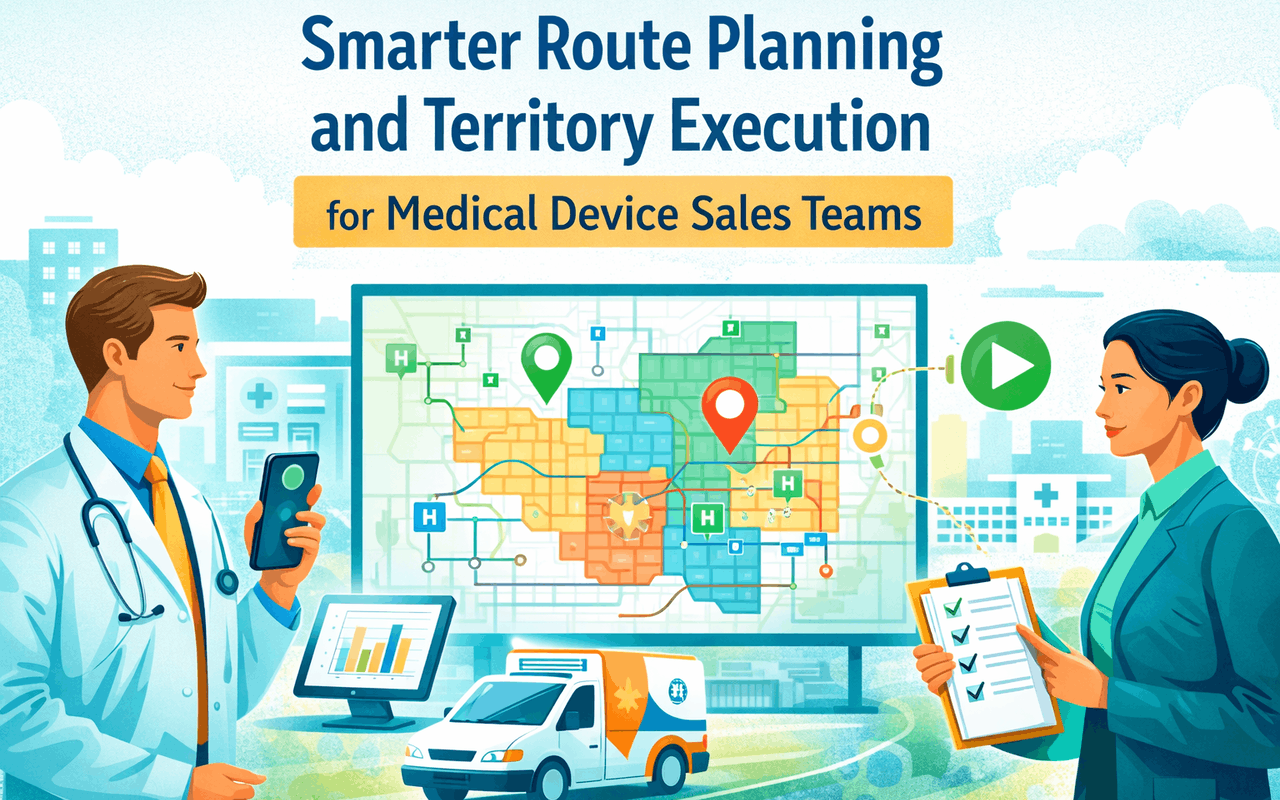
Smarter Route Planning and Territory Execution for Medical Device Sales Teams
On this page
Hospital device sales teams keep asking why pipelines look healthy on paper yet sputter in the field. The answer is structural.
In 2026, the 10 largest U.S. integrated-delivery networks (IDNs) now book roughly $240 billion in net-patient revenue, almost one-sixth of all hospital spend, so buying decisions that once lived in county-level committees are often sealed in a single corporate boardroom.
At the same time, procedures are escaping those flagship hospitals. Medicare data show that 3.4 million fee-for-service beneficiaries were treated in ambulatory surgery centers (ASCs) last year, a shift MedPAC calls structural, persistent, and accelerating.
Add the reality that only 32% of oncologists, often the early warning for other high-procedure specialties, still allow unrestricted rep visits, and you have a map that promises access the street can’t deliver.
Moreover, GPS telemetry from field-sales studies shows reps lose 30-50% of their paid hours to the windshield when routes aren’t engineered around real traffic and clinic windows, yet divisions that plugged algorithmic routing into the daily call list lifted new-prospect meetings by 57% and nudged revenue by 12% within a quarter.
When a territory model ignores those minutes and the credentialing kiosks that shave another few hours each month, quotas become ambitious to impossible before the quarter even starts.
In short, geography has become the least predictive variable in rep productivity. Any healthcare territory planning framework that fails to fuse provider-level opportunity, network membership, the real-world constraints of drive time, traffic patterns, parking delays, and facility badge windows into a single model.
In this piece, we’ll walk you through how to replace that fiction with data-driven territory design and route-first execution your reps can actually live with.
Why Traditional Territory Design Breaks Down in the Field
Legacy territory models were built for a world where a single hospital purchase committee, often chaired by the chief of surgery, could green-light your implant tray for every OR on campus. That world is gone.
The problem today is the planning math under the territory map. Buying decisions have consolidated at corporate headquarters, procedures migrate to outpatient sites, clinic doors open for tighter time slots, and the road swallows hours that never show up on a dashboard.
Until territory design accounts for those four forces, even the hardest-working field team will chase numbers the map can’t physically deliver.
1. Corporate purchasing now controls a critical mass of patient flow
The top 25 integrated-delivery networks account for more than 11 million hospital discharges a year, roughly one in every three U.S. inpatient stays.
When a single value-analysis team in Nashville or Chicago says “no” to a product category, dozens of hospitals flip at once. Territory boundaries that ignore IDN contracts let multiple reps chase the same locked-out facility while leaving genuine white space untouched.
When procurement moves to the corporate level, county lines and individual facility budgets no longer predict who actually signs off on an implant tray.
2. Surgeons Split Their Caseload Across Multiple Sites
The ASC market reached US $134.9 billion in 2023 and is projected to grow 6% annually through 2030.
Orthopaedic and ENT specialists now spend part of the week in an ASC and the rest in an acute-care OR. A map that assigns each street address to a different rep turns one surgeon’s calendar into two competing sales cycles.
3. Shrinking Access Windows Reduce Visit Capacity
For the first time, 53% of U.S. physicians place moderate-to-severe limits on rep visits. Shrinking windows mean a rep cannot simply “drop in” between cases. Any plan that still assumes open-door policies inflates expected call capacity and, by extension, inflates quota.
A related shift has further tightened the schedule. Only 42% of doctors now work in private practice, down from 60% a decade ago. Consolidation into larger groups often pushes scheduling and credentialing through central offices, adding extra lead time for every visit.
4. Drive Time Cuts into Selling Hours
A field study took a six-stop route that originally logged 6 hours 30 minutes of driving and cut it to 5 hours 28 minutes, 16% less time and 47% fewer miles.
Multiply that saving across a quarter, and the difference equals weeks of extra selling capacity. Territory models that ignore traffic, parking, and credential-desk queues at each facility set call targets that the road cannot accommodate.
5. Static Boundaries Cause Overlap and White Space
Add these factors together, and a classic county map ends up doing the worst of both worlds. Multiple reps chase the same IDN-controlled facility while brand-new ASCs sit outside every territory line.
The result is duplicated effort in some corridors and radio silence in others, hardly a recipe for predictable quota attainment.
Geography has become the weakest predictor of field productivity. Without incorporating corporate contracts, multi-site surgeon schedules, access limits, and route physics, a territory plan is little more than hopeful cartography.
The Real Constraints Medical Device Reps Face
Even when a product is genuinely better for patients, a medical-device rep’s calendar tells a harsher story. Corporate contracts, surgeon schedules, paperwork, and pure geography all pile up, shrinking the time left for actual selling.
Before we talk algorithms or map redraws, let’s look at the practical roadblocks that shave selling hours off every medical-device calendar.
1. Credentialing Can Stall a Territory for Half a Year
Most hospitals now require industry reps to clear a credentialing gate before they can even park. A 2022 industry survey found that 9 in 10 facilities require formal credentials for vendor access.
The paperwork is primary-source verification alone, and can take 60-180 days in many systems. Until that clock runs out, a covered account remains dark, no matter how many times it appears on a territory map.
2. Value-Analysis Committees Add Months to Every Evaluation
Once inside, the real hurdle is the value-analysis committee (VAC). Hospitals now expect hard clinical outcomes, cost offsets, and safety data for every device, and VAC reviews routinely stretch the sales cycle by several months.
A territory plan that ignores this queue overestimates how quickly a rep can convert surgeon interest into approved case trays.
3. Missing or Delayed Inventory Derails Cases
Even an approved product fails if the set isn’t on-site. In a 2025 benchmark survey of med-tech field teams, 55% of reps said missing or late inventory is the number-one cause of case delays.
Organizations that digitized their field stock cut frequent disruptions by 25% and won back 3 or more selling hours per rep each week. Until inventory visibility improves, surgeons and quotas wait.
4. Hybrid Engagement Splits Focus Across More Channels
The field call is no longer the only channel that matters. 81% of physicians and 89% of procurement staff want multichannel engagement, like video, phone, email, and in-person, depending on where they are in the buying process.
That means every simple follow-up now lives in two or three places at once, and reps must split focus between the road and the laptop.
Credentialing lags, VAC bottlenecks, inventory gaps, and omnichannel expectations all chip away at the usable week-long before traffic or access windows enter the picture. Any territory-execution strategy that overlooks these four frictions is planning for hours that a rep simply doesn’t have.
Smart Route Planning as the Foundation of Territory Execution
Time-and-motion studies within field-based healthcare organizations show that unplanned driving and ad hoc appointment slots drain far more capacity than territory gaps.
A recent analysis of GPS logs across multiple industries found that when routes are built on generic mileage rather than live traffic and appointment rules, 30-40% of every rep’s workday evaporates behind the wheel.
That lost time never appears in CRM dashboards, but it explains why monthly activity targets look credible in spreadsheets yet crumble on the street.
Route Planning Dictates How Much Territory You Can Monetize
An elegant territory split is still theoretical unless the diary lines up like badge windows, OR start times, and live traffic have to cooperate. When schedules are stitched together manually, the car wins.
A field-service firm that replaced “best-guess” calendars with algorithmic routing cut driving distance by 25% and lifted monthly sales 20%, all with the same headcount and territory grid.
Documented Uplift From Real-World Pilots
A widely used routing app for life-science reps reports that users drive 20% fewer miles and close 20% more business after switching from static calendars to dynamic loops.
A Midwest medical-device team layered the same engine onto their CRM workflow and saw first-time prospect meetings jump 57% within one quarter, without redrawing a single territory line.
The math tracks that reclaiming even 90 minutes a day equals roughly eight additional surgeon conversations a week, which compounds across an entire quarter of VAC cycles.
Faster Deployment
Most sales CRMs already store addresses, planned calls, and opportunity scores. The quick win is an API feed that enriches those records with traffic latency, credential-desk schedules, and OR block data, then hands the lot to a routing engine.
So, territory design defines potential, but route planning enables it. By sequencing each day around the variables that really govern access, medical-device organizations convert drive minutes into surgeon conversations and, ultimately, faster deal cycles.
Designing Territories Around Access and Opportunity
A territory line is only useful if it corrals the physicians you can actually reach today and the procedures that still make economic sense tomorrow.
That requires moving beyond bed counts and latitude-longitude grids to a model that treats provider access, procedure growth, and contracting power as first-class variables.
Map Opportunity At The Provider Level
Start with the procedure ledger, not the ZIP code. A single high-volume arthroplasty surgeon can generate more device revenue than an entire community hospital. Yet that volume is invisible if you begin with county populations.
Modern data sets let you rank individual physicians by annual case load, payer mix, and adoption propensity. Reps are then assigned clusters of high-opportunity providers rather than a single postcode block, so the quota reflects the real economic potential of those providers.
Reports show that territory models anchored to provider opportunity, not geography, cut overlap and white space that otherwise bleed coverage efficiency.
Weight Access, Not Only Volume
A surgeon who still sees reps is worth more than two who have gone “no-see,” even if their case counts match. In oncology, only 32% of physicians remain fully open to in-person visits.
Overlaying that access score on procedure volume prevents a common planning error, which is loading a rep with impressive but unreachable accounts. The exercise usually shrinks the top tier of targets by a third, but every name left on the list can be scheduled without having to beg for a policy waiver.
Factor Site-Of-Service Migration
MedPAC’s January 2026 status report shows that 3.4 million Medicare beneficiaries, up from 2.8 million five years ago, underwent surgery in ambulatory surgery centers (ASCs) in 2024, totaling 6.4 million procedures.
A territory grid that ignores ASC growth strands revenue outside your boundary and splits a single surgeon’s week between multiple reps. Designing around where the case will happen next year, not where it happened last year, keeps coverage aligned with volume shifts that are already on the books.
Build For Contract Boundaries
Corporate integrated-delivery networks (IDNs) increasingly dictate what gets implanted and where. When a value-analysis committee locks in a preferred vendor, every facility under that tax ID flips at once.
Territories should therefore be carved so that each rep owns an entire IDN cluster, avoiding the political and logistical chaos of two salespeople negotiating different hospitals within the same contract. It is often cleaner to cross a state line than an IDN line.
Calibrate Workload With Drive-Time
Once provider clusters are set, pull real drive-time metrics to compute how many high-priority calls fit into a week.
If the route engine shows the list requires ten hours of windshield time every day, the boundary needs another cut or an overlay rep. This step translates the elegant data science back into the physics of a rep’s calendar, ensuring that opportunity and access scores convert to feasible schedules.
Territories built on provider-level opportunity, access probability, site-of-service trajectory, and contracting power deliver two immediate gains, including reps spending less time chasing accounts they can’t reach, and leadership stops mistaking postcode density for revenue potential.
Aligning Territory Design with Field Execution
The first test of any redesign is whether the new mix of providers, drive time, and access windows translates into a calendar a rep can actually run. Workload-balanced models, those that weight travel time and account for effort, eliminate the mismatches that force one rep to sprint while the next dials idle numbers.
A mapping platform calls this the difference between theoretical coverage and operational reality, noting that organizations that optimize on effort rather than geography see selling time rise and burnout rates fall within a single quarter.
Rebalance Quarterly Instead of Annually
Highspot’s 2026 Go-to-Market Performance report argues that territory management must become an ongoing operating discipline, recommending quarterly reviews to prevent drift before it warps forecasts.
Teams that adopt this cadence preserve rep capacity and maintain steadier pipelines because imbalances never have a chance to calcify.
Link Territory Health To Hard Metrics
Most field CRMs already capture drive hours, appointment keeps, and account touch frequency. When sales operations instruments those indicators and rolls them into territory scorecards, problems surface early.
For example, a rep logging 8 face-to-face calls a day in Q1 but only 6 in Q2 signals either access changes or an over-extended loop. A benchmarking report shows that companies tying such usage data to redesign decisions realize 15% higher revenue and up to 30% stronger quota attainment after reallocation.
Put Contract Boundaries Ahead Of County Lines
In device sales, the real border is often the value-analysis committee, not the state line. Definitive Healthcare points out that misaligning reps against a single IDN’s facilities produces overlap on some campuses and silence on others, eroding both relationship equity and forecast reliability.
Territories that cluster entire IDN footprints under one owner avoid that tug-of-war and give the rep a coherent negotiating position at the contracting table.
How Alpha Sophia Supports Territory Design and Route Planning
Territory design only works when the same dataset powers market sizing, boundary drawing, and the route a rep runs on Monday morning. Alpha Sophia keeps those steps in one loop, so the strategy never drifts from field reality.
Granular Provider Universe With Procedure & Diagnosis Detail
The core database tracks ≈ 3.9 million U.S. clinicians and ties each NPI to site-of-care addresses, yearly CPT®/HCPCS procedure counts, and ICD-10 diagnoses.
Because volume and indication are surfaced together, operations teams can filter for “endocrinologists billing CPT 83036 (HbA1c) with ICD-10 E11.9 (Type 2 diabetes mellitus)” in seconds rather than merging separate claims extracts.
Territory Manager Converts Lists Into Drive-Time Maps
After filtering, those providers appear on an interactive map inside the Territory Manager. Boundaries can be freehand polygons, ZIP clusters, or complete IDN footprints, and the tool immediately shows provider counts plus maximum driving distances.
If a shape forces multi-hour detours, the warning surfaces before assignments go live.
Cohort Analysis Flags Imbalances Before They Hurt Pipeline
Saved territories feed straight into the Cohort Analysis dashboard, where each territory functions as its own cohort, an NPI list frozen at the last data refresh.
The platform then recalculates the same three metrics for each cohort using the same claims snapshot, like rolling 90-day procedure growth, inbound referral volume, and payer-mix distribution.
Because every number comes from the same underlying feed and time window, performance gaps reflect genuine market behaviour rather than mismatched data sources or reporting delays.
Provider API And CRM Connectors Keep Records Current
The same provider graph is exposed via a REST API, filtered lists are exported to Salesforce or Dynamics today, with HubSpot sync in final testing.
Because IDs, addresses, and volume fields stay intact, routing engines can sequence calls around badge windows without manual data cleaning.
Distance Queries Power Day-To-Day Route Optimization
For teams that build in-house mobile tools, the API supports distance-based pulls, “providers within 40 miles of 60611, ranked by lumbar-fusion count.” Reps receive call lists limited to what they can physically cover, bridging the last gap between a national territory model and a realistic daily schedule.
By running market definition, boundary drawing, and route sequencing on the same continuously updated provider graph, Alpha Sophia turns territory planning into a closed-loop process.
Conclusion
Territory design and route sequencing pay off only when they mirror how clinicians actually work.
Studies confirm that a well-executed territory redesign lifts revenue by 2-7% without adding headcount, according to Harvard Business Review, while teams that layer technology-driven routing onto those new boundaries achieve up to 30% higher quota attainment.
By anchoring maps to procedure-level opportunities, weighting them with real access windows, and refreshing them quarterly, MedTech leaders convert drive time into surgeon conversations and protect forecast accuracy.
Alpha Sophia’s unified provider detail keeps that loop tight, so strategy and street rarely drift apart. Instead of hoping geography equals growth, organizations can prove, with data, that every mile driven moves the quota needle.
FAQs
Why do traditional territory models fail in medical device sales?
They are built on static geography and headcounts, ignoring IDN contracts, shrinking access windows, and the shift of procedures to outpatient sites.
How does route planning improve field sales execution?
Sequencing calls around live traffic, credentialing hours, and OR block times reduces windshield time and frees capacity for additional surgeon meetings.
What factors should MedTech teams consider when designing territories?
Provider procedure volume, access probability, site-of-service mix, IDN ownership, and real drive-time physics all belong in the model.
How can driving distance impact rep productivity?
Long detours lower daily call counts, even a 20% cut in miles driven can translate into 2 to 3 extra surgeon conversations per day.
What role do hospitals and ASCs play in territory design?
They dictate where procedures occur. Ignoring fast-growing ASCs leaves revenue outside your boundary and fractures surgeon relationships across reps.
How often should territories be adjusted?
Quarterly health checks catch volume shifts, access changes, and rep churn before they cascade into forecast misses.
Can route planning reduce rep burnout?
Yes. Less time in traffic and fewer wasted badge queues translate into shorter days, higher call quality, and better job satisfaction.
How does smart territory execution improve coverage consistency?
Data-driven routing flags under-touched providers and automatically fills cancelled time slots, preventing silent patches in high-value accounts.
What data is needed to support route-based territory planning?
Clean provider identifiers, procedure and diagnosis volumes, facility access rules, live traffic feeds, and inventory logistics.
How does Alpha Sophia support MedTech route planning and territory execution?
It combines a procedure-rich provider graph, an interactive Territory Manager, cohort analytics, and direct CRM/API integrations, so design, routing, and in-quarter monitoring all draw from the same continuously updated dataset.
