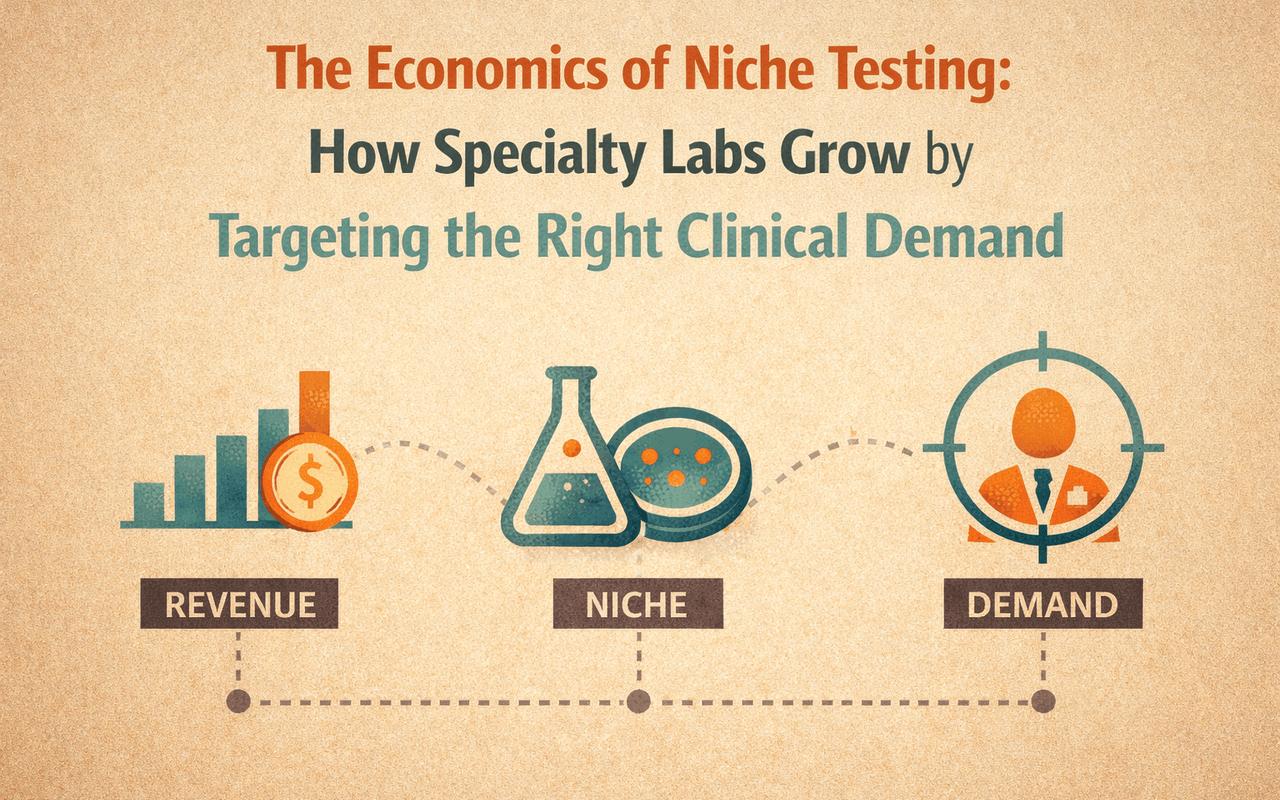
The Economics of Niche Testing: How Specialty Labs Grow by Targeting the Right Clinical Demand
On this page
For a specialty lab, growth does not usually come from becoming bigger in the conventional sense. It comes from becoming more relevant in a category of demand that larger competitors may treat as too narrow, too operationally annoying, or too slow to standardize.
That is the appeal of niche testing.
A niche assay or specialty panel may never produce mass-market volume. But it can still become a strong business line if the demand behind it is consistent, clinically sticky, and underserved in practical ways.
In many cases, the opportunity is hidden because most commercial strategies are built to chase scale first. They favor broad specialties, large account lists, and high-level market definitions. Specialty diagnostics rarely work that way.
The economics are different from routine lab testing. A lab may process fewer total orders, yet earn stronger long-term value from a smaller set of accounts if those accounts rely on the test for a recurring patient population, a difficult diagnostic pathway, or a care decision that cannot be handled with a basic panel.
That changes the commercial question. The issue is no longer how to reach more providers. It is how to build around pockets of demand that are specific enough to matter and durable enough to grow.
That is where many independent labs find their opening. They are trying to build profitable relevance in testing areas where clinical need, provider behavior, and business structure line up.
And that is really what this article is about, niche testing as a business model. Why it works, where labs misread it, and how specialty diagnostic growth becomes much more realistic when you understand the economics behind clinical demand.
Why Broad Market Outreach Often Fails for Specialty Labs
Broad outreach sounds sensible when you say it fast. More accounts, more calls, more territory coverage, more chances to win. But specialty diagnostics is not a volume game in the usual sense.
Demand is uneven, reimbursement is uneven, and provider need is uneven. So when a lab uses a wide-net commercial model, it often creates activity without creating much return.
Demand Is Not Spread Evenly
One of the biggest mistakes specialty labs make is assuming demand is distributed in a fairly predictable way across a specialty or region. It usually is not.
In diagnostics, value tends to cluster. Medicare Part B data for 2024 shows that the top 25 lab tests accounted for nearly half of all lab spending, at more than $4.1 billion.
The highest-spend test in that group was a genetic test with a median payment of $447 per claim. That tells you something important right away that high-value diagnostic demand is often concentrated in specific tests and use cases, not spread broadly across the market.
That makes broad outreach a weak fit for specialty labs. A wide physician list may look like an opportunity, but in reality, only a small portion of those accounts may ever generate meaningful, repeat specialty volume.
More Outreach Does Not Mean More Growth
Specialty testing usually takes more work to sell than routine lab services. Providers may need help understanding when to use the test, how it fits into care decisions, what documentation is needed, how billing works, or how specimens should be handled. So every low-fit account consumes more time than it would in a simpler testing category.
So, the commercial effort behind specialty testing is rarely light. Meanwhile, labs are not operating with endless spare capacity.
ADLM’s staffing analysis points to persistent workforce shortages, citing average vacancy rates of 7% to 11% in clinical labs in one ASCP study, with some areas reaching 25%, alongside a 12.3% five-year retirement rate in the 2020 ASCP vacancy survey.
The Market Keeps Getting More Specific
The AMA’s PLA code framework exists because many tests are now specific enough that standard CPT categories are not sufficient to describe them well.
In the 2025 cycle alone, the AMA added 17 new PLA codes. That is a sign of where the market is heading. It is getting more specialized, more fragmented, and more tied to precise clinical use cases.
So the issue with broad outreach is not only inefficiency but also a mismatch. The market is narrowing and becoming more code-specific, while the outreach model remains broad and generic. That is a bad combination.
So, routine testing can sometimes survive a broad-market approach because the demand base is larger and the service is easier to standardize.
Specialty labs do not get that luxury. Their commercial success depends on finding pockets of demand that are specific enough to support repeat use and profitable enough to justify support.
If they chase the market too broadly, they end up spending too much time on accounts that may look relevant on paper but never become real growth drivers.
Understanding the Economics of Specialty Diagnostic Testing
What makes specialty testing commercially interesting is that the business model works by a different logic altogether. Volume is often lower. The sales cycle can be slower. Operational demands can be heavier. And yet, the economics can still be stronger if the test sits within a recurring, hard-to-substitute clinical need that is valuable enough to justify the extra effort.
So, before discussing growth, it helps to look at the financial mechanics behind specialty diagnostic testing.
Higher Test Value Does Not Guarantee a Better Business
From the outside, specialty diagnostics can look attractive because the reimbursement per test is often higher than standard lab work. But higher-priced testing does not automatically create a strong business line.
The real question is whether demand is recurring, reimbursable, and concentrated enough to support the work needed to win the account and keep it. A niche assay may have impressive pricing, but if ordering is sporadic or reimbursement is unstable, the economics weaken quickly.
Reimbursement Pressure Changes the Math
That is especially important now because reimbursement pressure has not gone away.
CMS held the payment reduction at 0% for 2025 for most CDLTs that are not ADLTs. But for 2026 through 2028, CMS states that payments can still be reduced by up to 15% per year from the previous year’s amount.
That means labs cannot evaluate specialty testing based only on today’s payment level. They have to think about margin durability over time.
So a test line that looks attractive in the short term may still be fragile if the lab’s commercial model depends on weak-fit accounts or inconsistent demand.
Growth Lives in Concentrated Demand Pools
The HHS Office of Inspector General reported that total Part B lab spending rose in 2024, with increased spending on genetic tests helping drive that growth. In other words, value is being built within certain higher-complexity pockets of diagnostics, not evenly across the sector.
That makes niche testing economically viable when a lab can identify providers and clinics that have recurring clinical needs. A smaller market can still be a very good business if the demand inside it is concentrated and durable.
Coding Specificity Is Part of the Business Model
The more specialized the testing category becomes, the less useful broad market definitions become. PLA codes were created to identify proprietary lab analyses more precisely, which reflects how test-specific many modern diagnostic opportunities have become.
For specialty labs, that means the business model has to be built around more than specialty labels. It has to reflect specific clinical use cases, actual procedure activity, and real reimbursement conditions.
So, a specialty test line does not need mass-market volume to work. It needs enough repeat volume from the right providers to justify commercial effort, field support, logistics, and payer risk. When that happens, a smaller market can actually be a stronger and more defensible business than a broad, crowded one.
Identifying Providers Who Drive Specialty Test Demand
Once the business case for niche testing is clear, the next question is, where does that demand actually come from?
Not every provider in a relevant specialty will generate meaningful testing volume, and not every large account is worth pursuing. For specialty labs, growth usually comes from identifying the narrower pockets of clinical activity where a test is likely to be used consistently.
The Biggest Accounts Are Not Always the Best Accounts
One of the easiest mistakes a specialty lab can make is confusing size with fit.
A large physician group may look attractive because it has more providers, more locations, and more administrative infrastructure. But that does not necessarily mean it is a strong source of demand for specialty tests.
In many cases, the better account is a smaller clinic or specialist group with a tighter concentration of the exact patient population the test serves.
Medicare’s physician and practitioner datasets are organized at the provider-and-service level using NPI and HCPCS/CPT-coded procedures, which reflect how procedure activity is actually tracked and paid, rather than how sales teams often infer demand from specialty labels alone.
Procedure Activity Tells You More Than a Directory Ever Will
CPT and HCPCS activity gives a lab a much better signal because it reflects services that were actually billed.
The AMA describes CPT as the code set used to describe medical services and procedures performed by physicians and other qualified healthcare professionals. In other words, CPT data is evidence of clinical behavior.
That is especially relevant in niche testing markets, where demand often forms around a narrow diagnostic pathway rather than a broad specialty identity. If a provider is consistently billing adjacent procedures, related workups, or companion testing patterns, that is a much more useful sign than practice size or title alone.
This is also why the diagnostic market keeps getting more specific.
Look for Repeatable Clinical Need, Not One-Off Interest
A provider does not become a good target just because they can order your test. They become a good target when the clinical need shows up often enough to support repeat use. That is the difference between theoretical fit and commercial fit.
For example, a clinician may occasionally see patients who could benefit from a specialty assay. But if that pattern is irregular, the account may never justify the effort of onboarding, specimen logistics, sales follow-up, or field support. A smaller provider with steadier case flow can be much more valuable over time.
So essentially, the strongest specialty lab targets tend to sit where three conditions overlap:
- the provider sees the right patients,
- the procedure activity suggests a consistent diagnostic need,
- and the setting is commercially workable.
That last part matters more than people admit. A provider may show strong clinical relevance and still be a poor target if the account is locked into a health-system lab relationship, sits outside practical pickup coverage, or has a payer mix that makes the revenue picture unattractive.
So identifying providers who drive specialty demand is finding providers whose clinical behavior, test relevance, and operating context make a repeatable business case.
Moving from Broad Prospecting to Clinical Alignment
Finding the right source of demand is only half the job. The harder part is changing how the lab operates afterward.
Many specialty labs still rely on broad commercial motions built for larger, more general markets. But niche testing grows differently. The category is becoming more test-specific, as reflected in the AMA’s PLA framework for proprietary laboratory analyses, and the adoption of specialty tests often adds workflow, reimbursement, and implementation complexity rather than simply increasing routine volume.
That is why a tighter commercial model tends to work better: outreach has to connect to actual clinical relevance, procedural activity, and operational fit rather than broad specialty coverage alone.
Generic Outreach Breaks Down Fast in Specialty Diagnostics
Once a lab knows where demand actually lives, the sales approach has to change, too.
Broad prospecting tends to rely on generic filters like specialty, geography, maybe practice size, and broad messaging to match. That can create a lot of activity, but the activity is noisy. Reps spend time qualifying accounts that should never have been included in the sequence in the first place.
That is inefficient in any category. In specialty diagnostics, it is expensive.
The commercial effort is heavier, the onboarding is more involved, and the account universe is smaller. So when the prospecting model is loose, the wasted effort becomes more obvious.
Clinical Alignment Changes the Nature of the Pitch
Clinical alignment differs because the outreach starts from observed demand rather than from generalized relevance.
The rep is no longer trying to manufacture interest from scratch. They are stepping into a workflow that may already exist, but may be underserved.
Alpha Sophia’s claims-based CPT and HCPCS data helps labs find clinicians with real month-by-month demand, shorten sales cycles, and focus field teams where test adoption is more likely.
That is a more useful commercial motion for specialty labs because it matches how these tests are actually adopted. Most providers do not add a specialty test because of a catchy pitch. They add it when it fits a real diagnostic problem, a recurring patient need, or a workflow gap they are already feeling.
Better Targeting Also Improves Territory Economics
When labs prospect more precisely, they can place reps more intelligently, prioritize geographies with enough specimen density, and avoid spreading territory coverage across accounts that will never justify the spend.
Alpha Sophia’s claims-verified procedure counts and other fields that can be paired with a lab’s own route, contract, or revenue assumptions to estimate revenue-per-rep potential by territory.
That is a much stronger basis for a diagnostic lab expansion strategy than “We should hire in this region because there are a lot of specialists there.”
For many independent labs, niche testing begins as a promising line of business but remains a side bet. The science is there. The menu is there. The opportunity seems real. But growth stays patchy because the go-to-market model never catches up.
Moving from broad prospecting to clinical alignment is often what changes that.
It gives the lab a way to treat specialty demand as a real commercial system that can be mapped, prioritized, staffed, and expanded with more discipline. And once that happens, niche testing stops looking like a small category with occasional upside. It starts looking like a focused, defensible growth engine.
Strategic Advantages for Specialty Diagnostic Labs
Once a lab has identified the right demand pockets and built a tighter commercial motion around them, the bigger question now becomes what does that change financially and competitively.
For specialty labs, niche focus can shape margin, rep productivity, expansion decisions, and how easily the business can be copied by larger players.
Better Margins Come from Better Fit
For specialty labs, growth gets stronger when the business is built around dense pockets of relevant demand rather than broad market presence. That sounds obvious, but it changes the economics quite a bit.
A lab does not need huge territory coverage if it can win providers who generate repeat, reimbursable test volume in a category that is less exposed to routine price comparison.
Recent OIG data makes that contrast pretty clear. In 2024, genetic tests made up 43% of Medicare Part B lab spending, or about $3.6 billion, while accounting for only 5% of tests paid under the program. That is a strong sign that a relatively small share of testing activity can carry a very large share of value.
That does not mean every niche assay becomes a gold mine. It means specialty labs have a better chance of protecting their margins when they operate in segments where the test matters clinically and cannot be treated as a commodity line item.
Narrow Focus Can Make Commercial Teams More Productive
There is also a very practical sales advantage here. When a lab focuses on narrower but more probable demand pools, reps waste less time on low-fit accounts. They are not calling every provider in a broad specialty just because the title looks vaguely relevant. They are working with a smaller set of clinicians and clinics where the commercial case is easier to justify.
The sale can involve education, payer questions, specimen logistics, and some hand-holding at the start. So if the account list is loose, field productivity drops fast.
Territory Decisions Get Less Speculative
Another advantage is that expansion planning becomes more grounded. A lot of labs still make territory decisions using rough logic that there are many specialists in this city, this region has several large groups, and this market feels active.
The problem is that those signals are not specific enough for specialty testing.
Once demand is viewed through the lens of code-level activity and site context, planning gets sharper.
A Niche Position Is Harder to Displace
A lab that wins an account because it fits a recurring clinical need is harder to replace than a lab that wins on generic outreach alone.
Specialty testing relationships tend to get stickier when the provider depends on the test within a defined diagnostic pathway, especially if onboarding, reporting, and service have already been built into the clinic’s routine.
That makes niche testing commercially attractive for independent labs. They may not match national players on breadth, but they do not have to. They can still build a strong, independent lab business model around a narrower slice of demand that is valuable, recurring, and operationally realistic.
How Alpha Sophia Helps Labs Identify Specialty Testing Opportunities
Of course, this strategy only works if a lab can see specialty demand with enough precision to act on it. That is where commercial intelligence becomes a way to translate scattered clinical activity into a practical growth map.
For specialty labs, the value lies in seeing where niche demand is building, which accounts can support it, and how to turn that insight into a workable expansion plan.
Filter by CPT and HCPCS Activity
A niche testing strategy falls apart pretty quickly if the lab is still working from broad specialty lists. Alpha Sophia’s core value here is that it lets teams search provider profiles by CPT and HCPCS code and volume, so the starting point is actual procedure activity rather than job title or specialty label.
So, if a lab is trying to grow a specific assay or testing line, code-level activity is a much more useful signal than a long physician directory.
Procedure Volume Visibility
Labs can look at procedure volume patterns to tell the difference between accounts that are loosely relevant and accounts that may support repeat specialty testing business.
That makes the platform relevant to the economics of niche testing because it helps labs judge whether a demand pocket is commercially meaningful or just theoretically interesting. A niche market can work very well, but only if the underlying volume is strong enough to support it.
Referral and Affiliation Context
A niche testing opportunity often depends on the surrounding practice structure, such as who they are connected to, where they practice, and whether the account sits within a system that is harder to penetrate.
Alpha Sophia’s physician profiles include referral links, affiliation data, and practice-level context. It helps labs avoid overrating accounts that look strong on paper but are harder to win in real life.
Export Target Lists Into Sales Workflows
A lot of targeting platforms are great at generating insight and terrible at generating action. Alpha Sophia’s lists can export directly to CRM systems, so reps can work from a usable target list rather than a raw data pull.
For a specialty lab, that is important because niche growth usually depends on speed and focus. The shorter the distance between demand analysis and rep action, the easier it is to turn a small market opportunity into actual specimen volume.
Territory Planning
One of the more practical uses of Alpha Sophia in this context is territory design and route planning. Its heatmaps of procedure density and provider lists are built around service radius and route planning.
For a specialty lab that connects directly to the economics of expansion. Niche testing works when demand is concentrated enough to support field coverage, specimen pickup, and account service.
Conclusion
Niche testing works when a lab stops chasing broad relevance and starts building around concentrated, repeatable demand. For specialty labs, that often leads to a stronger business than broad-market outreach ever could because the goal is not more accounts, but better ones.
The real advantage is economic. When clinical need is consistent, reimbursement is workable, and account density is strong enough to support focused coverage, a smaller market can become a far more defensible growth engine.
That is exactly why niche testing remains such a practical path for independent and specialty labs.
FAQs
What is niche testing in diagnostics?
Niche testing refers to specialized diagnostic tests aimed at narrower clinical use cases rather than high-volume routine testing. These tests usually serve specific patient populations, disease areas, or diagnostic questions.
Why do independent labs focus on specialized testing markets?
Specialized testing can offer stronger commercial upside than routine testing when demand is recurring, and the lab can serve it well. It also gives independent labs a way to compete on relevance and service instead of scale alone.
How can labs grow without enterprise contracts?
Labs can grow by focusing on concentrated pockets of provider demand, building relationships with accounts that have recurring clinical needs, and expanding in markets where the testing category is commercially viable without relying on large health-system contracts.
What data helps identify niche diagnostic opportunities?
Procedure-level billing activity, CPT and HCPCS volume, payer context, specialty data, location data, and practice affiliations all help labs see where relevant demand is already forming.
How do CPT codes support niche targeting?
CPT codes help labs identify providers who perform procedures or services associated with a specific testing category. That gives commercial teams a more precise way to find likely demand than broad specialty filters alone.
Which specialties benefit most from niche testing models?
Specialties with concentrated diagnostic pathways tend to benefit most. That can include areas such as oncology, reproductive medicine, infectious disease, rheumatology, neurology, and toxicology, depending on the test and market.
How can independent labs avoid competing purely on price?
They can focus on testing categories where clinical fit, turnaround time, service quality, workflow support, and specialized relevance matter more than simple price comparison.
What are common growth strategies for specialty labs?
Common strategies include targeting providers with relevant procedure activity, focusing on underserved clinical segments, expanding geographically only where demand density supports it, and building commercial plans around repeatable test volume.
How does clinical activity data improve targeting accuracy?
It shows what providers are actually doing, not just what their specialty suggests they might do. That makes it easier to identify accounts with real testing demand.
How does Alpha Sophia support niche diagnostic market expansion?
Alpha Sophia helps labs identify providers with relevant CPT and HCPCS activity, assess commercial fit using account-level context, and move those insights into practical sales and expansion workflows.
