The Hidden Concentration of Diagnostic Ordering: Why a Small Percentage of Providers Drive the Majority of Test Volume
On this page
Diagnostics companies spend enormous energy forecasting demand, defining target markets, and building commercialization plans around broad provider categories—primary care, urgent care, pediatrics, internal medicine, OB/GYN, and so on. But inside the real market, diagnostic ordering is not evenly distributed across these segments. It is not even close.
A defining characteristic of most diagnostic categories is heavy ordering concentration, meaning that a relatively small subset of providers generates a disproportionately large share of total test volume. These “super-users” often represent the core of a market, while the majority of providers order a test only sporadically or seasonally. Similar skewed patterns have been described across other medtech and healthcare utilization contexts, where a minority of customers often drives a majority of volume and value.
This concentration pattern is so fundamental—and yet so overlooked—that many diagnostics companies continue to size markets, build territories, and launch products as if ordering were uniform. The result is wasted commercial resources, inaccurate forecasts, missed early adopters, and slow market penetration.
Understanding ordering concentration is essential for diagnostics manufacturers, particularly as competition increases across molecular, antigen, and point-of-care platforms. Point-of-care and CLIA-waived testing have accelerated this dynamic by enabling high-frequency testing in non-lab settings such as pharmacies and urgent care centers. The companies that grasp how concentrated their test categories truly are will build smarter strategies, deploy field teams more effectively, and design launch plans around where volume actually sits—not where traditional market assumptions place it.
For a broader view on how concentrated opportunity shapes medtech growth, see:
-
How to Win in MedTech: 5 Data Strategies Driving Commercial Success – https://www.alphasophia.com/blog-post/how-to-win-in-medtech-5-data-strategies-driving-commercial-success
-
5 Ways MedTech Companies Can Drive Commercial Success – https://www.alphasophia.com/blog-post/5-ways-medtech-companies-can-drive-commercial-success
This article explores what ordering concentration really looks like in the diagnostics landscape, why it forms, how it varies by specialty and practice type, and why provider-level intelligence has become a foundational requirement for accurate commercialization.
Why diagnostics markets are almost always top-heavy
In nearly every common test category—respiratory, strep, UTI, GI panels, wound care, and others—the distribution of ordering across providers follows a predictable pattern. A small percentage of physicians or practices account for a large portion of total test volume. This concentration exists for structural reasons:
1. Variation in patient mix
Providers who see higher volumes of acute visits naturally order more tests. Urgent care physicians, pediatricians in high-traffic practices, and family medicine clinicians in suburban areas with large patient populations often test far more frequently than providers with mostly chronic-care caseloads.
2. Differences in workflow models
Some practices structure visits around rapid testing—for example, urgent care centers and pediatric clinics—while others tend to treat empirically or defer testing. This creates consistent volume asymmetries and reinforces a “super-user” cohort.
3. In-office vs send-out preferences
Providers with CLIA-waived instruments or in-office testing capacity often order more frequently because the workflow is self-contained and turnaround time is under their control. Providers who rely on external lab relationships tend to order fewer tests per patient and may be constrained by courier schedules or lab capacity.
4. Clinical philosophy and diagnostic habits
Even within the same specialty, testing behavior varies dramatically. Some physicians test proactively; others rely heavily on clinical judgment and only use diagnostics to resolve uncertainty. These differences create persistent ordering clusters.
5. Organizational influence
Large physician groups, IDNs, and urgent care networks often implement standardized protocols. A single committee or lab decision can create a large volume spike concentrated within a defined provider subset or system.
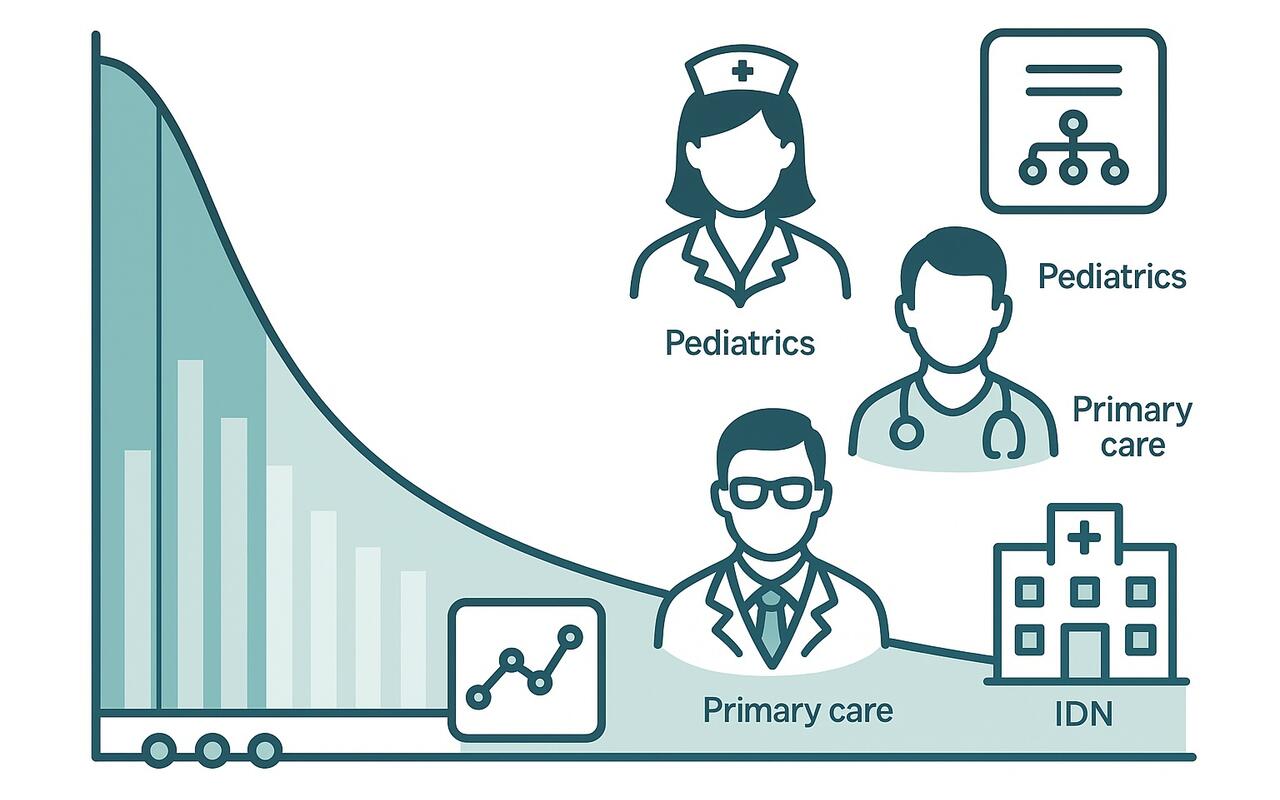
Because of these structural factors, the shape of the market is rarely a smooth distribution. It is typically a steep curve: high-volume providers on the left, low-frequency and seasonal providers on the right, and a long tail of intermittent ordering at the far end. Understanding this curve is essential for identifying opportunity.
For a deeper discussion of how modern medtech commercial models need to adapt to skewed customer behavior, see McKinsey’s “Medtech Pulse: Thriving in the Next Decade” (PDF):
McKinsey: Medtech Pulse: Thriving in the Next Decade
How concentration varies across practice types
Ordering concentration is not uniform across care settings. The provider mix within a market can dramatically influence the degree of top-heaviness.
-
Urgent care centers are among the most concentrated segments. A relatively small number of clinicians generate very high testing volumes because of their acute-care focus and rapid, protocol-driven workflows. For many respiratory panels, a small cluster of urgent care providers may account for a large share of a region’s total ordering.
-
Pediatrics tends to show high concentration during peak fall and winter months. Pediatric practices vary significantly in how aggressively they test for respiratory and GI illnesses. High-volume pediatricians consistently anchor the left side of the curve.
-
Primary care and internal medicine have the widest spread. Some internal medicine physicians see mostly chronic disease cases and test rarely, while others manage a high mix of acute visits and test far more frequently. The distribution here is broad but still top-heavy.
-
IDN-owned practices are more protocol-driven. Ordering may cluster around institutional guidelines rather than individual behavior. Concentration still exists, but often at the organizational or location level as much as the clinician level.
Each of these segments forms its own curve—with its own concentration patterns. Diagnostics companies that treat these segments interchangeably often misjudge where real opportunity lies.
For more on how medtech commercial teams can tailor strategies to different provider types and organizations, see:
Unlocking MedTech Success: Using Advanced Analytics to Connect with Healthcare Organizations
Why traditional market sizing misses hidden concentration
Many diagnostics teams size markets by combining overall CPT procedure volumes with broad specialty counts or national practice estimates. This approach assumes—often implicitly—that each provider within a specialty contributes roughly similar ordering behavior. In reality, the distribution may be extremely uneven.
This creates several predictable errors:
-
Overestimating the accessible market.
A large percentage of providers may only test occasionally. Counting them as routine users inflates market size and leads to unrealistic revenue expectations.
-
Underestimating the importance of early high-volume clusters.
A small group of high-frequency providers often represents the true early adopter segment. Commercial teams that overlook this cluster start too wide and dilute their focus.
-
Misallocating field resources.
Without understanding concentration, territories may be structured evenly even though the actual opportunity is uneven. Representatives may spend time calling on providers who will never meaningfully adopt the test.
-
Misinterpreting seasonality and trend signals.
A drop in ordering from a small number of high-volume providers can distort market trends unless concentration is accounted for.
-
Overshooting or undershooting forecasts.
Forecasting models that assume linear uptake across specialties or regions rarely map to real ordering patterns. Studies on medtech customer segmentation and omnichannel engagement show that tailoring outreach to high-value segments can substantially improve commercial productivity.
Provider-level data resolves these problems by showing exactly where ordering is coming from—and how stable those patterns are over time. This is precisely the kind of gap traditional CRMs cannot fill on their own, as discussed in:
The Limits of CRM in MedTech and How Data Intelligence Fills the Gaps
How concentration reveals early adopters and high-opportunity segments
Identifying high-volume ordering clusters is a powerful way to understand where market growth will originate. These providers often have common characteristics:
-
They see large acute-care patient volumes
-
They have efficient in-office testing workflows
-
They test proactively rather than reactively
-
They trust diagnostics as part of routine care
-
They are less sensitive to small workflow adjustments
-
They are accustomed to integrating new tests quickly
In practice, these providers become the backbone of early adoption for new diagnostics. They are more open to new instruments, expanded panels, and alternative modalities because their testing behavior is already embedded in their workflow.
Conversely, providers at the far right of the distribution—the low-volume or intermittent users—should rarely be targeted aggressively during early commercialization phases. They often lack the workflow patterns, patient mix, or operational setup to adopt new diagnostics rapidly.
Segmenting physicians by ordering concentration allows companies to:
-
identify early adopters with far greater precision
-
build territory structures aligned with real opportunity
-
tailor messaging to high-volume segments
-
prioritize training and support resources effectively
-
predict where uptake will occur and where it will not
This creates a more realistic, efficient, and defensible strategy.
How provider-level insights reshape go-to-market strategy
When diagnostics teams can see ordering concentration clearly, nearly every part of the commercialization process becomes more accurate.
-
Territory design becomes rational instead of arbitrary, with each rep responsible for meaningful opportunity rather than evenly distributed geography.
-
Segmentation becomes behaviorally grounded—identifying providers who show consistent, year-round ordering patterns, rather than grouping providers only by specialty.
-
Messaging and education can be tailored to the specific workflow needs of high-volume segments instead of a generic pitch that fits no one particularly well.
-
Forecasts and market models become anchored in real behavior, not in assumptions about how tests “should” be ordered.
-
Launch sequencing becomes more strategic, focusing on high-impact practices that can generate early traction and meaningful case volumes.
-
Competitive intelligence becomes far more accurate when companies can see how ordering shifts across the concentration curve during flu season, after guideline changes, or when new competitors enter the market.
Ultimately, concentration analysis moves diagnostics companies away from broad generalizations and toward a data-driven understanding of the market. This aligns with the broader shift in medtech toward commercial intelligence platforms that combine claims, affiliations, and provider analytics to support smarter targeting.
Why this matters for diagnostics companies in 2025 and beyond
As diagnostic innovation accelerates—particularly in rapid molecular platforms, expanded panels, home-to-lab hybrid tests, and new CLIA-waived technologies—many companies will compete for provider attention within the same high-volume clusters. CLIA guidance from CMS and FDA underscores how point-of-care and waived testing continue to expand into non-traditional sites of care, increasing competition for high-throughput accounts.
The companies that understand concentration will be better positioned to win because they are grounded in the realities of clinical behavior, not the theoretical constructs of traditional market research.
Provider-level claims intelligence allows diagnostics companies to:
-
quantify real, not assumed, demand
-
understand early adopter profiles
-
build territories and campaigns around demonstrable behavior
-
identify high-impact providers quickly
-
track seasonality and longitudinal change
-
design commercialization plans that mirror how the market truly behaves
Ordering concentration is not a minor nuance in diagnostics markets. It is a defining feature. Companies that embrace it will outperform competitors who continue treating the market as uniformly distributed.
For readers who want to go further into commercial intelligence and targeting:
Alpha Sophia – Commercial Intelligence & Optimization
FAQ
1. What does “ordering concentration” mean in diagnostics?
Ordering concentration describes the pattern where a relatively small percentage of providers or practices generate a disproportionately large share of total test volume in a given category.
2. Why is diagnostic ordering so heavily concentrated among a few providers?
Because of structural factors like patient mix, workflow models, in-office testing capacity, clinical philosophy, and organizational protocols. High-throughput urgent care, pediatric, and multi-provider primary care groups often become “super-users” of diagnostics.
3. How does ordering concentration affect market sizing?
Traditional market sizing often assumes each provider contributes similarly. When ordering is highly concentrated, this leads to overestimating accessible demand, misallocating resources, and misreading adoption trends.
4. How can diagnostics companies identify high-volume “super-users”?
By using provider-level claims or utilization data that shows test volumes by NPI, practice, and organization over time. This reveals which providers consistently order at high levels and which are intermittent users.
5. Why is understanding concentration important for go-to-market strategy?
It helps companies design territories around real opportunity, target early adopters, customize messaging for high-volume segments, and build more accurate forecasts and launch plans.
6. What role do CLIA-waived and point-of-care tests play in concentration?
CLIA-waived and point-of-care tests make it easier for certain practice types to test frequently, increasing volume concentration in sites that have the workflow and certification to use these tools at scale.
