Why Most Healthcare CRM Physician Lists Break at Scale (And How Teams Fix Them)
On this page
For many life sciences commercial teams, physician data problems begin quietly.
A spreadsheet from a conference gets uploaded into the CRM. A distributor sends over a provider list missing NPI numbers. An old territory file gets merged with marketing contacts. Before long, teams are working from fragmented physician records with inconsistent names, outdated affiliations, duplicate HCP profiles, and missing identifiers.
At a small scale, these issues seem manageable. At enterprise scale, they become a serious operational problem.
Today, healthcare organizations rely on accurate healthcare provider data for everything from sales targeting and territory planning to omnichannel marketing, market access, and launch execution. But many CRMs were never designed to handle the complexity of real-world physician data management.
Why Physician List Matching Is Harder Than It Looks
Matching physician lists to NPI numbers sounds simple in theory. In practice, healthcare provider matching is surprisingly difficult.
A physician may:
-
practice across multiple locations
-
change health systems or affiliations
-
appear under different naming conventions
-
have incomplete records
-
be listed without specialty information
Even small formatting differences can break automated matching systems. “Robert Smith MD” and “Bob Smith” may refer to the same physician, while two physicians with identical names may belong to entirely different organizations.
As a result, many healthcare CRMs become filled with:
-
duplicate provider records
-
inaccurate affiliations
-
missing NPI numbers
-
outdated physician addresses
-
fragmented engagement histories
This creates downstream issues across commercial operations.
The Hidden Cost of Bad Physician Data
Poor healthcare provider data affects far more than CRM hygiene.
When physician lists are inaccurate:
-
sales reps target the wrong accounts
-
marketing campaigns fail to personalize effectively
-
territory planning becomes unreliable
-
launch targeting loses precision
-
reporting and attribution become distorted
For MedTech and pharma teams, the operational cost compounds quickly.
A physician who cannot be accurately matched to an NPI may also be disconnected from:
-
procedure-level activity
-
claims data
-
organizational hierarchy
-
referral networks
-
treatment insights
Without normalized provider records, commercial intelligence becomes fragmented.
Why Manual NPI Lookup Fails at Scale
Many organizations still rely on manual workflows for physician list normalization:
-
searching the NPI Registry
-
cross-checking spreadsheets
-
validating affiliations manually
-
cleaning duplicates one by one
These workflows may work for dozens of records. They do not work for thousands.
Modern commercial teams increasingly need:
-
bulk NPI lookup
-
automated physician list matching
-
healthcare data enrichment
-
provider affiliation mapping
-
CRM normalization workflows
This is especially important when importing physician lists from conferences, distributors, third-party vendors, or legacy CRMs.
How Teams Are Fixing the Problem
Leading life sciences organizations are increasingly moving toward automated physician matching infrastructure that standardizes healthcare provider records before they enter downstream workflows.
Rather than relying on exact-name matching alone, newer systems use:
-
intelligent provider matching
-
affiliation analysis
-
specialty mapping
-
organizational hierarchy data
-
NPI enrichment logic
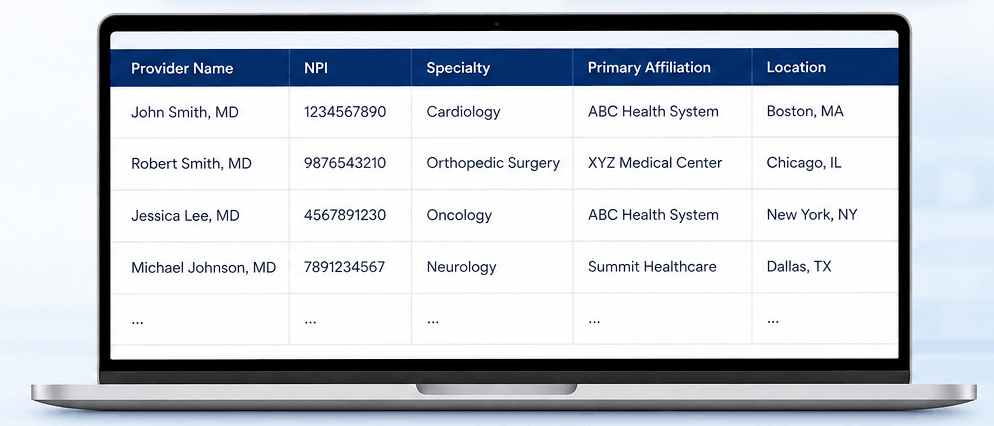
At Alpha Sophia, we built our Bulk NPI Lookup and Physician Matching solution specifically to address these operational problems.
Teams can upload physician lists with incomplete information and match records to:
-
NPI numbers
-
provider affiliations
-
specialties
-
organizational structures
-
healthcare system relationships
without requiring perfectly standardized input files.
Clean Physician Data Is Becoming Strategic Infrastructure
As healthcare commercialization becomes increasingly data-driven, physician data quality is no longer just a CRM maintenance issue.
It directly affects:
-
targeting precision
-
launch readiness
-
rep efficiency
-
omnichannel personalization
-
commercial analytics
The organizations that build clean, normalized healthcare provider infrastructure early gain a significant operational advantage later.
Because in modern healthcare, better decisions start with better physician data.
