Why Indication-Level Targeting Is Replacing Specialty-Based Sales in MedTech
On this page
In MedTech, a lot of sales strategy still begins with a familiar assumption that if the physician’s specialty matches the product category, the account is worth pursuing.
That logic used to be good enough, but it is not holding up as well anymore.
The problem is not only that specialty-based targeting is broad, but it is also that it can give commercial teams the wrong picture of the market.
A target list may look strong because it includes the right specialties, but that does not mean those accounts are seeing the right patient populations, managing the relevant condition mix, or creating real demand for the device.
As a result, companies often overestimate market opportunity, overbuild territories, and spend time chasing accounts that were never especially viable to begin with.
This has become more important now because MedTech commercialization has become less forgiving. Teams are expected to show clearer market logic, tighter account selection, and better use of field resources. Product adoption is also shaped by more than physician identity alone.
Diagnosis mix, care setting, and procedure concentration all play a role in whether an account is commercially relevant.
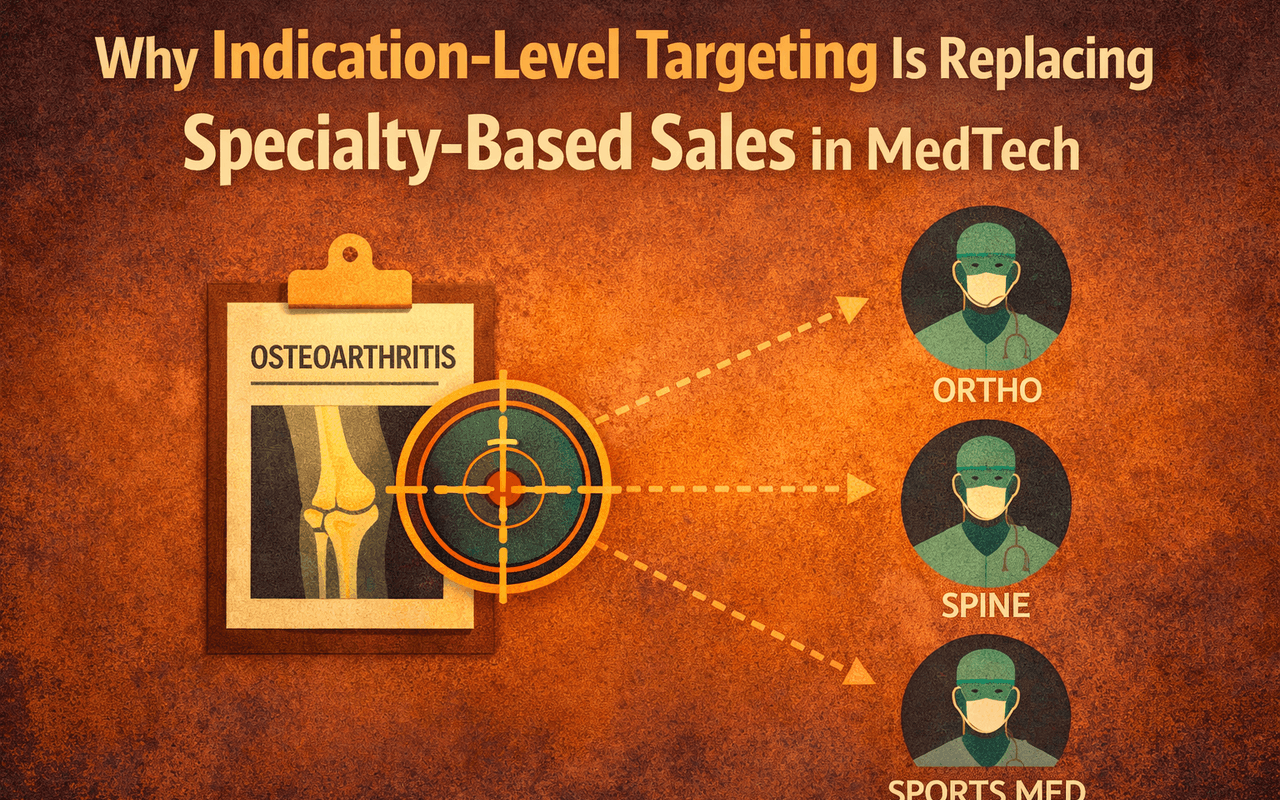
That is why indication-level targeting is gaining ground. Instead of treating specialty as the main proxy for demand, MedTech teams are starting to look at the clinical conditions and case patterns that actually relate to product use. It creates a more grounded view of where opportunity sits and helps separate theoretical market coverage from realistic commercial potential.
In this article, we will look at why specialty-based sales models are losing traction, what indication-level targeting looks like in practice, and why it is becoming a more reliable way to guide MedTech commercial strategy.
The Limits of Specialty-Based Sales Models
To see why this model is losing value, it helps to separate a specialty label from the commercial reality behind it.
Specialty Is Useful but a Weak Demand Signal
Specialty is still a reasonable first filter because it helps reduce the provider universe to clinicians who are broadly relevant to the category. But it is still only a rough screen. It does not tell you which providers are actually seeing patients with the condition tied to the product, how often those cases appear, or whether the related procedures are happening in settings where the device is likely to be used.
CMS’s ICD-10 framework exists precisely because condition-level specificity matters, and the CCSR framework groups more than 70,000 ICD-10-CM diagnosis codes into 530+ clinically meaningful categories so analysts can study care patterns with more precision. That is the logic behind moving from specialty-level targeting to indication-level targeting.
A physician can belong to the right specialty and still see very few patients with the condition your device is designed for.
That gap is not theoretical. A 2022 JAMA Health Forum study looked at 8,788 physicians across seven specialties in five U.S. metropolitan areas and found sizeable physician-level variation in practice patterns across common clinical scenarios, even after adjusting for patient and area-level characteristics.
In other words, physicians within the same specialty and market do not necessarily manage care in the same way or at the same intensity. For commercial teams, that is the core problem with specialty-first targeting, which is that shared specialty does not automatically mean shared clinical relevance.
Specialty-Based Lists Can Inflate the Market on Paper
When a MedTech team builds TAM or coverage plans from specialty lists alone, it often counts too many accounts as viable simply because they look adjacent to the product category.
The list feels complete, and the market seems large. But part of that market may consist of accounts with low exposure to the relevant diagnosis mix, limited procedural fit, or weak buying relevance.
The healthcare data infrastructure itself reflects why this is important. The CCSR framework groups more than 70,000 ICD-10-CM diagnosis codes into 530+ clinically meaningful categories specifically so analysts can examine utilization, cost, outcomes, and diagnosis patterns with more precision.
That is a useful reminder that broad specialty labels are often too coarse when the goal is to understand where real clinical activity lies. If researchers and health systems rely on diagnosis-level grouping to study care patterns, commercial teams also need a more specific view than specialty alone when evaluating opportunity.
Care Delivery Is More Complex Today
Specialty-based sales also struggle because the structure of care delivery has changed.
According to the AMA’s 2024 Physician Practice Benchmark Survey, only 42.2% of physicians were in private practice in 2024, down 18 percentage points from 2012. Only 37% worked in single-specialty practices, while 27.8% worked in multispecialty practices, and the gap between those two practice types has narrowed sharply over time.
That means a specialty match now tells you less than it once did about how care is organized, where influence sits, and how decisions move through a system.
This matters because commercial relevance is shaped by organizational factors, not only by clinician identity. A physician may look like an ideal target in a CRM, but the real buying environment may sit inside a larger health system, a multispecialty group, or a site network where patient flow and decision-making are shared across departments.
Specialty-based targeting does not capture that well. It was built for a simpler market structure.
The Site of Care Matters More Than Specialty Alone
The same problem shows up when procedures shift across settings. MedPAC reports that in 2023, about 6,300 ambulatory surgery centers treated 3.4 million fee-for-service Medicare beneficiaries, and ASC surgical procedure volume per beneficiary rose 5.7% that year.
MedPAC also notes that changes in clinical practice and technology have expanded the provision of surgical procedures in ambulatory settings. That is critical for MedTech because a product opportunity is often shaped not only by who treats a condition, but where treatment now happens.
Once relevant procedures move into ASCs, office-based settings, or narrower outpatient pathways, a specialty-first model becomes even less reliable.
Two physicians with the same specialty may participate in very different care environments, with very different procedure mix, patient throughput, and product economics. A list built around a specialty alone will miss some of that and overstate the rest.
The Real Limitation Is Commercial Blur
Specialty-based sales blurs the line between clinical adjacency and actual market opportunity.
It groups together accounts that look similar from a distance but behave very differently in practice. It can make territories appear balanced even when one rep inherits concentrated indication-level demand, and another gets a wide spread of low-fit names. It can make TAM look stronger than it is. And it can push reps toward activity that feels productive but is only loosely tied to the clinical use case the product actually serves.
That is why specialty still works as a first layer, but increasingly fails as the main one. The more a device depends on a specific diagnosis profile, treatment pathway, or site-of-care pattern, the less useful it becomes as a standalone sales model. It tells you who is nearby. It does not reliably tell you where demand is.
What Indication-Level Targeting Means in Practice
If specialty-based targeting starts with professional labels, indication-level targeting starts with the clinical problem itself.
That sounds simple, but it changes how a MedTech team defines the market. Instead of asking which specialties seem broadly relevant, the team starts by identifying the diagnosis patterns, procedure pathways, and care settings most closely tied to actual product use.
From there, they work outward to the clinicians, facilities, and systems that are most likely to see those cases in meaningful volume.
Start With the Condition, Not the Category
At the center of this approach is diagnosis-level specificity. ICD-10-CM is the standard U.S. system for coding diagnoses and medical conditions, and CMS guidance states that diagnosis codes should be reported at the highest level of specificity supported by the medical record.
That level of detail is exactly why indication-based analysis is more useful than broad specialty grouping when a commercial team needs to understand where relevant patients are actually being seen.
In practical terms, that means a MedTech company does not begin with all cardiologists or all orthopedic surgeons. It begins with the condition the device addresses.
Then Add Procedure Context
ICD-10 can tell you that the patient population exists, but it does not tell you whether the relevant procedure or intervention is actually taking place. CMS distinguishes diagnosis coding from procedural coding for exactly that reason that diagnoses and procedures capture different parts of the care event.
That is why indication-level targeting often works best when diagnosis data is paired with procedure data. The diagnosis tells you where the clinical need exists. The procedure layer helps show where treatment is active, where workflow fit may already exist, and where product adoption is more plausible.
For some devices, diagnosis may be enough to identify high-potential accounts. For others, especially those tied to procedural use, diagnosis without procedural context remains too broad.
The Site of Care Has to Be Part of the Picture
This is where the model becomes more commercially realistic. A product opportunity is shaped not only by who treats the indication, but also by where that treatment happens.
MedPAC reports continued growth in ambulatory surgery center procedure volume, which reflects a broader shift in how care is distributed across settings. If relevant cases are concentrated in ASCs, outpatient centers, or office-based environments, a physician-only targeting model will miss part of the market logic.
So, in practice, indication-level targeting usually combines three layers, including diagnosis, procedure, and site of care. That is what turns a clinical filter into a commercial one.
The Goal Is Better Market Definition
The point is not to pile on every available code and variable. That just creates a more complicated mess. The point is to define the market in a way that matches how the device is actually used.
A narrow cardiovascular device, for example, should not be mapped to an entire specialty if only a subset of clinicians and facilities regularly manage the relevant diagnosis-procedure mix. The same goes for women’s health, orthopedics, neuro, vascular, and many diagnostic-adjacent products.
When commercial teams start from the indication rather than the specialty bucket, they usually end up with a smaller target universe, but a more believable one.
That is what indication-level targeting looks like in practice. It is a more defensible way to connect clinical reality with commercial strategy.
Why MedTech Commercial Models Are Evolving
This shift is not happening because commercial teams have suddenly become more data-minded. It is happening because the market has become harder to read and less forgiving of loose targeting.
Growth Expectations Are Getting More Selective
MedTech companies are still investing in growth, but the focus is getting narrower. Deloitte’s January 2026 MedTech outlook notes that companies are shifting capital and resources toward highly focused, high-growth therapeutic areas such as pulsed field ablation, structural heart disease, and neuromodulation.
That kind of portfolio focus naturally pushes commercial teams toward a more specific view of demand. If growth bets are increasingly tied to narrower clinical use cases, broad specialty-based coverage starts to look too blunt.
Care Delivery Keeps Moving Across Settings
Commercial models are also evolving because patient care is no longer confined to one place. McKinsey’s 2025 U.S. healthcare outlook says physician offices and ambulatory infusion sites are projected to show high growth, driven by payer site-of-care policies and patient preferences for lower-cost settings.
MedPAC’s March 2025 report also adds that ASC procedure volume per fee-for-service beneficiary rose 5.7% in 2023, continuing the broader movement of appropriate procedures into ambulatory settings.
When procedures and patient pathways shift across sites, physician specialty alone becomes a weaker guide to where real device demand sits.
The Buying Environment Is Less Physician-Centric Than It Used to Be
The structure of the provider market has changed, too. The AMA’s survey found that only 42.2% of physicians were in private practice in 2024, down from 60.1% in 2012, while multispecialty practice models have become far more common.
That means commercial relevance is shaped less often by a single physician in a stand-alone practice and more often by larger organizations, shared service lines, and system-level operating structures.
A specialty match may still point you in roughly the right direction, but it tells you much less about where influence, throughput, and purchase decisions actually sit.
Commercial Teams Are Under More Pressure to Show Real Market Logic
There is also a planning issue here. When the market is mapped too broadly, everything downstream gets fuzzier, like TAM, territory design, launch sequencing, and coverage assumptions.
That matters more in a climate where healthcare margins remain under pressure. McKinsey’s late-2025 healthcare economics analysis finds that industry EBITDA, as a share of national health expenditure, was 230 basis points lower in 2024 than in 2019, with continued pressure expected through 2027.
In a market like that, commercial models built on loose assumptions become harder to justify. Teams need a clearer line between clinical demand and commercial effort.
More Specific Products Need More Specific Market Mapping
A final reason is product mix. Many newer MedTech growth areas are not sold well through a broad call on the specialty playbooks. They are tied to narrower disease states, more specific procedural workflows, or concentrated treatment settings.
As companies focus more of their portfolios on targeted clinical areas, the commercial model must follow suit. That is where indication-level targeting becomes more relevant. It gives teams a way to map actual opportunities around diagnosis, procedure, and care setting, rather than assuming the whole specialty is equally valuable.
Deloitte’s 2026 MedTech trend piece supports the broader pattern of investment flowing toward focused therapeutic categories rather than generic market expansion.
That is really what is changing. MedTech commercial models are not evolving just because better data exists. They are evolving because market structure, care delivery, and growth pressure now make older specialty-based models much less reliable.
Practical Benefits of Indication-Level Targeting
Once a MedTech team starts mapping demand at the indication level rather than the specialty level, the benefits show up across planning, coverage, and execution.
It Produces a More Defensible TAM
One of the biggest gains is market sizing. Specialty-based TAM models tend to count everyone who looks adjacent to the category. That makes the market feel larger, but not necessarily more real.
Indication-level targeting forces a harder question as to which clinicians and sites are actually seeing the diagnoses and procedures tied to the product.
CMS states that ICD-10 was adopted to enable greater specificity in identifying health conditions and that diagnosis codes should be reported to the highest level of specificity supported by the medical record.
When commercial teams use that level of specificity, they get closer to a serviceable market rather than a broad theoretical one. For MedTech leaders, that usually means fewer inflated assumptions about opportunities.
It Improves Account Prioritization
This is where indication-level targeting becomes immediately useful in the field. A specialty list often mixes together high-fit and low-fit accounts because everyone shares the same professional label.
Indication-level targeting separates those accounts by clinical relevance. It helps teams identify where the right patient population is likely to exist, where procedure activity is more concentrated, and where product conversations are more likely to be grounded in a real use case.
Alpha Sophia combines ICD, CPT, and HCPCS context to support clearer indication-level analysis rather than relying on a broad specialty view. That is exactly the practical benefit here that reps get a more meaningful call list, not only a shorter one.
It Leads to Better Territory Design
On paper, two territories may look balanced because they contain similar numbers of target specialists. In practice, one may hold a dense cluster of relevant indication-level demand while the other is padded with low-fit accounts.
That mismatch is more likely now because the provider market is less fragmented and more complex in organization than it used to be.
Indication-level targeting gives teams a better way to build territories around actual demand concentration rather than rough provider volume. That tends to produce fairer books, cleaner coverage logic, and more believable forecasts.
It Sharpens Commercial Messaging
When a rep knows an account is connected to a specific diagnosis and treatment pattern, the outreach can begin closer to a real clinical problem. That usually makes the message more relevant, especially for products tied to narrow use cases or specific procedural workflows.
That is a quieter advantage, but a meaningful one. In MedTech, weak first-call relevance kills momentum fast.
The Bigger Benefit is Less Commercial Guesswork
That is really the pattern across all of these advantages. Indication-level targeting reduces the amount of commercial guesswork built into the model.
It gives MedTech teams a more believable TAM, tighter account selection, stronger territory logic, and better context for sales conversations.
And that is the point. The value is not that the targeting becomes narrower for the sake of it. The value is that the commercial model more closely reflects how demand actually works.
Real-World Use Cases for MedTech Teams
The value of indication-level targeting becomes much clearer when you move from theory to real commercial situations.
When a Broad Specialty List Hides a Narrow Opportunity
This is one of the most common use cases. Let’s say a MedTech company sells a device tied to a specific cardiovascular condition. A specialty-based model might start with cardiologists and related facilities across a region.
That creates a large target universe, but it also pulls in many accounts that are only loosely connected to the actual use case.
An indication-level model would start with the diagnosis pattern tied to the product, then look at which physicians and sites are actually seeing those cases, and whether the relevant procedures are being performed in those settings.
That changes the commercial picture. Instead of treating the whole specialty as equally valuable, the team can focus on the narrower group of accounts where the patient mix and treatment pathway are more likely to support adoption.
When the Same Specialty Contains Very Different Clinical Profiles
Another strong use case is any category where physicians within the same specialty vary widely in what they actually treat.
For MedTech teams, this is especially relevant in categories such as orthopedics, women’s health, vascular care, neurology, and diagnostic-adjacent products because those markets often contain substantial variation inside the same specialty label.
For example, AAOS describes multiple orthopaedic subspecialties, and recent JAMA research found that across U.S. surgical fields, subspecialization has increased materially over time, which means two physicians who both sit under a broad specialty banner may still treat very different case types and perform very different procedures.
OB-GYN shows the same pattern, with ACOG identifying multiple boarded and non-boarded subspecialties rather than one uniform clinical profile. More broadly, a 2022 JAMA Health Forum study found sizeable physician-level variation in practice patterns even among physicians of the same specialty in the same metropolitan area.
That is why a broad specialty list often places high-fit and low-fit accounts side by side, the label may be the same, but the diagnosis mix, procedure mix, and care setting can be very different from one account to another.
When Site of Care Shapes the Opportunity
A device may be associated with the right specialty, but the real opportunity may depend on where the patients indicated for treatment are being treated.
That has obvious commercial implications. A physician may still be the clinical touchpoint, but the practical sales opportunity may lie within an ASC, outpatient center, or system-affiliated facility, where throughput, economics, and purchasing dynamics look very different from those in a hospital-led model.
Indication-level targeting helps commercial teams account for that by combining diagnosis, procedure, and site-of-care context, rather than assuming the specialty alone tells the full story.
When Launch Teams Need a More Believable Early Market View
During launch planning, many MedTech companies still begin by estimating opportunity through broad specialty counts. The risk is that this can make early TAM and territory assumptions look stronger than they really are.
If only a subset of that specialty is seeing the relevant indication at meaningful volume, then the launch model is already starting from an inflated market view.
Indication-level targeting gives launch teams a tighter way to identify likely early adopters, higher-fit geographies, and more realistic account clusters. That tends to produce a smaller market map, but a more believable one.
Across all of these scenarios, the pattern is the same.
Indication-level targeting works best when broad specialty categories hide meaningful variation in diagnosis mix, treatment patterns, or care setting. That is why it is becoming more important in MedTech.
How Alpha Sophia Supports Indication-Level Targeting
This is where Alpha Sophia becomes relevant in a practical way. Indication-level targeting only works if commercial teams can move beyond broad provider categories and actually work with diagnosis, procedure, and account-level context in one place.
Diagnosis and Procedure Data
Indication-level targeting gets much easier when diagnosis and procedure activity can be analyzed alongside provider, organization, and site-of-care context.
Alpha Sophia brings those layers together through all-payor diagnosis volumes and patient counts tied to ICD-10/11-CM and CCSR, as well as all-payor procedure volumes and patient counts tied to CPT and HCPCS. The platform also supports search, filtering, and sorting across HCPs, HCOs, and sites of care by those attributes.
Better Targeting
Broad specialty filters are useful at the top of the funnel, but they are too loose for many device categories. Alpha Sophia makes it possible to narrow the market using diagnosis and procedure context together, which helps teams move from large specialty-based lists to more specific indication-level cohorts.
Instead of treating an entire specialty as equally valuable, teams can focus on providers and sites connected to the diagnosis profile and treatment activity that actually matter for adoption.
Workflow Fit
Targeting insight is only useful if teams can act on it. Alpha Sophia supports search, filtering, exports, CRM integration, and API access, which makes it easier to move indication-based account selection into commercial workflows and day-to-day execution.
Market View
Taken together, these capabilities support a more grounded way to map the market. Diagnosis data helps show where the relevant condition mix exists. Procedure data adds treatment context. Provider and account-level data make that insight usable for commercial planning.
That is what indication-level targeting really needs, a clearer way to connect clinical relevance to commercial action.
Conclusion
Specialty is still useful. It helps narrow the field. But it is no longer enough to explain where a MedTech product is most likely to find real demand.
As MedTech markets become more complex, commercial teams need a clearer view of where relevant clinical demand actually lies. That is what indication-level targeting improves. It helps teams build market maps, target lists, and territories around diagnosis and treatment activity rather than broad specialty labels.
Alpha Sophia supports that shift by making diagnosis, procedure, and account-level context easier to use in one place. For MedTech teams, that leads to a more realistic view of the market and a more usable one.
FAQs
What is indication-level targeting in MedTech?
It is a way to target accounts based on the specific condition or diagnosis linked to the device, not just the physician’s specialty.
Why is specialty-based sales becoming less effective?
Because specialty is too broad. It does not show which providers are actually seeing the right patients or managing the relevant condition mix.
How do ICD-10 codes support indication-level targeting?
They help identify the diagnoses tied to a product’s real use case, which makes targeting more specific.
What benefits does indication-based targeting provide for sales teams?
It improves targeting, sharpens account prioritization, and supports more realistic territory planning.
How does indication targeting improve TAM analysis?
It helps teams size the market based on actual clinical relevance rather than broad specialty counts.
Can indication-level targeting reduce sales cycle length?
It can help by steering reps toward higher-fit accounts earlier.
How does this approach improve territory planning?
It helps build territories around real demand concentration, not just provider volume.
Which types of devices benefit most from indication-level targeting?
Devices tied to specific conditions, procedures, or treatment pathways benefit the most.
What data is required to implement this strategy?
Diagnosis data, procedure data, and provider or account-level context are the core inputs.
How does Alpha Sophia enable indication-level targeting?
Alpha Sophia brings together diagnosis, procedure, provider, organization, and site-of-care data to support more specific commercial targeting.
