Why Pharma Sales Territories Don’t Match How HCP Engagement Actually Works
On this page
A pharma rep walks into a community cardiologist’s office in suburban Phoenix with strong call notes, a clean two-pager on a new heart failure therapy, and roughly four minutes of clinical attention if she’s lucky. The cardiologist listens politely. She agrees the data looks compelling.
Then she explains that her prescription for this class is locked to the system formulary at the IDN that acquired her practice eighteen months ago, and the P&T committee that controls that formulary sits at a corporate office two states away, in a different rep’s territory entirely.
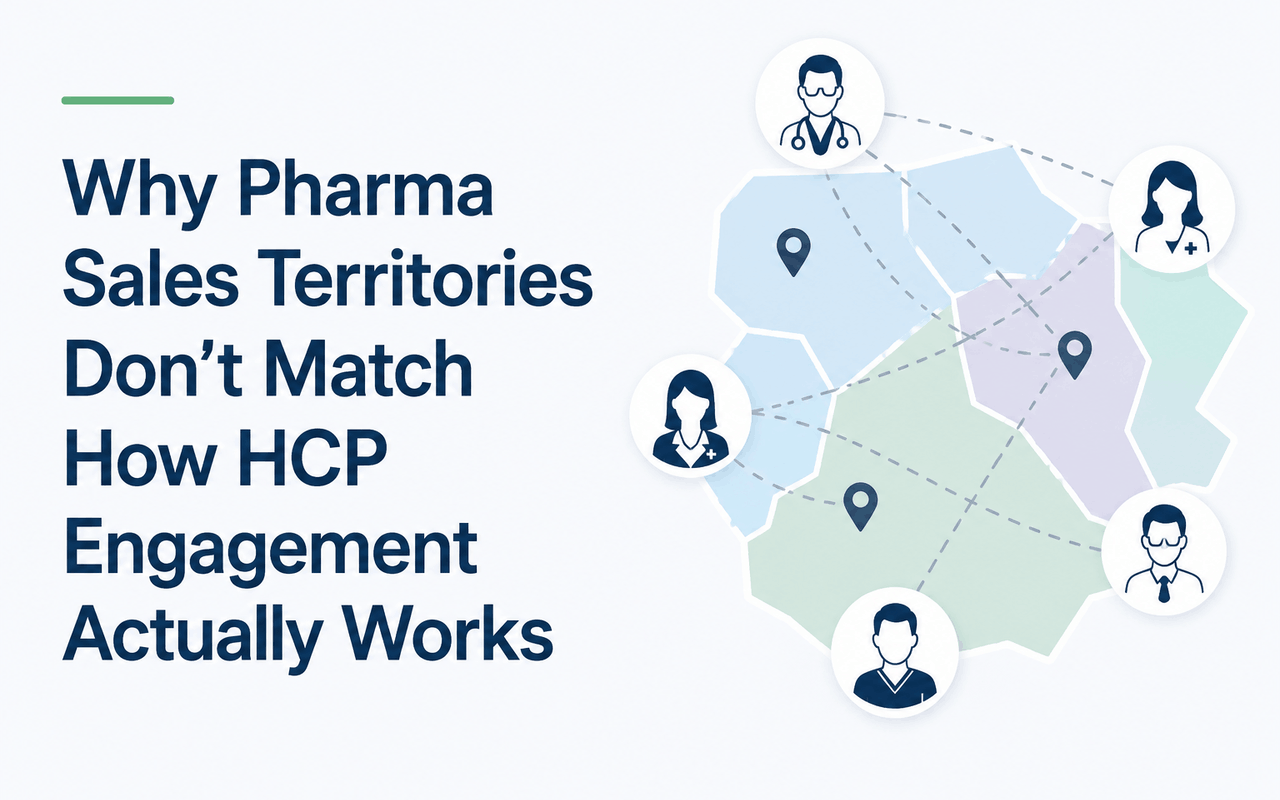
This is the gap that pharma commercial models have been trying to paper over for the better part of a decade. Territory boundaries are drawn on a map. Prescribing authority no longer lives on that map.
The result is a quiet, expensive misalignment. Reps calling on the wrong end of the decision chain, marketing dollars chasing surface-level prescribing data, and field forces shrinking even as the cost-per-meaningful-touch keeps rising.
According to Veeva’s Pulse Field Trends Report, HCP accessibility in the US dropped from 60% in 2022 to 45% in 2024, with market consolidation and health system restrictions named as primary drivers.
Half of the HCPs who remain accessible now meet with three or fewer biopharma companies. Pharma’s territory math was built for a world where individual physicians made independent prescribing choices. That world is largely gone.
How Pharma Territories Are Traditionally Structured
Pharma territory design has, for decades, leaned on a small set of inputs like geography, specialty, historical prescribing volume, and rep capacity.
The base unit is almost always the ZIP code or county, with territories then balanced for workload, travel time, and equitable opportunity across reps. Sales operations teams aim for what the industry calls “alignment balance,” meaning each rep gets a roughly fair shot at quota based on the providers in their patch.
Three structural assumptions underpin this approach. First, that the physician is the prescribing decision-maker. Second, that physical proximity correlates with rep efficiency. Third, that historical prescribing volume is a reasonable predictor of future prescribing volume.
The model also assumes a degree of independence among physicians that simply doesn’t reflect 2026 healthcare. When most prescribing decisions sat with solo practitioners or small group practices, geographic clustering of high-decile prescribers worked. A rep who covered a dense ZIP code of independent cardiologists had a directly addressable market.
So when the same rep is dropped into a market where 70% of those cardiologists are now employed by two health systems, high-decile stops meaning what it used to.
Pharma sales operations leaders know this. Most have layered account-based territory overlays on top of geographic ones, or built hybrid designs that mix geography with account assignments. What is rare is a territory model that treats HCP affiliations and referral networks as primary inputs, with geography as a secondary constraint.
How HCP Engagement Actually Happens in Pharma
The actual sequence by which a prescribing decision gets made in 2026 looks very little like what a territory map suggests. It moves through layers of influence, most of them invisible to the rep on the ground.
Institutional Layer
At the institutional layer, a Pharmacy and Therapeutics committee evaluates a drug for inclusion on the system formulary. This committee may meet quarterly. It evaluates clinical efficacy alongside acquisition cost, pharmacoeconomic impact, and operational fit.
As one industry analysis put it, the days of convincing a single doctor to try a new therapy are over. Today, you must convince a system, and the path to formulary approval inside an integrated delivery network runs through a labyrinth of committees with overlapping authority.
Clinical Layer
At the clinical-pathway layer, the drug either gets embedded into an order set, a clinical pathway, or a best-practice alert inside the electronic health record, or it doesn’t.
Influence Layer
At the influence layer, a smaller group of physicians shape prescribing behavior across their peer network. These are the chairs of P&T committees, the system specialty leads, the academic-affiliated KOLs whose endorsement gives the molecule social legitimacy inside the system.
A rep who calls only on volume prescribers is reaching downstream and missing the upstream signal.
Access Layer
At the access layer, even after all of the above is favorable, the rep still has to get face time. ZS Associates’ 2025 survey of more than 700 US HCPs found that pharma companies average a -10% Net Promoter Score with physicians, with most companies delivering more negative experiences than positive ones.
When access is scarce and goodwill is thin, generic outreach gets blocked before clinical merit is even evaluated.
So when a rep talks to a target physician, that conversation is the last step in a long chain. Most of the decision was already made by people the rep has never met.
The Disconnect Between Territory Design and HCP Access
Territory design rewards reps for geographic coverage and historical volume. HCP engagement, in reality, rewards companies for understanding affiliation networks and getting in front of decision-makers wherever they sit on a map.
A few specific tensions show how this plays out.
Geographic Alignment Fragments Affiliated Networks
When a major hospital system spans three or four ZIP-defined territories, the system itself is a single account in any meaningful sense. The P&T committee makes one decision for thousands of affiliated providers.
Yet the rep coverage is split. Two or three reps may each be calling on physicians employed by the same IDN, none of them aware of the others’ activity, none of them with a coordinated view of how the system as a whole is engaging with the brand.
One IDN white paper notes that pharma faces significant barriers in working with IDNs including understanding formulary placement, gaining access to facilities, and determining how much control over therapy selection providers have versus payers, and fragmented territory coverage makes those problems worse, not better.
Historical Volume Hides Institutional Dependencies
A physician’s historical script count is a lagging indicator. It reflects what the system formulary allowed, what the EHR order set defaulted to, and what reimbursement supported. It does not reflect the physician’s own clinical preference, much less her willingness to advocate for a new product.
Reps targeting based on past volume often find themselves pitching to physicians whose hands are tied. The Veeva Pulse data is blunt on this point, 30% of HCPs in internal medicine, oncology, psychiatry, and urology restrict access to just one company, and that single company is often chosen at the institutional level, not by the prescriber.
Specialty Labels Obscure The People Who Actually Shape Prescribing
A territory built around “all cardiologists in this region” lumps together the cardiologist who chairs the system’s P&T committee with the cardiologist who reads the formulary memo and follows orders. These are not equivalent targets.
A 2024 Bain study referenced in industry analysis found that HCPs prioritize practice knowledge over product knowledge by a two-to-one margin, yet the great majority of sales training and territory design still emphasizes product reach over institutional context.
The cumulative cost is meaningful. Reps spend time on physicians who can’t act, while the physicians who can are calendared into someone else’s plan or never called on at all. Marketing spend goes to broad segments when the leverage points are narrow. And brand teams measure success in calls completed instead of decisions influenced.
Why Pharma Sales Needs a Network-Based View
A network-based view treats the HCP as a node in a system rather than a coordinate on a map. The unit of analysis shifts from “the physician in ZIP 60611” to the physician’s role inside the affiliated system, her referral patterns, her institutional ties, and her behavioral signals about who actually drives her prescribing.
Affiliations Become A Primary Filter
Every HCP profile that informs commercial strategy should carry affiliation data like hospital system, IDN, group practice, ACO. When a rep prepares for a call, the system that pays the physician is at least as relevant as the physician’s NPI.
When sales operations designs territories, the goal becomes coverage of strategic accounts, with geography as a secondary balancing factor.
Pharma marketers writing on this trend have argued that as integrated delivery networks continue to expand, the influence of health systems over prescribing, formularies, and care pathways will only increase, which means the institutional layer can’t be a CRM afterthought.
Influence Maps Replace Decile Lists
Decile rankings tell you who prescribes the most. They don’t tell you who other physicians follow. A network-based view layers behavioral and structural signals (committee membership, publication patterns, referral inflows, residency lineages) on top of volume data to identify the small number of physicians whose engagement disproportionately moves the market.
Worth noting is that these influencers may sit in modest-volume practices. A community-based KOL with two papers in a major journal and a P&T committee seat can shape a region’s prescribing in ways no decile-ten physician ever will.
Referral Flow Informs Sequencing
In therapeutic areas with strong referral chains (oncology, cardiology, rheumatology), the gastroenterologist who refers to the oncologist matters as much as the oncologist herself.
A rep working a new IO therapy who calls only on oncologists, with no view of the upstream referral network, will see slow uptake even when the clinical case is strong. Mapping who refers to whom (and which referral pathways the affiliated system actually allows) is part of how commercial leaders sequence engagement — see referral intelligence for how claims data powers that network view.
Enabling Better Coordination Across Territories
A network-based view doesn’t eliminate territories. Reps still need defined accountability, manageable patch sizes, and clear rules of engagement. What it changes is how territories coordinate, especially when the underlying account spans multiple patches.
Three coordination patterns are emerging across pharma commercial operations.
Account-Led, Territory-Supported Coverage
For accounts where one institution drives the majority of prescribing across multiple geographic territories, a key account manager owns the institutional relationship (P&T committee, system formulary, medical affairs) while reps own the day-to-day clinical engagement inside their patches.
The KAM and the reps share a single account view. Activity gets logged against the institution, not just the individual physician.
When the P&T committee meets, the KAM knows what every rep has been hearing from system-affiliated providers in the past quarter. The reps know what evidence the KAM is bringing forward to the committee.
Shared Targeting Against Affiliated Networks
When two or more territories share coverage of an affiliated network, the targeting list is built from the network down, not the territory up.
Sales operations identifies the physicians whose engagement matters most to the system’s adoption pattern, distributes those targets across the relevant reps, and tracks coverage at the account level. This avoids the common pattern where one rep over-invests in an affiliated physician while another under-invests in a peer with greater influence.
Cross-Territory Metrics That Reflect Institutional Outcomes
If success is measured only by individual territory quotas, reps have no incentive to coordinate. If a portion of the incentive structure is tied to institutional outcomes (formulary wins, order-set inclusion, pathway adoption), the reps assigned to a shared account have a structural reason to collaborate. This is one of the harder pieces of the model to operationalize, and most pharma companies are still working through it.
The DT Consulting 2025 report on pharma CX notes that as traditional in-person field interactions continue to fall and HQ-driven channels rise, the industry is moving from relationship-based engagement to content-driven influence, and content-driven influence is only effective when it targets the right institutional decision layer.
The point of these coordination patterns is that a fragmented field force calling on an affiliated network without a shared view will, almost by definition, leave clinical and commercial value on the table.
How Alpha Sophia Supports Pharma Network-Based Targeting
The platform was built around the idea that commercial teams shouldn’t need a data science team to see how prescribing actually flows inside the US healthcare system. For pharma teams pivoting from geographic to network-based targeting, three areas matter most.
Coverage And Code-Level Resolution
Alpha Sophia draws from US medical claims, spanning Medicare, Medicaid, and commercial payors. Filtering runs at the CPT, HCPCS, ICD-10, and taxonomy level, which means commercial teams can isolate physicians by the actual diagnostic and procedural activity that maps to a therapy’s indication, not only by broad specialty buckets that collapse meaningful differences.
For a launch team trying to identify the specific oncologists treating a defined ICD-10 patient population inside a target IDN, this granularity changes what the right physician means in practice.
In oncology and other biomarker-driven indications, ICD-10 codes carry a second layer of signal. Because biomarkers themselves don’t appear in claims data, the diagnosis codes billed alongside certain procedures act as a practical proxy for the patient population a physician is managing at the molecular level.
So, an oncologist billing consistently for a narrow set of late-stage solid tumor codes is, in aggregate, treating the patients most likely to be candidates for a biomarker-selected therapy.
Filtering at the ICD-10 level lets pharma teams move from “all oncologists in this region” to the subset whose diagnosis mix actually overlaps with the therapy’s indicated population, before a rep or medical science liaison has walked through the door.
Territory Manager Built For Network Reality
The Territory Manager lets commercial operations design and edit territories nationwide using driving-distance logic, heat-map analysis, and configurable boundaries that support both independent and overlapping coverage.
A team can draw a territory around an affiliated network rather than a ZIP code, view opportunity size alongside the design itself, and plan routes against the actual sites of care a rep needs to reach. When a single IDN spans multiple traditional patches, that overlap can be designed in, not worked around.
Cohort Analysis For Institutional Comparison
The cohort analysis feature compares groups of HCPs across procedure volume, diagnosis mix, and other behavioral dimensions.
For pharma teams trying to understand why prescribing patterns differ between two affiliated networks (or between affiliated and independent providers within the same therapeutic area), this gives a structured way to test hypotheses before committing field investment.
Workflow Integrations And Direct Data Access
Native integrations with Salesforce and HubSpot keep target lists synchronized with the CRM the field force already lives in.
For larger teams that want HCP intelligence flowing directly into their own data infrastructure, the Alpha Sophia API provides programmatic access to the same underlying provider data, supporting custom pipelines into data warehouses, BI tools, or proprietary targeting models.
What ties these capabilities together is a shift in the unit of analysis. Geography is still there. So is specialty. But the platform is structured to make affiliations, code-level activity, and influence signals first-class inputs to commercial decisions, rather than fields buried three clicks deep.
For pharma teams trying to move from a territory-first mindset to a network-first one, that structural change is what makes the operational difference.
Conclusion
Pharma territory design hasn’t kept pace with how prescribing decisions actually get made. The center of gravity has shifted from the individual physician to the institutional account, from solo decision-making to committee-mediated formularies, from local geography to multi-state affiliated networks.
Continuing to optimize a ZIP-code-based field model in this environment is a misallocation of one of the largest line items on a commercial P&L.
The teams pulling ahead are the ones treating the HCP as a node in a system, layering affiliations, influence signals, and code-level activity on top of geography, coordinating across territories when accounts span them, and measuring success against institutional outcomes rather than rep-level call volume alone.
The data infrastructure to do this exists. The operational question is whether the commercial model is willing to be redesigned around it.
FAQs
Why do pharma sales territories not reflect real HCP engagement?
Territories are typically built on geography, specialty, and historical prescribing volume. HCP engagement, especially in consolidated markets, runs through institutional decision-makers like P&T committees and system formularies that often sit outside any individual rep’s territory.
What factors influence HCP engagement in pharma sales?
Beyond clinical merit, the main factors are institutional affiliation, formulary status, EHR order sets, payer coverage, and rep access policies. Individual physician preference still matters, but it operates inside a layered system of constraints set by hospitals, IDNs, payers, and clinical pathway committees.
How do hospital systems impact pharma sales strategies?
Hospital systems centralize formulary decisions, embed clinical pathways into EHR workflows, and often restrict rep access at the facility level. This means a single P&T decision can influence prescribing across thousands of affiliated providers, making system-level engagement at least as important as individual physician calls.
What are IDNs and why do they matter in pharma sales?
Integrated delivery networks coordinate hospitals, physician practices, outpatient services, and sometimes payers under unified governance. With more than 80% of US hospitals now part of an IDN, these networks control significant portions of formulary, contracting, and care pathway decisions, making them critical accounts in any pharma commercial strategy.
How can pharma teams improve targeting across territories?
By treating affiliations and influence signals as primary targeting inputs rather than overlays, coordinating coverage when accounts span multiple territories, and tying part of the incentive structure to institutional outcomes like formulary wins and order-set inclusion. Geographic balancing remains useful but shouldn’t be the leading variable.
How does Alpha Sophia help map HCP networks?
Alpha Sophia provides CPT, HCPCS, ICD-10, and taxonomy-level filtering across approximately 80% of US medical claims, cohort analysis for comparing groups of providers, and a Territory Manager that supports network-aware territory design with overlapping coverage where needed. Native Salesforce and HubSpot integrations plus an open API keep this data connected to existing commercial workflows.
