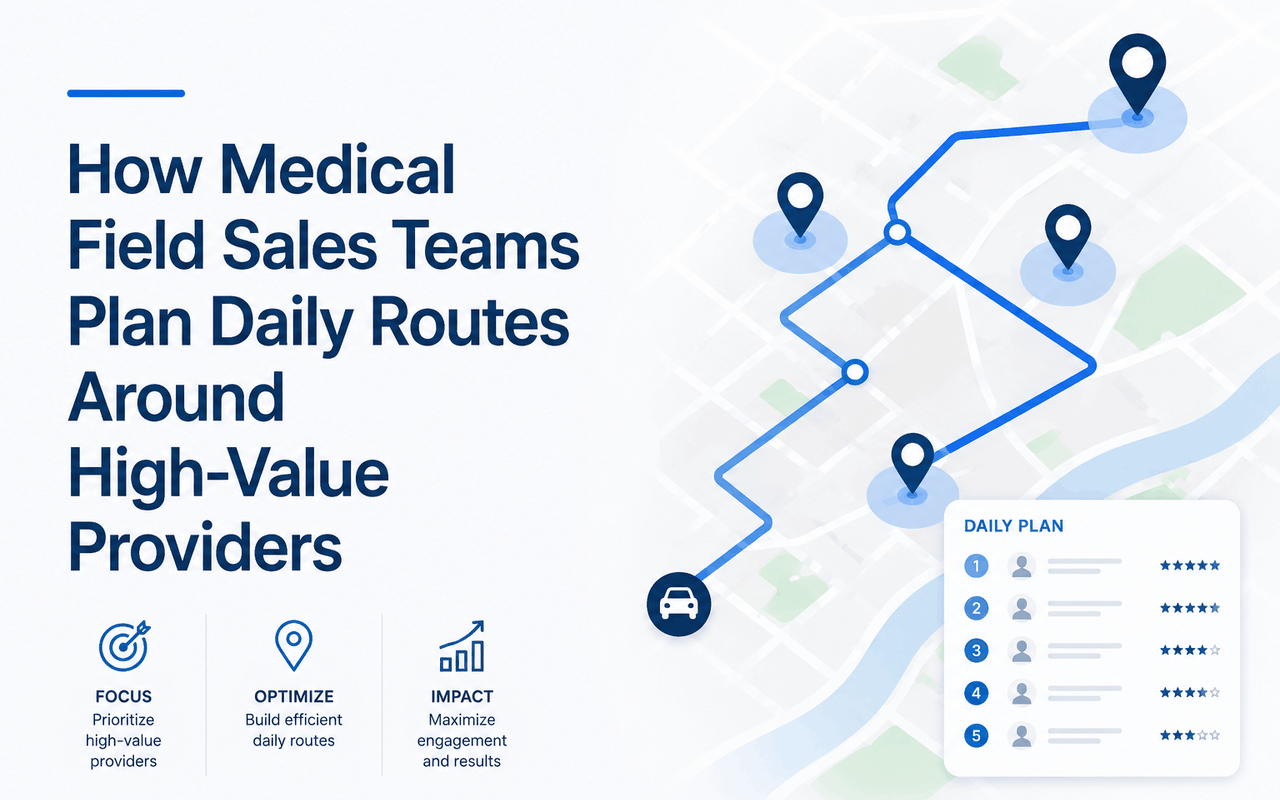
How Medical Field Sales Teams Plan Daily Routes Around High-Value Providers
On this page
A field rep with twelve accounts in their priority tier and a working day of roughly seven hours does not have a coverage problem. They have a sequencing problem. Which three accounts get the visit today, which two get the video call, which seven get pushed to next week, and in what order does the rep drive between them.
That set of decisions, made fresh every morning, is where most of the territory’s revenue gets won or lost. And in healthcare specifically, the math behind those decisions has gotten harsher.
Veeva’s Pulse Field Trends Report found that US HCP access dropped from 60% in 2022 to 45% in 2024, with half of accessible HCPs limiting engagement to three companies or fewer.
Across the industry, PharmExec reports that physicians find only one-third of sales calls valuable and that nearly 90% of interactions last under two minutes.
So a rep who burns three hours of windshield time to land a two-minute interaction with a low-value provider is not running a productivity problem. They are running a planning problem that started long before the keys went in the ignition.
This article walks through how field sales teams plan daily routes that respect that math.
Why Daily Route Planning Is Critical in Medical Field Sales
The standard objection to formal daily planning is that experienced reps already know their territory. Most do. The issue is not navigation, it is allocation.
A rep who instinctively groups visits by geography is solving for fuel and time. A rep who instinctively groups visits by access window, clinical relevance, and call frequency is solving for revenue. Those are different problems, and they produce different days.
Healthcare amplifies the difference. Hospital credentialing systems, OR schedules, lunch-and-learn windows, and gatekeepers all constrain when a rep can reasonably show up.
Veeva also reports that nearly 30% of physicians in internal medicine, oncology, psychiatry, and urology restrict access to a single company. In oncology, the access ceiling collapses further. So a route that ignores access windows ends up filling the day with visits that happen, but do not count.
The compounding cost is visible in the metric most leaders watch. An analysis of Sales Management Association research finds that thoughtful territory and route design can drive 10% to 20% increases in sales productivity.
The flip side is true too, when route logic is ad hoc, the productivity hike never shows up, and quota attainment goes down without anyone being able to point at a single bad decision.
Defining High-Value Providers for Daily Planning
“High-value” is the most overused term in field sales, and the least usefully defined. At the strategic level, a provider’s value is tied to procedure volume, clinical alignment, and long-term revenue potential.
At the daily level, though, what matters is whether visiting that provider today will move something specific forward this week. Those two lenses often point to different names, and the tension between them is one of the hardest parts of daily planning.
Account Tiers and Daily Priority Are Different Decisions
A top-tier orthopedic surgeon who has declined three meeting requests in the past month is still a strategic priority for the year. On a given Tuesday, though, anchoring the day around yet another attempt to reach that surgeon means burning two hours of prime drive time on a low-probability interaction.
Meanwhile, a mid-tier provider who emailed yesterday with a clinical question about a new device represents a genuine opening that has a shelf life of maybe 48 hours.
The daily plan has to weight recency, deal stage, and engagement readiness at least as heavily as lifetime account value, because the week’s revenue does not come from the names at the top of the annual list. It comes from whichever providers are reachable and movable right now.
Clinical and Billing Data as the Foundation for Provider Priority
The quality of daily prioritization depends entirely on the quality of the underlying data. Anaplan’s research on medical device sales planning shows that effective sales planning makes organizations four times more likely to hit their sales objectives, and that effectiveness traces back to the granularity of the inputs.
For a rep building tomorrow’s route, that granularity means knowing which providers actually bill for the relevant CPT or HCPCS codes, at what monthly volume, and against which payor mix.
A surgeon handling 300 procedures per month in the rep’s adjacent code set is a fundamentally different daily priority than a surgeon handling 30, even if both carry the same account tier label.
Access Windows Determine When Value Can Actually Be Captured
Even the highest-volume provider has zero daily value if they cannot be reached. IntuitionLabs’ analysis of pharma field sales optimization notes that more than 20% of physicians restrict rep access outright.
For the rest, access often comes in narrow windows like Tuesday mornings between cases, Thursday afternoons before clinic ends, the fifteen minutes after grand rounds when a surgeon is still in the hallway.
Building the day around these windows, rather than trying to force a geographically efficient route onto them, is what separates a productive day from a day that simply looks busy on paper.
Structuring Daily Routes Around Proximity and Efficiency
Once the provider list for the day is set, the sequencing question becomes practical like how to move between stops without surrendering the morning to the windshield.
The natural instinct here is to optimize for shortest driving distance, but in healthcare that instinct often leads reps to cluster around convenient, low-value stops and away from the harder-to-reach providers who carry the most opportunity.
Anchoring the Day Around One or Two Key Visits
The most effective daily structure in pharma field sales follows an anchor-and-cluster logic. The rep picks one or two non-negotiable visits, the highest-priority provider interactions for that day, and locks them into the calendar first.
Everything else fills in around those anchors by geography and time. This keeps the day from drifting toward easy, familiar stops that happen to be close together, which is what happens when a rep builds the route bottom-up from proximity rather than top-down from priority.
Treating Travel Time as a Hard Ceiling
The logic behind map-based route planning is simple enough. Every hour recovered from windshield time is an hour that can go to provider conversations, in-services, or follow-ups.
eSpatial’s pharma territory planning guide frames optimized territory and route design as the primary lever for reducing windshield time and burnout, freeing reps to spend their time doing the actual work.
The shift that makes this work operationally is treating travel time as a hard capacity constraint when building the day’s plan. A rep who budgets three hours of drive time and plans six visits within that envelope will consistently finish the day with more completed interactions than a rep who plans eight visits and absorbs whatever the traffic decides.
Why Site of Care Has to Be Part of the Route
A surgeon’s billing address in the CRM often does not reflect where they actually spend their week. Many clinicians split time between a hospital outpatient department, an ambulatory surgery center, and a private office, and the distribution shifts by day.
A daily route built from CRM addresses alone will occasionally send a rep to the wrong location at the wrong hour, which turns a planned visit into a wasted stop. Field teams that incorporate site-of-care data alongside billing profiles catch this before the day starts.
Alpha Sophia’s guide on using data to target the right providers makes the same point at the targeting layer that procedure volume, affiliation, and practice site have to be read together, because any one of them in isolation can mislead.
Balancing Planned Visits and Flexibility
The best daily plan is one that survives first contact with the real world. Healthcare is full of schedule disruptions that a rep cannot predict.
Planning that treats the day as rigid breaks as soon as any of these happen. The discipline is in building a structure that can absorb two or three disruptions without collapsing.
Building in a Daily Flex Buffer
Experienced field teams tend to plan their days at roughly 80% of what a fully optimized day could hold. That remaining 20% absorbs delays, accommodates walk-in opportunities at nearby accounts when a scheduled visit falls through, and leaves room for the unscheduled follow-up calls that often produce more value than the planned ones.
When reps plan at full capacity, the last two stops almost never happen, and those providers quietly fall off the coverage rotation until a quarterly review surfaces the gap.
Working With the Signals the Day Produces
A clinic’s front desk saying “the doctor is unavailable” is useful information, and not a setback. So is an unexpected referral from a current account, a missed call from a target provider, or a CRM alert showing that a previously unresponsive surgeon just opened a product email.
The daily plan should be a framework that responds to these inputs. CRM-integrated routing tools increasingly let reps re-sequence stops mid-day, and the teams that use this capability well tend to end the day with more high-quality interactions than the teams that bulldoze through the original plan regardless of what the morning reveals.
Folding Video Into the Daily Route
Veeva’s data shows that in-person and video engagement increasingly reinforce each other, and that HCPs who engage via both channels are more accessible overall than those who limit interaction to in-person only.
So, this means a daily route might legitimately include two physical visits in the morning, a video call over lunch with a provider two hours away, and one more in-person stop in the afternoon.
Common Mistakes in Daily Route Planning
Most route-planning mistakes do not look like mistakes on any given day. They look like reasonable decisions that compound into a quarter of underperformance.
Stop Count Is the Wrong Measure of a Productive Day
A day with eight visits to low-volume providers feels productive but rarely moves a number. Three visits to high-volume, high-relevance providers will almost always produce more pipeline movement, even if the CRM log looks thinner.
Salesmotion’s analysis of SMA territory research captures this at the territory level that 64% of B2B companies rate their own territory design as ineffective, and the root cause is almost always balancing on account count rather than opportunity weight. The same logic applies at the daily level.
Familiar Accounts Are Not the Same as Priority Accounts
Reps naturally gravitate toward providers who are friendly, easy to reach, and enjoyable to visit. Over a quarter, this pattern hollows out the territory’s growth potential, because the highest-value targets are often the ones who are hardest to reach and least comfortable to approach.
A daily plan that does not explicitly include at least one stretch target tends to calcify around the same comfortable rotation, and the territory’s upside never gets touched.
Institutional Lock-Ins Make Proximity Irrelevant
A surgeon employed by a health system with an exclusive contract with a competitor is effectively inaccessible, regardless of how close they are on the map or how high their procedure volume runs. Continuing to anchor daily routes around that provider wastes time that could go to genuinely open accounts.
BCG’s MedTech research frames this as part of the broader efficiency mandate, MedTech companies face pressure to find 7% to 12% savings on their total cost baseline, and persistent unproductive field activity is one of the first places leadership scrutinizes.
Optimizing Each Day in Isolation Breaks the Week
Tuesday’s route has to make sense in the context of what happened Monday and what needs to happen Wednesday through Friday.
A rep who optimizes each day independently often ends up covering the same geography twice in a week while leaving another cluster untouched. Daily routes need to nest inside a weekly arc, which is what the next section covers.
From Daily Routes to Weekly Consistency
A day of good routing decisions means very little if the week’s structure is incoherent. The reverse is also true that a well-designed weekly plan falls apart when daily execution is ad hoc. The connection between the two is where most field teams either build momentum or lose it.
Setting the Week’s Frame
The pattern that works for most healthcare field teams is a two-layer planning rhythm. On Friday afternoon, the rep (or the rep and their manager together) sets the week’s strategic frame, which priority accounts need a visit, which deals need to move forward, which parts of the territory have been under-covered.
On Sunday evening or early Monday morning, the rep refines the first day’s route based on what confirmed over the weekend, what changed in the CRM, and which video calls make sense alongside the in-person stops.
Each subsequent day follows the same evening-before refinement. This separation keeps reps from starting every morning with a blank-slate planning problem and prevents the weekly plan from drifting as the week progresses.
Measuring Coverage, Not Only Activity
Weekly consistency also depends on tracking the right metric. Call counts and miles driven are easy to log but tell leadership very little about whether the territory is actually being worked.
Coverage rate, specifically the percentage of priority providers engaged at least once over a rolling four-week window, is more honest. It exposes the providers who keep getting skipped and the ones who are being over-visited.
Alpha Sophia’s guide to choosing modern HCP targeting tools makes a related point at the platform layer that the value of a targeting tool depends on whether the rep can actually reach the right providers with the right frequency, which is a coverage question more than a volume question.
Closing the Loop Between Field Execution and Strategic Planning
What happens at the provider’s door needs to flow back into the territory and targeting plan quickly.
If a top-tier provider has refused engagement three times running, that is a signal to deprioritize and redirect the time elsewhere. If a mid-tier provider starts placing orders or referring colleagues, that is a signal to elevate them before the next planning cycle.
Field teams that shorten this feedback loop to days rather than months get a territory plan that sharpens itself over time. Teams that wait for the annual review end up running on assumptions that were stale by February.
How Alpha Sophia Supports Route Planning for Field Teams
Daily route planning depends on three things working together, a defensible picture of which providers are worth the visit, a clear view of where those providers actually practice, and a way to translate both into a workable daily plan.
Alpha Sophia brings all three into the same workflow, which matters because reps who have to pull data from one tool, map it in a second, and log it in a third tend to skip the first two and plan from memory.
Claims-Level Provider Profiles
The platform draws on roughly 80% of US medical claims across Medicare, Medicaid, and commercial payors. Field teams can filter providers by CPT, HCPCS, ICD-10, and taxonomy, which means a rep planning tomorrow’s route can identify the providers in their geography who actually bill for the relevant procedures, at what volume, and against which payor mix.
Daily prioritization grounded in claims data is sharply different from prioritization grounded in annual account tiers, and the difference shows up in which doors the rep walks through.
Territory Manager
Alpha Sophia’s Territory Manager is designed around how reps actually work a territory day to day. Sales operations teams can build, edit, and rebalance territories nationwide, configure independent or overlapping territory boundaries, and view opportunity size alongside territory design in the same workflow.
Heat-map analysis surfaces clusters of high-priority providers, so a rep can immediately see which geography deserves a dedicated day. Driving distance is calculated in miles, and route planning allows start and end points to be configured, so a rep building tomorrow’s plan can anchor around a key visit and sequence the remaining stops within a realistic drive-time budget.
Cohort Analysis
Provider behavior shifts, referral patterns change, new ASCs pull volume out of hospital outpatient departments, and competitive contracts flip. Alpha Sophia’s cohort analysis feature lets teams compare groups of providers over time, surfacing the trends that should reshape daily and weekly planning.
A cohort of mid-tier orthopedists whose procedure volume has been climbing for two consecutive quarters, for instance, represents an emerging cluster that deserves more frequent visits before a competitor notices the same signal.
CRM Integrations and API Access
None of this helps if the data lives in a separate tool that reps have to remember to check. Alpha Sophia integrates natively with Salesforce and HubSpot, so updated provider profiles, priority scores, and territory definitions flow directly into the CRM the rep already uses every morning.
For teams running custom stacks, Alpha Sophia’s open API lets engineering teams pull provider intelligence into proprietary planning, routing, and call-management systems, so the rep’s daily planning environment already contains the clinical and geographic data they need without a separate login.
Conclusion
The rep who treats daily planning as a logistics problem will run a full day and move very little. The one who starts with the question of which providers are clinically relevant, actually reachable, and worth the time today tends to end the week with more momentum.
Claims data, site-of-care information, and a realistic sense of institutional constraints are what turn that second approach from instinct into a repeatable process.
The tooling matters because the data has to be in front of the rep before the day starts, not sitting in a system they will not open until Friday.
FAQs
What is route planning in medical field sales?
Route planning is the practice of sequencing daily provider visits to maximize meaningful HCP interactions within a realistic travel budget. It combines provider priority, access-window timing, and geographic logic into a single daily plan.
How do reps identify high-value providers?
The most reliable signals are procedure and billing volume by CPT or HCPCS code, payor mix, site of care, and current engagement readiness. Annual account tiers help set the strategic frame, but daily prioritization depends on which providers are reachable and movable this week.
Why is daily planning important for field sales teams?
HCP access has dropped meaningfully in recent years, with many physicians limiting engagement to a handful of companies. A poorly planned day burns scarce physician access on low-value interactions, and that cost compounds quickly across the quarter.
How can reps reduce travel time between visits?
Geographic clustering around one or two anchor visits is the most effective single tactic. Set the day’s key provider interactions first, then build surrounding stops around those anchors rather than plotting the shortest loop through every account in range.
What factors should be considered when planning daily routes?
Provider priority, deal stage, access windows, site of care, driving distance, recent engagement signals, and whether a video call might be more effective than an in-person visit for certain providers on a given day.
How do sales reps prioritize accounts for daily visits?
By separating strategic account tier from daily priority. Lifetime value sets the annual plan, but daily decisions should weight recency, engagement readiness, and deal stage. Claims data and CRM signals are the inputs that make this judgment defensible rather than instinctive.
