From Publications to Practice: Identifying Physicians Whose Research Shapes Clinical Adoption
On this page
Publication data is often where healthcare influence mapping begins. That makes sense. It is public, structured, easy to search, and deeply tied to scientific credibility.
If a physician publishes consistently in a disease area, appears across PubMed, speaks at meetings, and gets cited by peers, they are clearly part of the conversation.
But that is only part of the picture.
Clinical adoption does not move through publications alone. It moves through physicians who can translate evidence into day-to-day care, influence peer decisions, shape local norms, and carry new ideas from abstract discussion into actual use. In the implementation literature, those roles are often described through opinion leaders and champions, who help shape beliefs, encourage uptake, and support change in practice.
Some physicians are highly visible in the academic literature but have limited impact on routine clinical practice. Others may publish less often, yet have a much stronger pull inside hospitals, group practices, ASCs, and specialty networks.
The physicians who matter most for adoption are often the ones who connect those two worlds.
That gap between research visibility and real-world clinical influence is not theoretical. Healthcare has lived with an evidence-to-practice lag for years. A widely cited review of health research translation found that time lags are substantial and often measured in years, while a later feature summarized the familiar estimate that it takes an average of 17 years for evidence to change practice.
For teams in Medical Affairs, Clinical Development, Commercial Strategy, Field Medical, and launch planning, the more useful question is which physicians publish in ways that also shape care patterns. That is where publication analysis becomes much more useful. Done well, it helps teams move beyond static KOL lists and identify physicians whose research presence connects to real clinical adoption influence in healthcare.
Why Publications Matter in Healthcare Influence
Publication data is not the whole story, but it is still one of the strongest places to start. It gives teams a credible, searchable record of who is contributing to a clinical field, how often they appear, what topics they are associated with, and how visible they are within the broader scientific conversation.
That is important because healthcare influence usually starts with credibility. Before a physician changes practice, they often help shape the way a field understands a problem.
Publications Create Visible Scientific Credibility
A published physician has already crossed a threshold that matters in healthcare. Their work has entered the formal evidence stream. It can be indexed, cited, reviewed, debated, and built on.
In practical terms, publication activity helps teams separate physicians who are simply listed within a specialty from those who are actively contributing to a defined clinical conversation.
For example, one physician may carry a broad oncology or cardiology label but have no visible publication footprint in the mechanism, disease stage, or treatment setting that matters. Another may publish repeatedly on a narrow indication, a comparative effectiveness question, a device outcome, or an implementation issue that is much closer to the actual adoption pathway.
And the scale of that literature is massive. PubMed now contains more than 40 million citations and abstracts of biomedical literature, while National Library of Medicine production statistics show that PubMed has been adding well over 1.5 million citations annually in recent years.
That volume is exactly why structured publication analysis matters. No team is going to manually sift through millions of records and somehow come away with a useful physician shortlist.
The value lies in narrowing the field by topic, disease area, mechanism, procedure, or treatment category, then looking at which authors keep showing up in relevant clusters.
This is also why publication data remains central to healthcare publication data analysis. It offers a durable signal of subject-matter engagement. A physician who appears repeatedly around a specific disease state, intervention class, or treatment pathway is more likely to be shaping how that topic is understood than someone with a general specialty label and no research footprint.
Publications Show Topic-Level Commitment, Not Just Name Recognition
One useful thing about publication records is that they are harder to fake than reputation.
Publication patterns are useful not only because they show topic focus, but also because they show recency, consistency, and the kind of contribution a physician is making.
A stronger read looks at whether the work is recent, whether it appears in respected journals, whether the physician is moving into more prominent authorship roles, whether the output is concentrated in a narrow topic area or spreading into adjacent questions, and whether the work clusters around early-stage science, applied clinical questions, translational themes, or implementation-oriented evidence.
So, that means a physician who publishes repeatedly on a disease mechanism is not necessarily the same kind of influencer as one who publishes on treatment workflow, device outcomes, comparative effectiveness, or implementation questions.
All may be credible but only some are likely to matter for adoption.
This is where teams often make the first good cut. Publication analysis helps identify who is active in the right conversation before the shortlist gets handed to medical affairs, commercial strategy, or field teams.
Research Visibility Still Carries Real Influence
A physician who contributes to the literature can shape how peers frame a clinical problem, what evidence they consider credible, and which names become associated with a developing area of care.
That kind of influence can extend well beyond the paper itself. Published work can lead to speaking invitations, participation in guidelines, peer recognition, trial activity, and referral credibility. Once that happens, the physician’s role may expand from “author” to “interpreter” or “trusted explainer” inside the field.
And influence through trusted peers is not trivial. A study of physicians adopting a mobile clinical IT tool found that those under the influence of opinion leaders were three times more likely to adopt the tool than those who were not.
That does not mean every published physician becomes an opinion leader. But it does show why identifying physicians with visible scientific authority still matters. When research credibility and peer trust come together, adoption can move much faster.
Publications Help Surface Emerging Leaders Earlier
A physician does not need to be a national celebrity to be influential. In many categories, especially in specialist care, local or regional leaders matter just as much. Sometimes more.
A physician with rising publication activity in a highly specific area may become important before the market fully notices. That is useful for both pharma and MedTech teams building a clinical research adoption strategy, because early relationships are often more valuable than crowded late-stage outreach.
This is one reason publication data keeps showing up in medical affairs targeting strategy. It can reveal traction before broad visibility arrives.
Still, Publications Only Tell You So Much
Publication data is strong on scientific visibility. It is much weaker on day-to-day clinical pull. It can show who is contributing to the literature, but not always who is changing behavior at the point of care. It may tell you who is prominent in an academic network, yet tell you very little about who has influence inside a procedure-heavy service line or a high-volume outpatient setting.
That is a limitation that healthcare has never moved from evidence to routine practice. The literature on implementation has been saying that for years. Evidence can be robust, published, and well known, yet still take a long time to change what clinicians actually do.
So yes, publications matter. They matter because they show who has earned scientific attention. But they do not, on their own, answer the question of who turns that attention into clinical adoption.
The Difference Between Academic Visibility and Clinical Impact
A physician can be highly visible in the literature and still have limited influence on what gets adopted in real-world care. That sounds counterintuitive at first, but it is one of the most important distinctions in KOL identification.
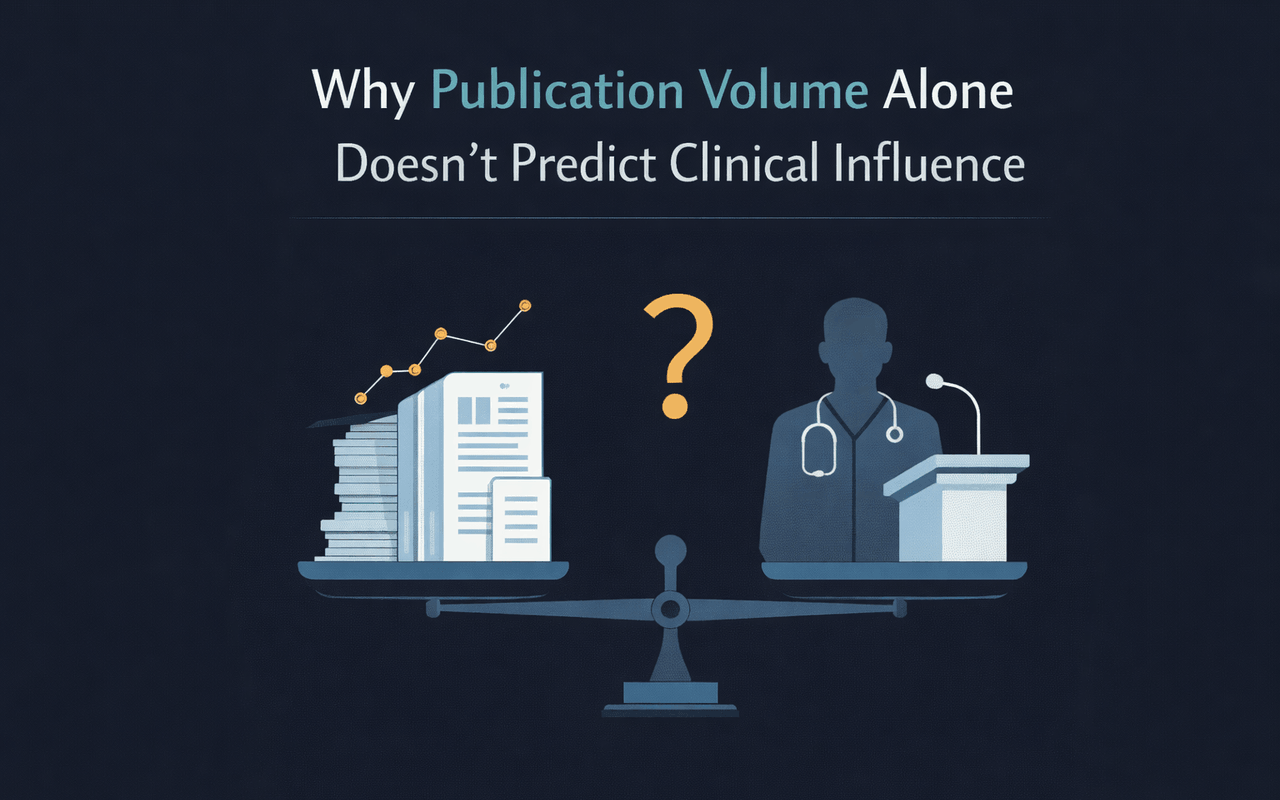
Academic visibility and clinical impact overlap. They are not the same thing.
Academic Visibility Is Easier to Measure
Academic visibility leaves a trail. You can count publications, citations, co-authors, journal placements, speaking roles, and society activity. Those are structured signals. They are relatively easy to gather and compare.
That is why so many teams lean on them. Academic signals give the comforting feeling of objectivity. A physician may have dozens of publications, recurring authorship in major journals, and regular speaking roles at national congresses, yet still have limited influence over routine treatment decisions in the sites of care where adoption actually spreads.
But academic visibility mostly tells you who is prominent in the research conversation. It does not automatically tell you who your colleagues follow in everyday clinical decisions.
This is the core issue with relying too heavily on publication counts alone in a KOL identification strategy for MedTech or pharma.
Clinical Impact Shows Up in Practice
Clinical impact is usually less tidy and more valuable. It shows up in procedure volume, patient mix, site-of-care presence, referral relationships, institutional roles, and peer trust.
That kind of influence is often local before it becomes visible nationally. A physician may not have the longest bibliography in the field, but if they are deeply active in care delivery and highly trusted by peers, their effect on adoption can be far stronger than their publication count suggests.
Research on social influence in healthcare backs this up. In one empirical study of physicians’ adoption of electronic health records, social interaction structures were linked to individual physicians’ utilization rates, indicating that adoption behavior was shaped by professional networks, not just by formal information exposure.
The study examined 40 residents and 15 attending physicians in an ambulatory primary care practice and found meaningful links between network structure and system use.
Why Research Influence and Clinical Influence Split Apart
There are several reasons these two forms of influence can separate.
First, some physicians work in environments that are heavily academic but less connected to the settings where broader adoption happens. Their work may shape scientific thinking without strongly affecting community practice, procedural behavior, or regional care delivery.
Second, some physicians publish in a field without being high-volume clinicians in the exact procedures, patient types, or treatment settings that matter commercially. They may be scientifically relevant but operationally distant from the places where uptake actually occurs.
Third, some of the physicians with the greatest influence on adoption are not the most visible in the literature. They are the clinicians embedded in active care delivery and peer networks, where colleagues watch their decisions, share patients with them, and follow their lead in practice.
Research on local opinion leaders and physician peer networks shows that professional behavior often spreads through trusted clinical relationships, not through publication visibility alone.
This is also why local opinion leaders matter so much. The Cochrane review on local opinion leaders included 24 studies and 337 hospitals and practices and concluded that opinion leaders, alone or with other interventions, can improve professional practice.
The Physicians Who Matter Most Often Sit in the Middle
The most valuable physicians for adoption work are often the ones who bridge academic visibility and clinical relevance.
This is why research influence vs clinical influence should not be treated as a debate. One is not better than the other in every situation. The real task is to identify where they overlap and where they do not. That is what turns analysis of healthcare publication data into something commercially useful.
Signals That Indicate Physicians Influence Clinical Adoption
One reason this work is often harder than it should be is that the relevant signals usually sit in different places. Publication analysis may live with Medical Affairs, while billing, claims, or provider activity data sit with commercial or analytics teams.
The real differentiator is bringing those views together, because physicians do not influence adoption through only one of them.
Active Clinical Volume Matters More Than Generic Relevance
A physician can publish in a therapy area and still have limited impact on adoption if they are not actively treating the relevant patient population or performing the relevant procedures at meaningful volume.
This is one of the clearest gaps between academic visibility and clinical influence. Publication records tell you who is active in the literature. Procedure and claims activity help show who is active in care.
Alpha Sophia’s KOL AI is built around that linkage, connecting publication signals with NPI, CPT, provider volume, and location so teams can move from author lists to practicing physician profiles.
Peer Networks Often Predict Adoption Better Than Prestige Alone
A physician who sits at the center of a peer cluster, shares patients with many clinicians, or is routinely consulted by others, may influence adoption far beyond what their publication count suggests.
A 2018 study on physician adoption of new drugs found that peer adoption, especially among physicians who shared patients, strongly influenced whether other physicians adopted those drugs.
The same pattern appears in other kinds of healthcare technology uptake. A study of EHR adoption found that social interaction structures within a physician network were associated with individual physicians’ utilization rates, showing that adoption behavior is shaped by who interacts with whom, not just by exposure to formal evidence.
That is why publication analysis of healthcare KOL work improves when network mapping is layered in.
Institutional Position Can Multiply a Physician’s Influence
A published clinician at a high-volume academic medical center, a large specialty group, or an influential regional hospital may have an outsized effect because their practice environment provides greater reach.
Broader diffusion research in healthcare has consistently shown that adoption varies across organizations because barriers, incentives, and knowledge flows differ by site and structure.
This is where organization-level data becomes useful. Alpha Sophia’s provider profiling solution brings together HCP, HCO, and site-of-care context, including affiliations, practice locations, licenses, and organizational performance metrics.
That gives teams more than a physician record. It gives them the setting around that physician, which is often what determines whether influence stays isolated or spreads.
Rising Influence Usually Leaves Clues Before the Market Notices
Not every influential physician is already famous. In fact, some of the most useful names in early adoption work are the ones who are still on the way up.
Emerging influence often shows up as a pattern rather than a headline, like a growing number of relevant publications, a tighter cluster around a mechanism or indication, increasing procedure activity, stronger network centrality, or rising presence inside important institutions.
Those signals matter because teams that identify emerging leaders earlier can build better relationships before everyone else piles onto the same shortlist.
A physician who is gaining traction in a growing care pattern can matter more than a legacy name whose influence is broad but less connected to the current adoption opportunity. That sounds backward, but it is not. In a launch strategy, timing often beats prestige.
Rising influence often leaves measurable clues before the market fully notices. Alpha Sophia’s recent KOL work points to signals such as publication velocity, citation momentum, year-over-year procedure growth, trial-role escalation, and strengthening network position as early indicators that a clinician’s influence curve is steepening.
Practical Engagement Signals Still Matter
Even after a physician looks right scientifically and clinically, teams still need to know whether engagement is workable. Compliance context, payment transparency, verified identities, and operationally usable profiles all affect whether a target is actionable.
Alpha Sophia includes Open Payments data and CRM-ready exports in its KOL workflows, helping bridge the gap between identification and field execution.
That may sound less exciting than citation growth or network mapping, but it is very important. A shortlist is only useful if teams can use it without having to rebuild everything manually in another system.
Why This Matters for MedTech and Pharma Teams
This distinction between publication visibility and clinical influence changes which teams engage, when they engage them, and what kind of traction they can realistically expect.
For MedTech and pharma teams, better KOL identification does not just improve list quality. It affects launch timing, field efficiency, medical strategy, and the odds that new evidence actually turns into practice change.
MedTech Adoption Is Usually Local, Procedural, and Social
In MedTech, adoption often depends on a small number of physicians who influence procedural norms inside specific sites of care. A therapy area may look large on paper, but adoption tends to move through very specific channels, such as high-volume operators, department leads, physician trainers, and respected peers within hospitals, ASCs, and specialty groups. That makes research influence vs clinical influence an especially important distinction.
Evidence from cancer care shows how peer exposure can shape technology uptake. A study on the adoption of brachytherapy for women with early-stage breast cancer found that physician peer exposure was associated with later adoption of the treatment approach.
That is the kind of diffusion pattern MedTech teams run into all the time. This is why a KOL identification strategy MedTech teams use cannot stop at publications or podium presence.
Pharma Teams Need More Than High-Citation Authors
Pharma has a related but slightly different problem. In many categories, teams start with known investigators, frequent authors, or recognized therapeutic experts.
Those physicians are important, especially for advisory work, scientific exchange, and the interpretation of evidence. But not all highly published physicians have an equal effect on clinical behavior.
A 2020 cohort study of Medicare oncologists found that physician peer use of bevacizumab was associated with subsequent physician adoption and use. That is a useful reminder for pharma teams that treatment decisions do not spread through evidence review alone. They also move through peer exposure and local usage patterns.
For medical affairs, this means publication analysis should help identify credible experts, but clinical context should help prioritize which experts matter most for real-world uptake.
Regional and Emerging Leaders Are Often Undervalued
A common mistake in both MedTech and pharma is overconcentration around the same high-profile names. Those names matter, but they are rarely the whole story.
In many markets, regional physicians and emerging leaders carry stronger influence over adoption because they are closer to the day-to-day realities of care delivery and more embedded in active peer networks.
Combining Publication Data with Clinical Signals
Publication analysis is useful because it narrows the field. Clinical data is useful because it grounds that field in reality.
The strongest targeting strategies combine both. They do not ask whether research matters or whether clinical behavior matters. They assume both matter and try to measure where they intersect.
Start With Topic Precision Instead Of Broad Specialty Labels
A good publication-led workflow usually begins by identifying physicians who are connected to the specific disease area, mechanism, treatment class, or procedural question that matters.
Broad specialty labels are too blunt for this. “Cardiology,” “oncology,” or “orthopedics” tells you almost nothing on its own. Topic-level publication data gives teams a much more precise entry point into the right scientific conversation.
Alpha Sophia’s KOL AI uses MeSH-powered PubMed search to help teams filter authors at that level of specificity. That keeps the first cut focused on physicians who are actually contributing to the relevant literature rather than simply sitting inside the right specialty bucket.
This is where healthcare publication data analysis earns its keep. It helps separate topical expertise from generic category membership.
Validate Clinical Relevance With Practice Data Or Start There
In some workflows, publication data is the starting point, and practice data is used to validate real-world relevance.
In others, especially in MedTech, the sequence runs the other way. Teams begin with procedure activity, provider volume, or site-of-care patterns, then use publication and trial data to understand scientific relevance and broader influence.
The stronger approach is not choosing one source over the other. It is connecting both views.
This is where claims, procedure activity, and site-of-care context become critical. A publication may tell you that a physician is relevant to a disease or treatment area. CPT, HCPCS, organizational affiliation, and location can tell you whether that relevance is active, current, and commercially meaningful.
Add Network Context to Understand How Influence Travels
Adoption does not spread evenly through a market. It spreads through relationships. That is why network context matters after scientific relevance and clinical activity are established.
Peer network studies have shown that physicians are influenced by the adoption behavior of the clinicians around them, especially when those peers are connected through shared patients or regular professional interaction.
That means teams should care not only about whether a physician is credible, but also about whether that physician holds a position where their behavior is likely to spread.
Bring the Data Into Field Workflows
The last step is operational. Even a well-built list loses value if teams cannot use it across launch planning, medical affairs, CRM workflows, or territory design. That is why integrated outputs matter.
That matters because KOL identification feeds outreach, advisory planning, launch sequencing, territory decisions, and field prioritization. A list that cannot cleanly integrate into those workflows becomes shelfware.
How Alpha Sophia Helps Identify Influential Physicians
Finding physicians who shape clinical adoption takes more than a publication search. Teams need to see who is active in the literature, who is active in practice, and where influence is likely to spread.
Alpha Sophia brings those signals together into a single workflow, making publication analysis more useful for medical affairs, launch planning, and KOL identification.
MeSH-Based Publication Search
Alpha Sophia’s KOL AI uses MeSH-powered PubMed search to help teams identify authors by disease area, mechanism, or compound.
That gives teams a more precise starting point than broad specialty filters do and makes it easier to focus on physicians publishing in the exact clinical area that matters.
Publication Data Linked to Provider Activity
Publication visibility is more useful when it is connected to real clinical work. Alpha Sophia links publication signals with provider-level data such as NPI, CPT, volume, and location, helping teams identify physicians who are not only publishing on a topic but are also active in the relevant care patterns.
Influence and Co-Author Mapping
Alpha Sophia also layers in co-author and influence mapping to help surface physicians whose impact extends through peer networks. This helps teams go beyond the most visible names and identify regional and emerging leaders who may have strong real-world influence.
HCP, HCO, and Site-of-Care Profiles
Its provider profiling workflows add more context around the physician, including specialties, practice locations, affiliations, licenses, and organizational data. That helps teams understand where they practice and how their influence may connect to specific sites of care.
CRM-Ready Outputs and Data Access
Alpha Sophia also supports action after identification. Its KOL workflows include CRM-ready reporting, and the broader platform supports data delivery through exports, API access, and integration paths. That makes it easier to move from shortlist creation to actual execution across medical and commercial teams.
Compliance Context for Outreach
For teams preparing engagement plans, Alpha Sophia includes Open Payments data in its KOL workflow. That adds another layer of context when evaluating and prioritizing physician outreach.
Taken together, these features help teams move beyond publication lists and build a more complete view of which physicians may actually influence clinical adoption.
Conclusion
Publications are still a useful starting point for identifying influence in healthcare. They show who is active in the scientific conversation and who is contributing to the evidence base.
But clinical adoption is shaped by more than research visibility. It is also shaped by active practice, peer influence, and the settings where care decisions are made.
That is why the strongest KOL identification work combines publication data with clinical signals. The goal is not to find the most visible name. It is to find the physicians whose research presence connects to real-world adoption.
FAQs
Why are physician publications important in healthcare influence?
They help show expertise, topic focus, and scientific credibility in a specific clinical area.
How can companies identify physicians who influence clinical adoption?
By combining publication data with clinical activity, provider context, and peer network signals.
What is the difference between academic researchers and practicing physicians who publish?
Academic researchers may have strong publication visibility, while practicing physicians who publish often combine research credibility with direct clinical influence.
How does publication data help identify key opinion leaders?
It helps teams find physicians who are actively contributing to relevant scientific discussions.
Why do MedTech companies engage physicians who publish research?
Because they can bring both scientific credibility and, in some cases, practical influence on adoption.
How can clinical activity data improve KOL identification?
It helps show whether a physician is actively treating relevant patients or performing relevant procedures.
What role do publications play in medical affairs strategy?
They help identify credible experts for scientific engagement, advisory work, and field planning.
How can organizations identify emerging physician leaders?
By looking at publication trends, clinical activity, and influence within peer networks.
Why is research-to-practice influence important for adoption?
Because evidence has more impact when it is carried into real clinical decision-making.
How does Alpha Sophia help analyze physician publication data?
Alpha Sophia combines publication search with provider, claims, and network data to give teams a fuller view of physician influence.
