How Poor HCP Data Creates Both Over-Engagement and Coverage Gaps
On this page
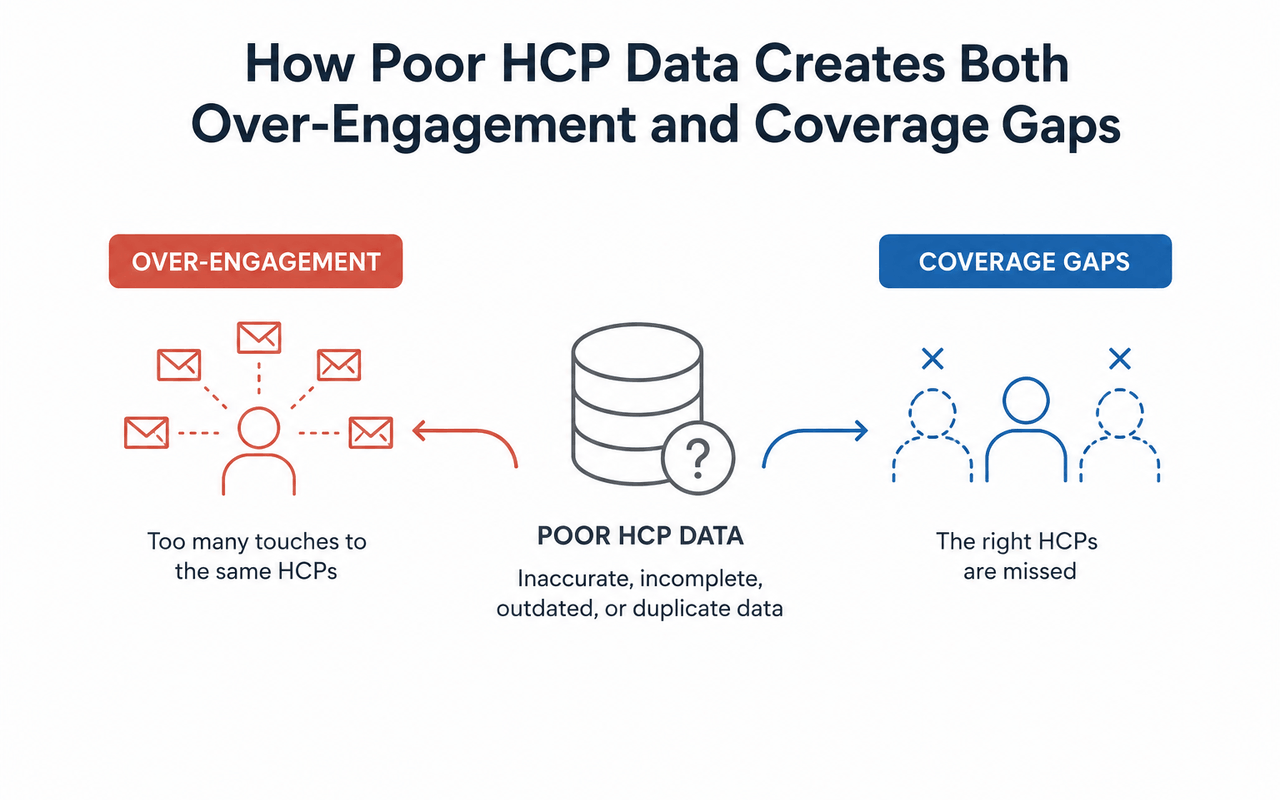
Two commercial failures usually get diagnosed as opposite problems. One team is burning visits on a small set of physicians who are already saturated with attention. Another team cannot explain why a high-volume surgeon in the same region has never been contacted by anyone.
Leadership reads the first as a discipline problem and the second as a coverage problem, then funds two separate fixes. But both symptoms trace back to the same defect in the HCP data accuracy that every territory map sits on.
When a provider does not resolve to one clean record, the planning system counts some clinicians several times and loses others entirely, and it does both within the same budget. The cost shows up as wasted rep time on one side and abandoned revenue on the other.
How One Provider Ends Up With Three Reps and Three Call Plans
A single physician rarely exists as a single line in a commercial system. Physicians work across several sites, and researchers studying physician multisite practices found an average of 3.3 practice locations per physician, with roughly two thirds working at more than one site.
Each location carries its own street address, sometimes its own practice name, and often a different phone or fax string. When those addresses enter a CRM through different list purchases, integrations, or rep-entered accounts, the same clinician appears as several distinct healthcare provider records.
Nothing in the system flags them as one person, because the records are keyed to place and spelling rather than to a stable identity.
Next, what compounds the split even further is territory logic. A provider whose hospital address falls in one territory, whose surgery center sits in a second, and whose private office lands in a third can be assigned, in good faith, to three different reps.
Each rep opens the provider as a fresh account, builds a call plan around it, and starts a relationship the others know nothing about. The provider then fields three introductions for the same product inside a quarter, sometimes within the same week.
Commercial teams already see this when marketing and field data don’t match, where the same surgeon can receive three separate approaches or none at all, and duplicate provider records turn that into a structural certainty.
So, the damage is worse than redundant effort. Physician access is scarce and concentrated, so duplicated outreach lands on the providers least able to absorb it.
ZS analysis of oncology found that approximately 68% of the oncology universe is access restricted, and reps now detail only about 5% of oncologists at least twelve times a year, down from roughly 20% a decade ago.
The reachable physicians are a shrinking pool, and three uncoordinated call plans aimed at one of them spend a quarter’s worth of access on a single relationship. There is a compliance dimension too.
Every touch and transfer of value is reportable under the Sunshine Act, and three reps logging activity against three records for one physician corrupts the aggregate-spend picture before anyone reconciles it.
The High-Value Targets No Territory Is Covering
The same broken data that multiplies one provider erases others.
When a clinician’s most relevant record is incomplete, misfiled under a defunct group name, or attached to an address no rep is responsible for, that provider never resolves into a coverable target. They do not show up on a call plan because, as far as the planning system is concerned, they are not clearly there.
Territory design then draws boundaries around the records it can see, and the providers sitting in the gaps between records become invisible by default.
Effective territory management is supposed to ensure that no important prescriber falls through the cracks, and poor provider data simply defeats that goal without anyone noticing the omission.
These are not low-value providers being correctly deprioritized. They are often the opposite. A high-volume specialist who recently moved practices, or split time across a new ambulatory site is exactly the clinician whose record is most likely to be stale or fragmented.
The result is a coverage gap hiding inside a territory that looks fully staffed on paper, with 39% of physicians reporting no contact from a pharmaceutical representative in the prior six months even as reachable providers report fatigue from repeated outreach.
So, white space of this kind rarely announces itself. A rep cannot miss a provider they never knew existed, and a manager reviewing call counts sees a busy territory, not an absent one.
The signal only appears later, when a competitor’s device shows up in a procedure the team should have owned, or when a launch underperforms in a region the model said was covered.
By then the cost is locked in. This is why teams that rebuild territory design around resolved provider data tend to surface accounts that were technically in their market the whole time, only never legible enough to assign.
The Single Data Problem Behind Both Failures
Over-engagement and coverage gaps are the same failure seen from two angles. Both happen because the commercial system cannot reliably answer one question, which is whether two records describe the same provider.
When the answer is wrong in one direction, the system splits one clinician into many and over-covers them. When it is wrong in the other direction, the system fails to connect a real provider to a usable record and skips them.
Both directions stem from a single failure. When a system cannot tell whether two records belong to one provider, it over-covers the clinicians it splits apart and misses the ones it never links to a record at all.
Internal Records Fragment Around Place Instead of Identity
Commercial systems usually identify providers by the attributes that change most. Name spelling, credential suffix, practice name, and address all shift as physicians move, marry, join groups, or pick up new sites.
A provider with several practice locations generates several plausible records, and a CRM keyed to those fields treats each as a candidate for its own account. Improperly formatted or inconsistent identifiers make this worse, and federal data guidance notes that identifier errors routinely break the links that should tie a provider’s records together.
The NPI Stays Constant While Names and Addresses Change
There is already a stable key for this. The National Provider Identifier is a unique, intelligence-free number issued to each covered provider, and it stays the same even when the provider changes name, address, or affiliation.
An individual provider is meant to hold one active NPI for life. That makes the NPI the natural anchor for telling whether two records are the same clinician.
The problem is that most internal systems collect the NPI inconsistently, store it in a field nobody planned territories around, or never capture it at the point of entry.
The identifier goes unrecorded even in Medicare claims data, where only 65% of 2016 outpatient claims carried a valid clinician NPI, a figure that had reached just 76% by 2022. So the one identifier that would prevent both failures sits unused while the system keeps matching on names.
Resolving One Provider Reconciles Both Symptoms
Anchor every record to the provider’s NPI and the two failures collapse into one fix. The three duplicate accounts for one physician resolve to a single profile, so only one rep owns the relationship and only one call plan exists.
Work from that single resolved view, and redundant outreach and coverage leaks close at the same time, because both were always the same identity problem viewed from two sides.
Why Smaller Teams and Automation Make Both Worse
Commercial teams are leaner than they were, and more of the work now runs through automation. Each pressure removes a layer of human judgment that used to catch identity errors before they became wasted visits or missed accounts.
Together they turn a manageable data problem into a compounding one.
Lean Teams Cover More Ground With Less Room for Error
Field forces are smaller and territories are wider. Many newer products launch as targeted efforts where a projected peak under $500 million cannot justify a large permanent sales force, so a single rep now carries the geography that two or three once split.
A larger territory means more providers per rep, more multisite clinicians whose records fragment, and less time for any rep to notice that two accounts are the same physician or that a known specialist is missing.
The slack that used to absorb data errors is gone. A duplicate that wastes a half-day or a gap that hides a top account costs proportionally more when the team is small.
Consolidation Concentrates Access and Multiplies Shared Sites
Provider consolidation is accelerating, and it pushes both failures harder. Group practices keep absorbing physicians, with the average practice growing from 15 to 18 physicians and health-system-affiliated practices growing from 54 to 66.
Larger groups mean more shared addresses, which means more providers who look identical on a map and more records that collide or split. Consolidation also moves access decisions to the system level, and ZS found that 19 of 25 major health-system mergers were followed by a steeper-than-average decline in rep access.
The reachable surface shrinks while the records describing it multiply, which concentrates outreach on fewer providers and buries more of them.
Automation Acts on Bad Records at Machine Speed
Automation executes whatever the data says, faster than anyone can check it. A routing engine assigns a provider to three territories because three records exist. A sequencing tool emails the same physician from three campaigns because three profiles meet the criteria.
General analyses of CRM data quality note that systems auto-creating records introduce a new class of duplicates generated without human review, and the same logic applies to provider data.
The promise of AI-assisted targeting and call planning depends entirely on the record underneath. Point an agent at a provider universe full of split and stale records, and it will scale both the over-contact and the blind spots, on schedule, every cycle.
How Alpha Sophia Gives Territory Planning One Record Per Provider
Fixing this does not require rebuilding a CRM or running a deduplication project inside an existing stack. It requires an external reference that already resolves each provider to one identity, so territory planning starts from a clean view instead of inheriting the fragmentation.
Alpha Sophia is built to be that reference, and it changes territory design at the point where both failures begin.
One External Record
Alpha Sophia maintains an external provider master with claims activity across Medicare, Medicaid, and commercial payors, refreshed on a regular basis.
Every provider resolves to a single profile keyed to the NPI rather than to a name or an address. That means one physician practicing across a hospital, a surgery center, and a private office reads as one provider with several locations, not three candidate accounts.
Territories Drawn Against Resolved Providers
Alpha Sophia’s Territory Manager lets teams build, edit, and manage territories nationwide, draw and redefine boundaries, set start and end points for rep routes, and plan routes by driving distance in miles.
Heat map analysis shows where relevant procedure volume actually sits, and teams can view opportunity size alongside territory design so boundaries follow demand rather than ZIP-code convenience.
Planners can configure independent or overlapping territories deliberately, which is different from the accidental overlap that duplicate records create. One provider lands in one rep’s plan because the platform knows it is one provider.
A Reference Layer Outside the CRM
Alpha Sophia does not try to clean or merge records inside a team’s own system. It sits beside the stack as the authoritative reference that planning and execution check against.
Territory definitions, priority scores, and resolved provider profiles move into the systems reps already use through export, the HubSpot integration, and the Alpha Sophia API for custom pipelines.
The internal CRM keeps doing its job of tracking activity. The external reference supplies the one thing the CRM cannot generate on its own, which is a trustworthy answer to whether two records are the same provider.
With that answer in place, the same budget that once over-contacted a saturated few and missed a high-value many starts spending on the providers who are real, reachable, and worth the visit.
Conclusion
Over-engagement and coverage gaps drain the same budget from opposite ends. Both persist as long as one provider can exist as three records or as none, and both close once every record resolves to a single identity.
For a lean team carrying a wide territory, that resolution separates a plan that looks covered from one that actually is.
Anchor the provider universe to the NPI before drawing a single boundary, and the same headcount reaches more of the right physicians and stops paying twice to call on the same one.
FAQs
What causes HCP coverage gaps in life sciences CRM data?
Coverage gaps appear when a provider’s most relevant record is incomplete, outdated, or filed under an address or practice name no rep owns, so the clinician never resolves into a coverable target. High-value providers who recently moved or joined a system are the most likely to fragment this way.
How do duplicate HCP records lead to over-engagement in commercial teams?
A physician with several practice locations can generate several records keyed to different addresses, and territory logic may assign each to a different rep. Each rep then builds an independent call plan, so one provider receives multiple uncoordinated approaches for the same product.
How does poor HCP data accuracy affect an HCP engagement strategy?
Poor HCP data accuracy distorts engagement in both directions at once, over-contacting providers the system has split into duplicates and skipping providers whose records are stale or fragmented. Any engagement strategy built on that data inherits the distortion and scales it.
What is commercial data quality and how does it affect healthcare provider records?
Commercial data quality is the degree to which provider records are accurate, complete, current, and resolved to one identity per clinician. When quality is low, healthcare provider records duplicate, drift, and break the links between a provider and their actual billing activity.
How does provider data standardization reduce HCP coverage gaps?
Provider data standardization anchors each record to a stable identifier such as the NPI rather than to names and addresses that change. With a consistent anchor, fragmented records for one provider reconnect and previously invisible providers become assignable.
