Quick Summary
The best AcuityMD alternatives are Alpha Sophia, MedScout, Definitive Healthcare, IQVIA OneKey, and MedTechIntel. We compared them with AcuityMD based on the questions MedTech buyers ask us on sales calls.
Here’s where each alternative stands out:
- 1. Alpha Sophia Alpha Sophia is the pick for CPT-level targeting from all-payer claims you can query in Claude or ChatGPT.
- 2. MedScout MedScout is the closest straight swap for device sales teams, and it’s got its own AI connector.
- 3. Definitive Healthcare Definitive Healthcare fits teams selling into hospitals and IDNs.
- 4. IQVIA OneKey IQVIA OneKey is for pharma and global teams that need HCP records in 118 countries.
- 5. MedTechIntel MedTechIntel is the budget option for musculoskeletal device reps.
For a closer comparison, the table below shows how each platform stacks up against AcuityMD on procedure volumes, claims coverage, Open Payments, referral data, AI access, and pricing.
| What you’re comparing | AcuityMD (Baseline) | Alpha Sophia | MedScout | Definitive Healthcare | IQVIA OneKey | MedTechIntel |
|---|---|---|---|---|---|---|
| CPT-level procedure volume | Procedure volume by HCP and facility | CPT/HCPCS volumes by provider | Procedure volume by provider and site | CPT/HCPCS-tagged claims | Code-level volumes via separate MedTech product | Not publicly documented |
| All-payer claims coverage | All-payer; 330M+ patient lives | About 80% of US medical claims; all-payer | Medicare and commercial claims | All-payer claims | Commercial + Medicare institutional (MedTech product) | Not publicly documented |
| Open Payments data | Yes | Yes | Yes | Open Payments in Carevoyance HCP profiles | Yes, via separate MedTech product | Sunshine Data |
| Referral data | Yes | Yes | Yes | Yes | Not publicly documented for OneKey | Not publicly documented |
| Claude and ChatGPT access | Yes, AcuityMD MCP Server | Yes, MCP connector | Yes, MedScout MCP | No public MCP connector | No public OneKey MCP connector | No public MCP connector |
| Pricing model | Quote; unified platform fee | Quote; Max includes 5 users | Quote; 2-week MCP trial | Custom quote | Contact sales | $69–$289 per month |
Why Listen to Us?
We cover 7.5M+ US healthcare providers and serve over 100 customers, including OSSTEC, Ossiform, Medical Metrics Diagnostics, and ChestPal.
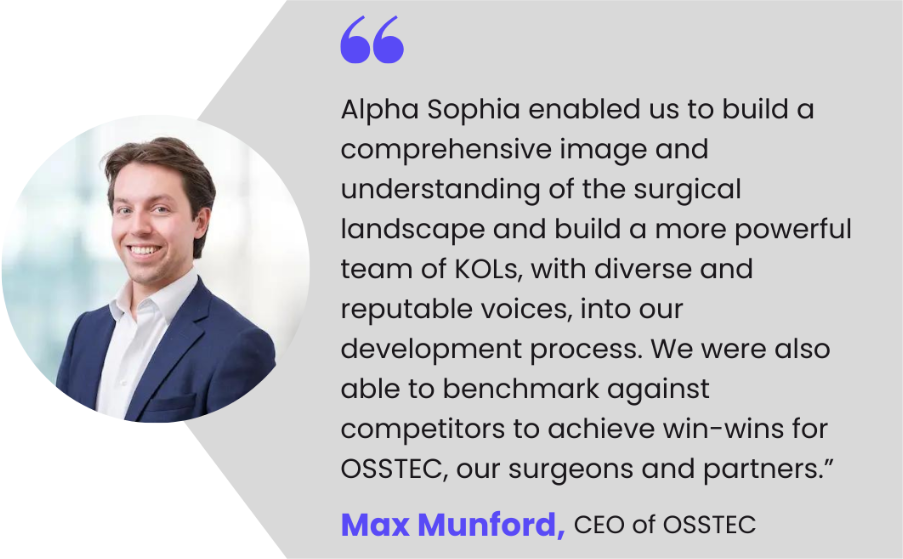
When OSSTEC was preparing to enter the US market, it used Alpha Sophia to identify relevant surgeons and key opinion leaders and research competitors. Its CEO, Max Munford, said the platform helped build “a comprehensive image and understanding of the surgical landscape.”
We also regularly hear questions about how Alpha Sophia compares with AcuityMD during sales conversations. We’ve even published a detailed breakdown answering 58 questions buyers ask about Alpha Sophia, MedScout, and AcuityMD.
What is AcuityMD?
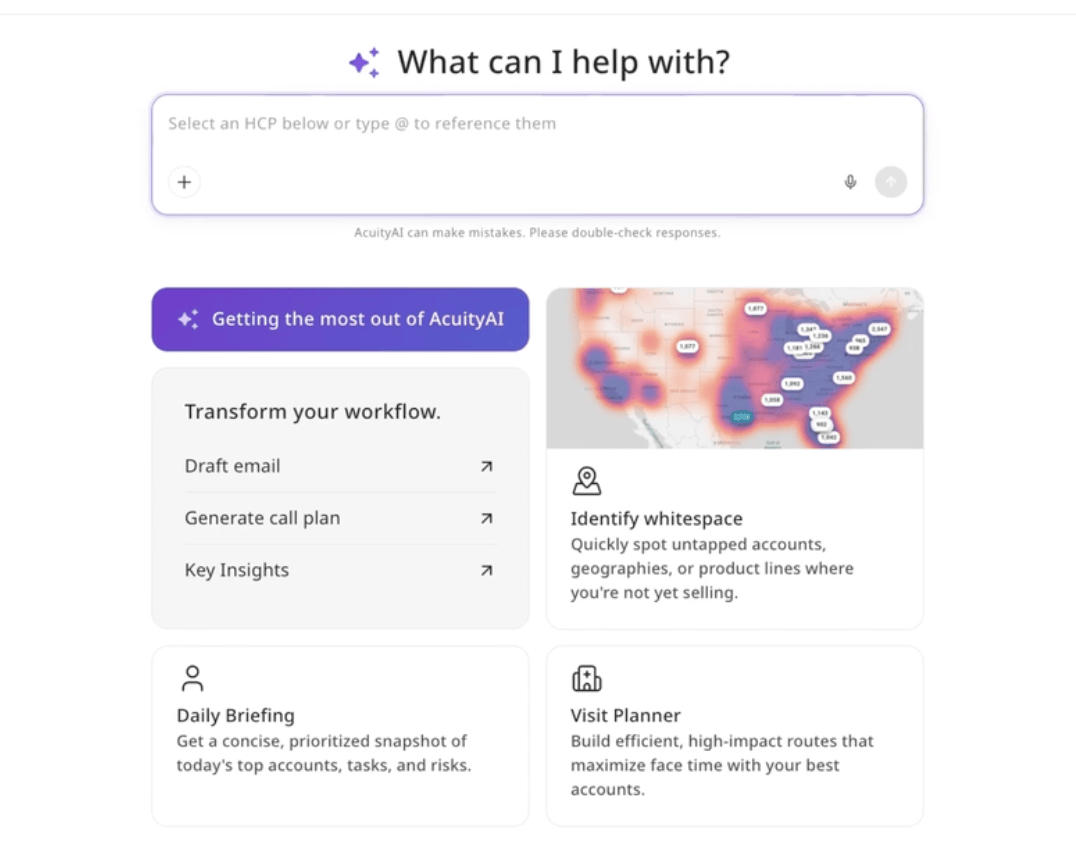
AcuityMD is an AI-powered platform that helps medical device companies identify potential customers, prioritize sales opportunities, and manage their commercial operations. It’s built for MedTech sales reps, sales leaders, commercial operations teams, and marketers.
The platform combines claims data from 150+ payers with CMS data, covering more than 330 million patients. It uses this information to support market analysis, physician targeting, territory planning, and referral intelligence. Teams can also manage their sales pipeline, contracts, and forecasting within the platform.
Why Seek Alternatives to AcuityMD?
Even with over 500 medical device companies using AcuityMD, it isn’t necessarily the right fit for every team. The platform offers a broad range of commercial capabilities, but not every business needs them all.
Here are three reasons MedTech teams may consider alternatives:
A Closed System Built Around Its Own CRM
AcuityMD is designed to be the system your team works in, with its own CRM for pipeline, quoting, contracts, and forecasting. That works for teams ready to move their sales process onto it, but very small teams and larger companies with their own CRM, tools, and workflows often end up paying for a second system they don’t need.
Getting data out can cost extra, too. Buyers on our sales calls tell us only some views can be exported, and that additional exports and special reports come at an extra charge. AcuityMD does run an MCP server for Claude and ChatGPT, so AI access alone isn’t a reason to switch.
Pricing Requires a Sales Conversation
AcuityMD doesn’t publish its pricing. Instead, it offers a unified platform fee covering data, sites of care, and integrations, with quotes provided on request.
This isn’t unique to AcuityMD. Alpha Sophia, MedScout, Definitive Healthcare, and IQVIA OneKey also use quote-based pricing. Still, for smaller MedTech teams that primarily need procedure-based prospecting, the lack of upfront pricing makes it difficult to assess budget fit or compare costs without speaking to vendors.
For more context, see our breakdown of why healthcare platforms like AcuityMD and Definitive Healthcare can be expensive.
You May Not Need the Full Commercial Platform
AcuityMD combines physician targeting and claims intelligence with territory management, pipeline tracking, contracts, and forecasting. That’s useful for teams looking to manage much of their sales process in one platform.
However, a MedTech company that already handles pipeline management and forecasting in its CRM may primarily need accurate procedure data to identify and prioritize surgeons. For these teams, a platform focused on healthcare intelligence could be a better fit than adopting another extensive sales system.
5 Best AcuityMD Alternatives
1. Alpha Sophia
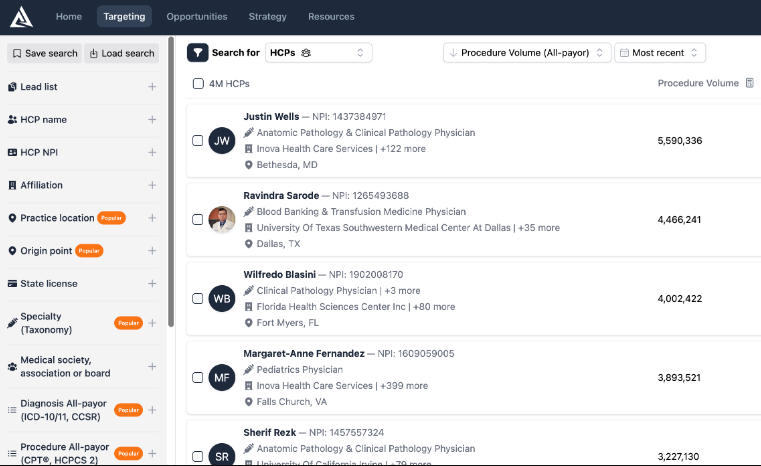
Alpha Sophia is a healthcare commercial intelligence platform that lets MedTech teams search US physicians by specialty, procedure volume, affiliations, and geography.
Like AcuityMD, we’re built on claims data. You can filter physicians by the CPT or HCPCS codes relevant to your product and rank them by reported procedure volume. Our data covers about 80% of US medical claims, including commercial insurance, Medicare Advantage, and Medicaid. This gives sales teams a broader view of physician activity than Medicare-only datasets.
With Referral Intelligence, you can also identify physicians who may be sending patients to a particular clinic or specialist. For example, Hayek Medical used Alpha Sophia to identify high-potential prescribers by procedure volume and location, cutting a 16-hour weekly research workflow in half. Gary Mefford, its Senior Manager of US Clinical Sales, reported that one rep secured referrals from an entirely new clinic after using the platform.
Alpha Sophia is also built to fit around the tools you already use. Every lead list exports to Excel, and through our MCP server you can query Alpha Sophia’s healthcare data from Claude, ChatGPT, or Cursor. For example, ask for the 50 highest-volume knee replacement surgeons within 25 miles of Boston, and the assistant can return a ranked list based on our claims data rather than relying on model-generated estimates. Our team can also help you set up the connection.
For a detailed comparison, see our Alpha Sophia vs. AcuityMD page.
Key Features
- CPT and HCPCS targeting: Filter 7.5M+ US providers by the procedure and supply codes relevant to your product.
- Referral Intelligence: Map patient referral patterns to identify physicians connected to the clinics and specialists you’re targeting.
- Open Payments data: See disclosed financial relationships between physicians and manufacturers, as explored in our orthopedic Open Payments report.
- MCP server access: Query Alpha Sophia’s healthcare data through Claude, ChatGPT, Cursor, and other compatible AI assistants.
- Alpha Sophia Assistant: Ask questions inside the platform and receive filtered provider lists.
- Key Opinion Leader AI: Identify KOLs using publications, citation networks, and clinical trial activity.
- Export and CRM sync: Export lists to Excel or CSV, or connect Salesforce or HubSpot through a custom integration.
Pricing
Alpha Sophia doesn’t publish fixed subscription prices. Our Max plan includes five users, all-payer claims insights, procedure volumes, 360° provider profiles, and onboarding support. The Custom plan offers additional capabilities, including CRM integrations, API access, and custom analyses. See our pricing page for details.
Pros
- CPT and HCPCS filters help sales reps build target lists around relevant procedures rather than broad physician specialties.
- All-payer claims include commercial and Medicaid activity that Medicare-only datasets miss.
- MCP access lets teams retrieve provider intelligence through Claude or ChatGPT without switching to another platform.
Cons
- Healthcare claims coverage focuses on the US, so teams researching international providers will need another data source.
- Full AI agent access depends on subscription entitlements, while free MCP access has eligibility and usage limits.
- Subscription pricing isn’t publicly listed, so buyers must request a quote.
2. MedScout
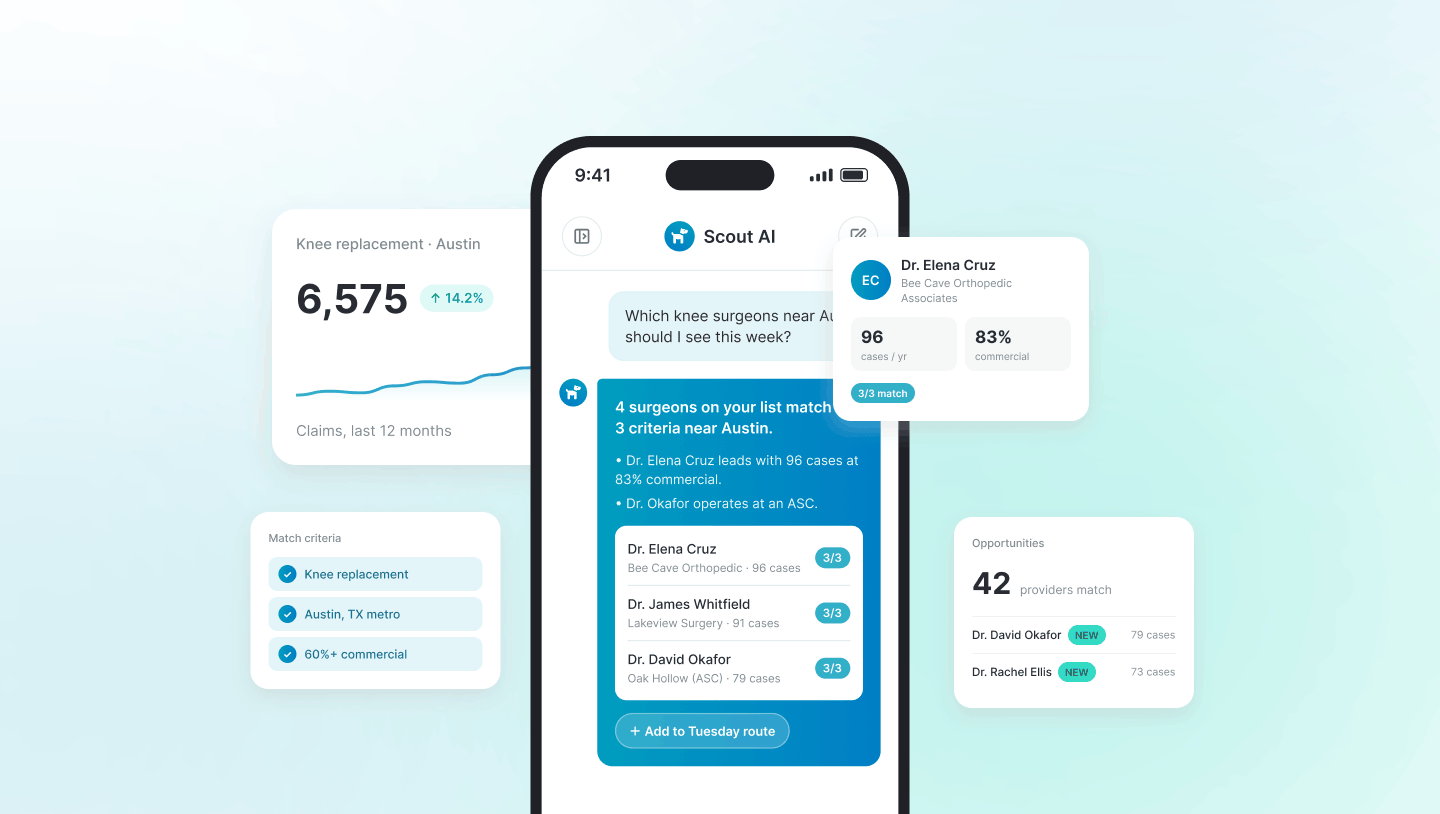
MedScout is an AI-powered platform for MedTech sales reps, sales leaders, and marketers, based in Austin, Texas. Its physician targeting, territory planning, and referral analysis make it one of the closest alternatives to AcuityMD in terms of day-to-day sales workflows.
The platform provides claims data covering over 330 million patients, updated monthly, with procedure, diagnosis, and prescription volumes by provider. In October 2026, MedScout also launched an MCP connector that works with Claude, ChatGPT, Gemini, and Copilot. Like Alpha Sophia, it lets teams access healthcare intelligence through external AI assistants.
See our Alpha Sophia vs. MedScout breakdown for a closer comparison.
Key Features
- Smart Targeting: Rank providers by procedure, diagnosis, and prescription volume.
- Referral Networks: Visualize which physicians refer to each other.
- CRM integration: Sync with HubSpot, Salesforce, Microsoft Dynamics, or Pipedrive.
- Mobile app: Check accounts and targets from the field.
Pricing
MedScout doesn’t publish subscription prices, so you’ll need to request a quote. However, its MCP connector comes with a free two-week trial that requires no credit card. Continued access after the trial requires a paid subscription.
Pros
- Four CRM integrations, including Pipedrive and Dynamics, suit teams that don’t use Salesforce.
- The two-week MCP trial lets you test MedScout’s data through Claude or ChatGPT before committing.
- Monthly data updates help teams track procedure trends.
Cons
- Subscription pricing isn’t publicly available.
- The free two-week trial covers MCP access rather than the full platform.
3. Definitive Healthcare
Definitive Healthcare is a healthcare data and analytics platform with profiles covering 9,000+ hospitals and IDNs, 3.5M+ healthcare professionals, and 14,000+ ambulatory surgery centers. Its extensive facility and organizational data make it particularly useful for MedTech teams selling into hospitals and health systems.
Its all-payer claims cover commercial insurance, Medicare, Medicaid, and federal programs, with procedure and diagnosis data organized by CPT, HCPCS, and ICD-10 codes. Definitive Healthcare also introduced an early-access conversational AI platform in August 2026. Still, unlike Alpha Sophia, it doesn’t publicly offer an MCP connector for accessing its data through Claude or ChatGPT.
Our Alpha Sophia vs Definitive Healthcare comparison goes deeper.
Key Features
- HospitalView: Research hospitals and IDNs by size, ownership, and affiliations.
- PhysicianView: Look up healthcare professionals and their claims-based procedure activity.
- Atlas All-Payor Claims: Analyze medical claims across commercial and government payers.
- Carevoyance: Identify target providers, plan sales territories, and track sales activities using MedTech-focused sales enablement tools.
Pricing
Definitive Healthcare doesn’t publish fixed subscription prices. Instead, it provides custom quotes based on selected data products, bundles, and add-ons such as additional user seats.
Pros
- Extensive hospital and IDN data helps capital equipment teams research health systems and identify potential buyers.
- All-payer claims include Medicaid and federal programs alongside commercial insurance.
- Flexible purchasing options let teams choose individual data products or bundled solutions.
Cons
- No publicly documented MCP connector for accessing its healthcare intelligence directly through Claude or ChatGPT.
- Combining multiple datasets or adding user seats can affect subscription costs, which aren’t publicly disclosed.
- Teams focused primarily on physician prospecting may need to evaluate whether its broader healthcare intelligence offerings match their requirements.
4. IQVIA OneKey
IQVIA OneKey is IQVIA’s global HCP and HCO reference database. It covers over 25 million healthcare professionals and 6 million organizations across 118 countries, with 17.5 million updates to its records each month.
Its international coverage makes it particularly useful for pharmaceutical and MedTech companies targeting healthcare providers across multiple countries. However, OneKey primarily provides provider and organization information.
For US medical device companies needing claims data, Open Payments and procedure volumes, IQVIA offers a separate product, MedTech Market Activator. It combines commercial and Medicare institutional claims with provider intelligence and quarterly procedure-volume updates.
IQVIA also launched its agentic AI platform, IQVIA.ai, in March 2026, but there’s no publicly documented MCP connector for accessing OneKey data directly through Claude or ChatGPT. See our Alpha Sophia vs IQVIA comparison for more details.
Key Features
- OneKey Live Access: View, download, and manage HCP and HCO records.
- OneKey Match: Match your existing customer lists to OneKey records.
- OneKey Advanced Targeting: Segment HCPs for targeted campaigns.
- Medical License Monitor: Track medical license status to support compliance.
Pricing
IQVIA doesn’t publish subscription prices for OneKey. Pricing depends on factors such as geographic coverage, data access, and selected features, so you’ll need to contact sales for a quote.
Pros
- HCP and HCO records across 118 countries support teams expanding into international markets.
- Over 17.5 million monthly updates help keep provider records current.
- Unique provider identifiers make it easier to match and integrate healthcare data across systems.
Cons
- Device-specific claims and procedure data are available through the separate MedTech Market Activator product.
- Its published MedTech claims coverage focuses on commercial and Medicare institutional claims.
- Subscription pricing isn’t publicly available, so buyers must contact sales.
5. MedTechIntel
MedTechIntel is a sales intelligence platform for the musculoskeletal (MSK) device industry, launched in 2021. It’s the only option on this list with publicly listed monthly prices.
It’s more specialized than AcuityMD, helping orthopedic, spine, and other MSK sales teams identify surgeons, distributors, and facility opportunities. The platform provides surgeon profiles, professional relationships, and facility intelligence, but doesn’t publicly document CPT-level procedure volumes or all-payer claims coverage. That makes it better suited to teams focused on prospecting and territory research than those requiring detailed claims analysis.
Key Features
- Target New Surgeons: Find surgeons by subspecialty, training history, and professional relationships.
- Expand Distribution Network: Search 8,000+ sales rep and distributor profiles.
- Maximize Facility Contracts: Research hospitals, IDNs, GPOs, and ambulatory surgery centers, including surgeon operating privileges.
- Accessibility Scores: Assess how accessible a facility may be based on its location, ownership, and purchasing network.
Pricing
- Basic: $69/month
- Premium: $149/month
- Enterprise: $289/month
Pros
- Publicly listed monthly prices let individual reps and smaller teams evaluate costs without requesting a quote.
- Distributor profiles help manufacturers expand their MSK distribution networks.
- Accessibility scores help sales reps prioritize facilities where gaining access may be easier.
Cons
- Its focus on musculoskeletal devices limits its usefulness for teams selling into other specialties.
- CPT-level procedure volumes and all-payer claims coverage aren’t publicly documented.
- The Basic plan excludes sales channel and manufacturer profiles, which require Premium or Enterprise.
How We Compared the Tools
We evaluated each platform using six criteria that MedTech buyers frequently ask about: CPT-level procedure volume, all-payer claims coverage, Open Payments data, referral intelligence, Claude and ChatGPT access, and pricing. We reviewed publicly available product and pricing information from each vendor, noting where specific capabilities or pricing details weren’t disclosed.
How to Choose the Right AcuityMD Alternative
If you need an all-in-one MedTech sales platform with physician targeting, pipeline management, and contracts, AcuityMD may still be your best fit.
If your priority is CPT/HCPCS-based targeting with all-payer claims data and access through Claude or ChatGPT, Alpha Sophia is worth considering. MedScout is another strong option for device sales teams looking for similar workflows to AcuityMD, along with external AI access.
For teams selling into hospitals and IDNs, Definitive Healthcare offers extensive facility intelligence. IQVIA OneKey is better suited to companies targeting healthcare providers across multiple countries. At the same time, MedTechIntel offers a lower-cost entry point for independent musculoskeletal device reps, with published plans starting at $69/month.
FAQs
Is AcuityMD a startup?
AcuityMD is a growth-stage, venture-backed company founded in 2019. It has raised more than $160 million, including an $80 million Series C round led by StepStone Group in April 2026.
Who is the founder of AcuityMD?
Mike Monovoukas is AcuityMD’s CEO and co-founder. He founded the company alongside Robert Coe, its CTO, and Lee Smith, its VP of Customer Experience.
Is there a free or cheaper AcuityMD alternative?
There are lower-cost options and free tools, but no confirmed free alternative offering AcuityMD’s full capabilities. Our Bulk NPI Lookup lets you match physician lists to NPI numbers for free. MedScout offers a free two-week trial of its MCP connector, while MedTechIntel has paid plans starting at $69 per month.
How do you switch from AcuityMD to another platform?
Start by exporting your existing provider lists and territory data from AcuityMD or your connected CRM, where available. Keep the NPI numbers so you can match providers in the new platform. Then recreate your target lists using the same procedure codes and compare the results to check for differences in coverage and volume. If possible, run both platforms before your AcuityMD subscription ends to avoid disrupting your team’s prospecting workflows.