Quick Summary
Definitive Healthcare covers a lot of ground, but its cost, contract terms, and platform breadth can be too much for lean MedTech and life sciences teams. Alternatives include Alpha Sophia, a strong option for teams that want claims-grounded targeting with agent-native AI access. AcuityMD works well for surgical device companies, while MedScout stands out for referral-based territory intelligence.
Our top three picks:
| Tool | Best For | Data Source | AI/MCP Access | Pricing Model |
|---|---|---|---|---|
| Alpha Sophia | MedTech teams that need claims data and AI agent access | All-payer US claims, Open Payments, NPI | MCP server for Claude, ChatGPT, Cursor | On request |
| AcuityMD | Device companies focused on surgical procedure intelligence | Claims and device-level data | No public MCP access | Quote-based |
| MedScout | Sales teams building territory plans with referral mapping | Claims and referral data | MCP available | Quote-based |
When Definitive Healthcare Is Too Much for Your Team
Definitive Healthcare has the data. But smaller MedTech teams may find the pricing hard to assess upfront, the contracts restrictive, and the platform broader than their day-to-day needs. Finding the right alternative starts with knowing which data your team really needs and what you’re willing to pay for it.
For example, if your reps are looking for the highest-volume orthopedic surgeons in Ohio, they don’t need enterprise-wide analytics across every payer.
This guide walks through five alternatives on data depth, pricing, and AI access.
Why Listen to Us?
We cover 3.9M+ providers across the US and work with over 100 commercial teams. As Gary Mefford at Hayek Medical put it, “One day after Alpha Sophia, my rep had referrals from an entirely new clinic.” By connecting Alpha Sophia to Google Maps, Hayek Medical cut data-gathering time by 50%, making it easier for the team to work efficiently and decide faster.
One day after Alpha Sophia, my rep had referrals from an entirely new clinic, from a doctor that is one of the top prescribers in the state.


Gary Mefford
Senior Manager of US Clinical Sales at Hayek Medical
We also hear prospects ask how Alpha Sophia compares with Definitive Healthcare, particularly on pricing, ease of use, and the data they actually need.
What Is Definitive Healthcare?
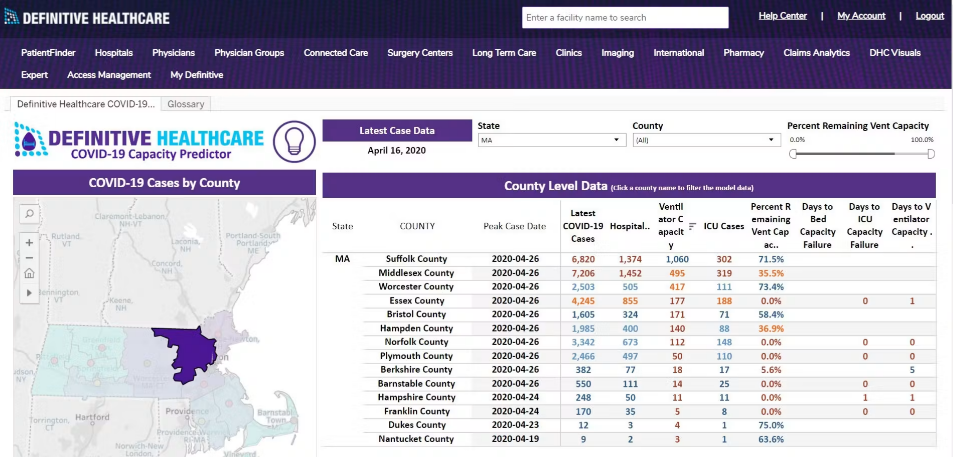
Definitive Healthcare is a healthcare commercial intelligence platform that brings together data on US hospitals, physicians, insurers, and medical claims. Commercial and analytics teams use it to build provider lists, track market trends, and plan territories. Its data includes claims, provider affiliations, and financial disclosures. Large pharma and MedTech companies have used the platform for years, particularly for market research and commercial planning.
Why Seek Alternatives to Definitive Healthcare?
The following feedback comes from sales conversations with teams that have evaluated or used Definitive Healthcare. Their comments highlight three concerns: cost, the amount of data the platform provides, and data accuracy.
Pricing and Contract Terms
Definitive Healthcare can be too expensive for smaller teams, and it doesn’t publish its pricing. An operations manager at a healthcare company called it “just way too pricey,” estimating the cost at “in the 40,000 range.”
Contracts can also include multi-year commitments and automatic renewals, and procurement can take weeks. For a small commercial team that needs a straightforward provider target list, the cost and buying process can be hard to justify.
Too Large for a Lean Sales Team
Definitive Healthcare covers hospitals, health systems, physician groups, insurers, and more. That breadth might make sense for a large pharma analytics team, but a 10-person MedTech sales team may not need all of it. A VP-level buyer at a MedTech company called the platform “the 300 pound gorilla” and explained, “We’re a small company. We’d rather probably work with a smaller company. There’s so much information in Definitive that’s completely unnecessary.”
Outdated Contact Details Cost Reps Time
Provider records don’t always stay current. Your reps may find outdated phone numbers or email addresses in their target lists, wasting time on contacts they can’t reach. That’s especially true when you’re launching a product or building a new territory and need to reach the right surgeons.
Data freshness was also a concern for a sales strategy director at a diagnostics company, who said Definitive’s data “was not always the most current” and “wasn’t always the most accurate.”
5 Best Definitive Healthcare Alternatives
- Alpha Sophia
- AcuityMD
- IQVIA OneKey
- MedScout
- H1
| Tool | Best For | Data Source | AI/MCP Access | Pricing Model |
|---|---|---|---|---|
| Alpha Sophia | MedTech teams needing claims-grounded targeting and AI agent access | All-payer US claims, Open Payments, NPI, referrals | MCP server (Claude, ChatGPT, Cursor) | On request |
| AcuityMD | Device companies needing surgical procedure intelligence | Claims and device-level data | No public MCP | Quote-based |
| IQVIA OneKey | Large pharma teams needing global prescriber data | 300+ global data sources, Rx data | No public MCP | Enterprise quote |
| MedScout | Sales teams focused on territory planning and referral mapping | Claims and referral data | MCP available | Quote-based |
| H1 | Medical affairs teams identifying KOLs and investigators | Publications, trials, grants | No public MCP | Enterprise quote |
1. Alpha Sophia
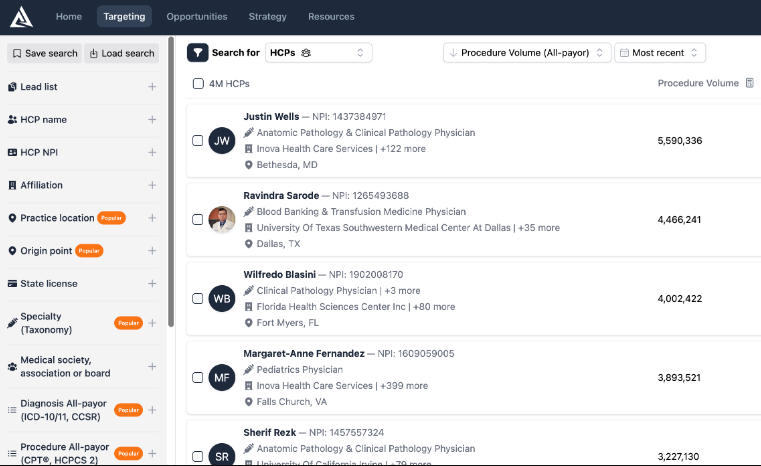
Alpha Sophia is a healthcare commercial intelligence platform for MedTech and life sciences commercial teams. Our database covers more than 3.9 million US providers and includes claims data, procedure volumes, affiliations, and location filters. Unlike broader platforms like Definitive Healthcare, we give commercial teams a more focused way to find providers based on the procedures they perform and the patients they treat.
Say you’re selling spinal fusion devices. You can filter providers by the relevant CPT codes to find surgeons performing the most fusions. From there, you’ll see where they practice, who they refer patients to, and what their Open Payments disclosures reveal. You won’t need to build a list from scratch using NPI records and scattered CRM exports.
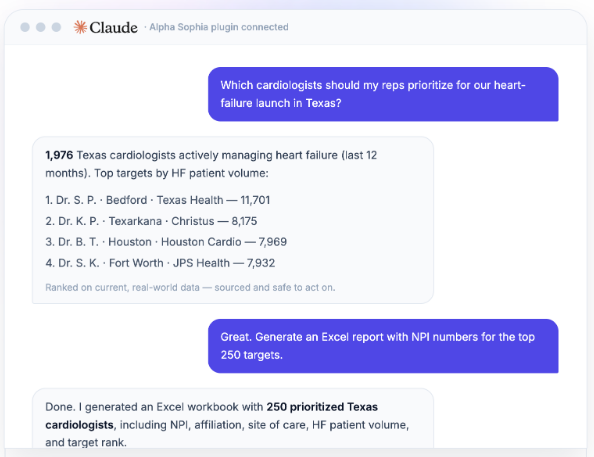
We also have an MCP server that connects our provider data to Claude, ChatGPT, and Cursor. A commercial ops lead could ask Claude to find 20 high-volume hip replacement surgeons in Florida and get back a structured list based on our claims data. Your team can research providers from its AI workspace instead of moving between tools to assemble the same information.
Monica Wellejus at Ossiform called Alpha Sophia “a really powerful tool to do both your research on your target audience and the market in general.” That kind of research is what we’re built for: finding the providers who matter for a product and giving reps a clearer idea of whom to approach.
Our experience with Alpha Sophia has been truly positive, both in terms of the platform and the people behind it. The team supported us with everything we needed, even requests beyond scope like large data exports and training. As a lean team, that level of support made a huge difference in how we handle outreach and build our market strategy.


Dennis Farrell
Vice-President of Medical Device Commercialization at Medical Metrics Diagnostics
Pricing is available on request, and we don’t require a multi-year commitment. For teams that find Definitive Healthcare too broad or expensive for their needs, we offer a more focused way to build provider lists and plan outreach.
Key Features:
- Claims-grounded provider filtering: Search 3.9M+ US providers by CPT and HCPCS billing volume, procedure trends, and all-payer claims data.
- Alpha Sophia Assistant: Ask questions about your market in plain language and get answers grounded in claims and provider data.
- Key Opinion Leader AI: Identify KOLs in any specialty based on clinical activity, publication history, and speaking engagements.
- MCP server access: Query our data directly from Claude, ChatGPT, or Cursor through the Model Context Protocol.
- Referral intelligence: See which providers refer to whom, so your reps know who influences purchasing decisions across a territory.
- Bulk NPI Lookup: Look up provider details for hundreds of NPIs at once, free, without logging in.
- Built-in CRM and export: Track outreach, export lists to Excel or CSV, and sync with your existing CRM.
Pricing
Pricing is available on request.
Rating
G2 rating: 5/5
Pros
- Claims-grounded targeting covers CPT, HCPCS, and all-payer data for 3.9M+ US providers, so your team builds lists from billing volume
- Agent-native MCP access lets you query provider data from Claude, ChatGPT, or Cursor without leaving the AI tools your team already uses
- More affordable and faster to deploy than enterprise incumbents, with no multi-year contract lock-in
Cons
- US providers only, so international teams need a separate source for non-US markets
- Pricing isn’t published, so you’ll need a demo to get a quote
- Newer to market than Definitive Healthcare, with a smaller but growing customer base
2. AcuityMD
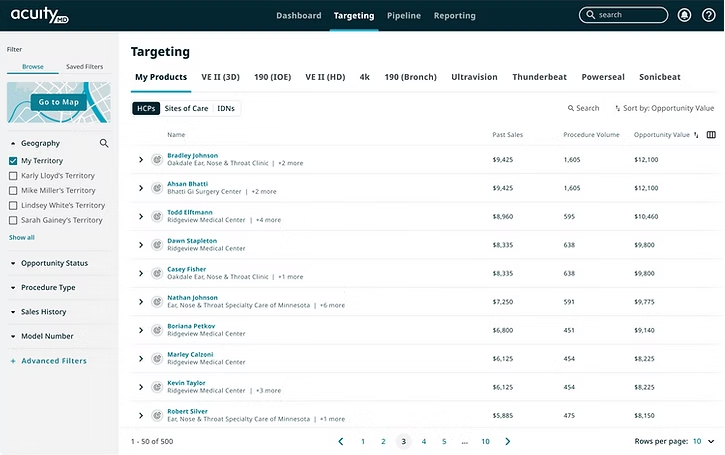
AcuityMD is a surgical intelligence platform built for medical device companies. If you sell implants, instruments, or other surgical products, it shows procedure volumes by surgeon, facility, and geographic area. It also scores conversion opportunities based on which surgeons use competing devices.
Compared with Definitive Healthcare, AcuityMD goes deeper into surgical procedures and device adoption. You can see the specific procedures surgeons perform and how often they perform them. That gives device reps a clearer picture of which surgeons to target and helps them plan their week.
Key Features:
- Surgical procedure analytics: Map procedure volumes at the surgeon, facility, and geographic level using claims data
- Device-level opportunity scoring: Identify which surgeons use competing devices and score conversion opportunities
- Market maps: Visualize your total addressable market by procedure, geography, and competitive share
- CRM integrations: Sync opportunity data with Salesforce and HubSpot so reps work from one view
Pricing
AcuityMD doesn’t publish pricing on its site. They’re quote-based and scoped to team size and data needs.
Rating
Not available
Pros
- Surgical-level procedure intelligence goes deeper on device-specific data than most platforms in this category
- Opportunity scoring helps reps prioritize the surgeons most likely to switch devices
- Clean interface that sales teams can learn quickly without analyst support
Cons
- Focused on surgical specialties, so teams selling into primary care or diagnostics may find coverage gaps
- No public pricing, and the sales process requires a quote conversation
- No MCP or agent-native AI access for teams working inside AI tools
3. IQVIA OneKey
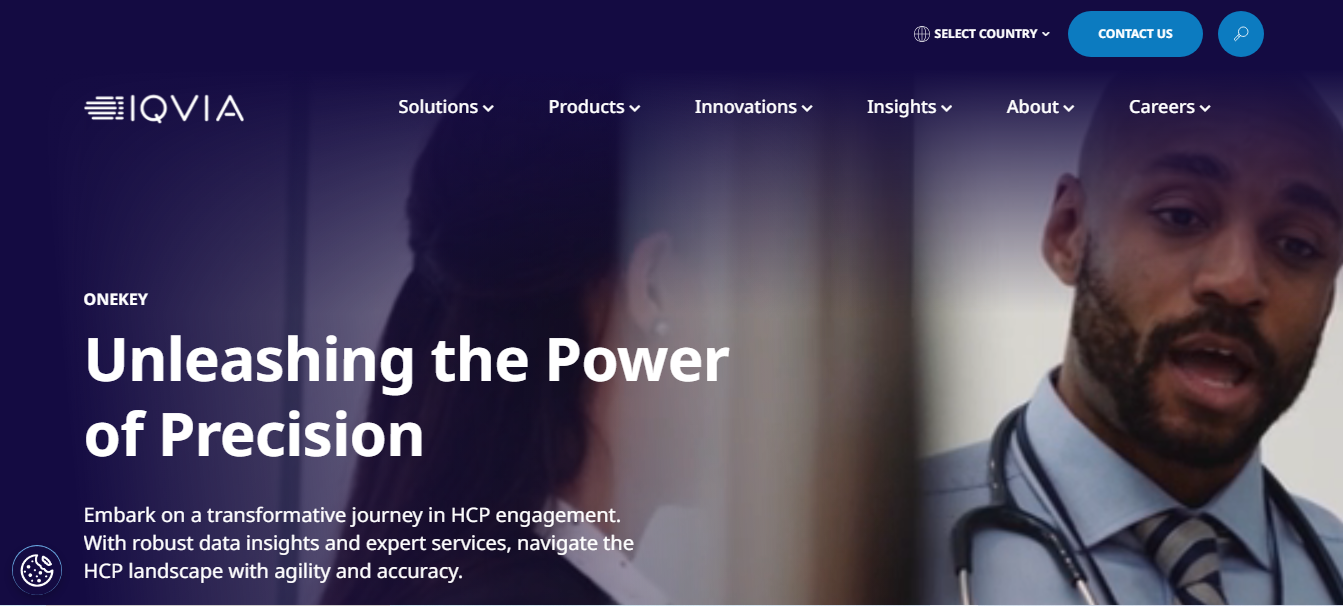
IQVIA OneKey is geared toward pharma and life sciences companies that need provider data across multiple countries. It maintains profiles for healthcare professionals (HCPs) and healthcare organizations (HCOs), alongside prescribing data and support for compliance workflows.
OneKey is an alternative to Definitive Healthcare for teams that need international coverage and already use IQVIA’s broader analytics platform. For a smaller US-based MedTech team selling orthopedic devices in just a few territories, that global reach may be more than necessary. A more focused database may be easier to justify if your priority is finding and targeting providers in the US.
Key Features:
- Global HCP and HCO profiles: Access provider and organization records across 300+ data sources worldwide.
- Prescribing data: See prescription volumes by drug, payer, and geography for pharmaceutical targeting.
- Compliance workflows: Flag interactions against Open Payments and Sunshine Act requirements before they happen.
- Custom analytics: Build reports and territory analyses through IQVIA’s broader analytics stack.
Pricing
IQVIA doesn’t publish pricing for OneKey. They’re enterprise-quoted and negotiated through a longer procurement process.
Rating
Gartner rating: 4.5/5
Pros
- Global coverage across 300+ data sources, which matters if you’re selling outside the US
- Global prescribing data by drug, payer, and geography suits pharma teams targeting prescribers
- It’s one of the largest HCP and HCO databases in the industry by provider volume
Cons
- Enterprise pricing and long sales cycles put it out of reach for small and mid-size teams
- The platform’s breadth can overwhelm teams that just need a provider target list
- Implementation timelines can stretch to months, not days
4. MedScout
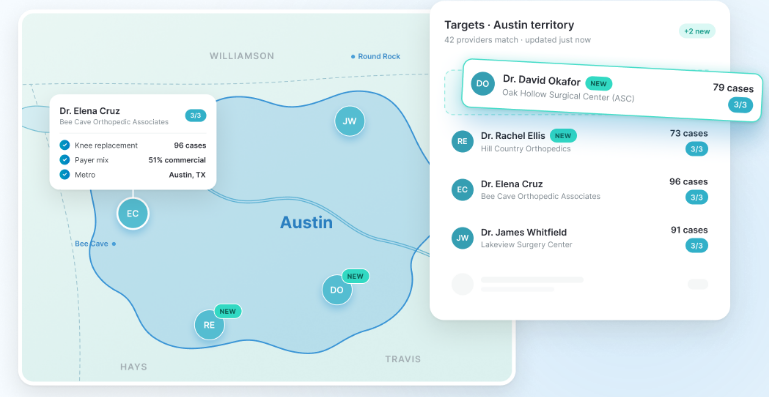
Knowing which surgeons perform the procedures you care about is one thing. Knowing which doctors send patients their way gives your reps another route in. MedScout helps MedTech and life sciences sales teams map those referral relationships alongside providers and facilities in their territories.
That’s where MedScout differs from a broader platform like Definitive Healthcare. Your reps can look beyond the surgeon and identify the primary care physicians and specialists who refer patients to their practice. MedScout also supports MCP access, so teams can pull territory data through compatible AI tools without leaving their workflow.
Key Features:
- Territory intelligence: Map providers, facilities, and referral patterns across a sales territory in one view.
- Referral flow mapping: Trace patient referral paths between providers to find relationships that drive device purchasing.
- Procedure volume tracking: Filter providers by CPT-level procedure counts to find high-volume targets.
- MCP integration: Access MedScout data from AI tools through the Model Context Protocol.
Pricing
MedScout uses quote-based pricing. Contact the company for a quote.
Rating
Not available
Pros
- Referral mapping reveals the provider relationships that drive device purchasing across a territory
- MCP access lets your team pull territory data directly into AI tools
- Intuitive enough for reps to self-serve without analyst support
Cons
- Focused on territory intelligence, so it’s less useful for KOL identification or medical affairs work
- Pricing isn’t published on the site, so you need a sales conversation to get numbers
- Smaller provider database compared to Alpha Sophia or Definitive Healthcare
5. H1

H1 is a healthcare professional data platform that serves medical affairs, clinical development, and compliance teams. It identifies key opinion leaders (KOLs), vets clinical trial investigators, and screens healthcare providers for potential conflicts of interest.
Its data centers on publications, clinical trials, grants, and professional affiliations. Compared with Definitive Healthcare, H1 focuses more on physicians’ research, expertise, and influence. For sales teams building target lists by procedure volume, though, that focus may not be enough. If you need to find the surgeons performing the most ACL repairs in your territory, H1 isn’t designed for that job.
Key Features:
- HCP profiles with publication data: View provider profiles enriched with publication history, trial involvement, and grants.
- KOL identification: Rank healthcare professionals by influence based on research output, speaking engagements, and affiliations.
- Clinical trial intelligence: Search active and completed trials by investigator, site, and therapeutic area.
- Compliance screening: Check providers against payment and conflict databases before engaging them.
Pricing
H1 doesn’t publish pricing on its site. They’re enterprise-quoted and scoped to the organization’s data and compliance needs.
Rating
Not available
Pros
- Publication and clinical trial data make it a good option for medical affairs and KOL work
- Conflict-of-interest screening helps compliance teams vet providers before engagement
- Research-grade data on investigators and trial sites that commercial platforms don’t carry
Cons
- Built for medical affairs, not commercial sales, so reps won’t find territory planning or pipeline tools
- Enterprise pricing with a longer procurement process
- Limited claims and procedure data compared to platforms built for commercial targeting
Selection Criteria
How We Evaluated
We compared these five Definitive Healthcare alternatives across what MedTech and life sciences commercial teams ask about most.
- Claims data depth, including CPT-level procedure volumes and all-payer coverage
- Pricing transparency and contract flexibility
- AI and agent-native access through MCP
- Referral and relationship data
- How quickly a team can get up and running
How to Choose the Right Definitive Healthcare Alternative
Start With the Data Your Reps Need
If your team sells surgical devices, for example, ask vendors to show you procedure volumes by CPT code, not just provider profiles and specialties. KOL-focused teams may care more about publications, clinical trials, and research affiliations, while referral-driven sales teams need visibility into who sends patients to which providers. The right database depends on how you find your next customer.
Decide How Much Platform You Need
Definitive Healthcare’s broad coverage can make sense when research, analytics, and sales teams all need the same platform. A small MedTech team working in a few US territories may be better off with a specialist tool for surgical activity or referrals. Check whether you’ll need a second product to cover the gaps.
Look Beyond the Quoted Price
Definitive Healthcare doesn’t publish its prices, and some buyers consider it expensive. Ask for a full quote that includes the features, integrations, and user access your team needs. Also check the contract length and renewal terms. The starting price won’t tell you much if essential features cost extra.
Check How Target Lists Get Into Your Workflow
A target list isn’t much help if reps have to spend hours cleaning it up before they can work with it. Ask vendors to show you how to export a list or sync it with your CRM. If your team uses AI tools, check whether the platform connects to them; Alpha Sophia, for example, offers MCP access through Claude, ChatGPT, and Cursor.
Choose the Right Definitive Healthcare Alternative for Your Team
Definitive Healthcare isn’t your only option. For many MedTech and life sciences commercial teams, it’s more than they need at a price they didn’t expect. If you want claims-grounded provider targeting, flexible pricing, and access to an AI agent, book a demo with Alpha Sophia to see how it compares.
FAQs
What Is the Best Alternative to Definitive Healthcare?
For MedTech commercial teams, Alpha Sophia is the strongest overall alternative. It covers 3.9M+ US providers with claims-grounded data and costs less than enterprise incumbents. It also offers MCP server access for Claude, ChatGPT, and Cursor. AcuityMD is the best fit if you sell surgical devices specifically.
How Does Definitive Healthcare Compare to IQVIA?
Definitive Healthcare focuses on US healthcare data, while IQVIA OneKey offers international provider data, prescribing information, and compliance support for global pharma teams.
Can I Get Healthcare Provider Data Without a Long-Term Contract?
Yes. Alpha Sophia doesn’t require a multi-year commitment. That’s more flexible than Definitive Healthcare’s typical contract structure, which often involves multi-year auto-renewal terms.
Do Any Definitive Healthcare Competitors Offer AI or MCP Access?
Alpha Sophia and MedScout offer MCP access, allowing teams to query provider data through compatible AI tools such as Claude, ChatGPT, and Cursor.
Is AcuityMD Better Than Definitive Healthcare for MedTech?
AcuityMD focuses on surgical procedure data and scoring device opportunities. Definitive Healthcare covers a broader range of healthcare data, which may be more than some device sales teams need.